Advertisements
Advertisements
Observe the figure below and answer accordingly.
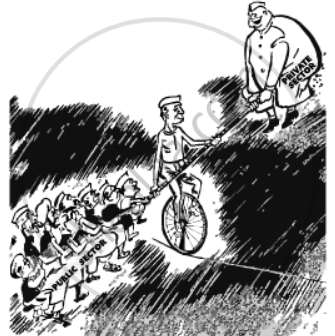
Which type of economic model was adopted by India?
Concept: undefined >> undefined
Study the following diagram and answer accordingly.

What message does this cartoon give to the international community?
Concept: undefined >> undefined
Advertisements
Read the following passage and answer accordingly.
Economist Jeffrey Sachs is widely associated with shock therapy. He developed a plan of shock therapy for post-communist Poland in 1990, for post-communist Russia in 1992, and several other countries, including Bolivia and Chile.
Bolivia, in particular, in 1985, had success as a result of shock therapy in ending a period of hyperinflation.
Poland also initially seemed to benefit from shock therapy as inflation was controlled, but it saw a sharp rise in unemployment that peaked at 16.9%.
Sachs did not like the term shock therapy, which he said was coined by the media and made the reform process sound more painful than it was.
In Russia, neo-liberal shock therapy did not produce favourable outcomes. Shock therapy was applied swiftly and in large scale, as opposed to how it was applied to other nations.
Almost all of Russia’s industries were undervalued and sold to private individuals and companies, with most acquired by a few Russian oligarchs.
With limited government intervention, most industries disappeared. The Russian currency declined, causing high inflation and the erosion of most citizens’ savings. Unemployment increased drastically, and government subsidies were removed, further pushing Russian families into poverty.
Which country benefited from Shock therapy in 1985?
Concept: undefined >> undefined
Read the following passage and answer accordingly.
Economist Jeffrey Sachs is widely associated with shock therapy. He developed a plan of shock therapy for post-communist Poland in 1990, for post-communist Russia in 1992, and several other countries, including Bolivia and Chile.
Bolivia, in particular, in 1985, had success as a result of shock therapy in ending a period of hyperinflation.
Poland also initially seemed to benefit from shock therapy as inflation was controlled, but it saw a sharp rise in unemployment that peaked at 16.9%.
Sachs did not like the term shock therapy, which he said was coined by the media and made the reform process sound more painful than it was.
In Russia, neo-liberal shock therapy did not produce favourable outcomes. Shock therapy was applied swiftly and in large scale, as opposed to how it was applied to other nations.
Almost all of Russia’s industries were undervalued and sold to private individuals and companies, with most acquired by a few Russian oligarchs.
With limited government intervention, most industries disappeared. The Russian currency declined, causing high inflation and the erosion of most citizens’ savings. Unemployment increased drastically, and government subsidies were removed, further pushing Russian families into poverty.
What happened in Poland after the initial success of the shock therapy?
Concept: undefined >> undefined
Read the following paragraph and answer according.
NITI Aayog or National Institution for Transforming India Aayog is basically a policy think tank of Government of India and State Governments that replaces the 65-year old Planning Commission.
The Union Government of India had announced formation of NITI Aayog on 1st January, 2015. The body is composed of a CEO and a Vice Chairperson, to be appointed by the Prime Minister, in addition to some full-time members and two part-time members, while four Union Ministers would serve as ex-officio members.
Besides, there would be specific regional councils, while experts and specialists from various fields would be called as special invitees nominated by the Prime Ministers.
NITI Aayog will serve as a “think tank” of the government as a “directional and policy dynamo” and would provide both to the governments at the centre and in the states with strategic and technical advice on key policy matters including economic issues of national and international importance.
NITI Aayog will have regional councils to focus on developmental activities on specific areas and is patterned on the National Reforms Development Commission of China.
When was NITI Aayog formed?
Concept: undefined >> undefined
Read the following paragraph and answer according.
NITI Aayog or National Institution for Transforming India Aayog is basically a policy think tank of Government of India and State Governments that replaces the 65-year old Planning Commission.
The Union Government of India had announced formation of NITI Aayog on 1st January, 2015. The body is composed of a CEO and a Vice Chairperson, to be appointed by the Prime Minister, in addition to some full-time members and two part-time members, while four Union Ministers would serve as ex-officio members.
Besides, there would be specific regional councils, while experts and specialists from various fields would be called as special invitees nominated by the Prime Ministers.
NITI Aayog will serve as a “think tank” of the government as a “directional and policy dynamo” and would provide both to the governments at the centre and in the states with strategic and technical advice on key policy matters including economic issues of national and international importance.
NITI Aayog will have regional councils to focus on developmental activities on specific areas and is patterned on the National Reforms Development Commission of China.
The CFO and Vice Chairperson of NITI Aayog is appointed by ______.
Concept: undefined >> undefined
Read the following paragraph and answer according.
NITI Aayog or National Institution for Transforming India Aayog is basically a policy think tank of Government of India and State Governments that replaces the 65-year old Planning Commission.
The Union Government of India had announced formation of NITI Aayog on 1st January, 2015. The body is composed of a CEO and a Vice Chairperson, to be appointed by the Prime Minister, in addition to some full-time members and two part-time members, while four Union Ministers would serve as ex-officio members.
Besides, there would be specific regional councils, while experts and specialists from various fields would be called as special invitees nominated by the Prime Ministers.
NITI Aayog will serve as a “think tank” of the government as a “directional and policy dynamo” and would provide both to the governments at the centre and in the states with strategic and technical advice on key policy matters including economic issues of national and international importance.
NITI Aayog will have regional councils to focus on developmental activities on specific areas and is patterned on the National Reforms Development Commission of China.
How will NITI Aayog serve India?
Concept: undefined >> undefined
Which of these statements about the Bombay Plan is incorrect?
Concept: undefined >> undefined
Terrorism refers to ______
Concept: undefined >> undefined
Which of the following statements about NITI Aayog are true?
- NITI Aayog acts as a “think tank” of the Union Government.
- NITI Aayog acts against terrorism.
- NITI Aayog acts in the spirit of cooperative federalism.
- NITI Aayog decides more roles for bigger states and smaller roles for smaller states.
Choose the correct option:
Concept: undefined >> undefined
The movement ‘Arab Spring’ that began in 2009 later turned into a ______
Concept: undefined >> undefined
While throwing some light on the Mandal Issue, give one reason for anti-Mandal protests in India.
Concept: undefined >> undefined
Analyze three major developments towards the end of the 1980s that made a long-lasting impact on the politics of India.
Concept: undefined >> undefined
Highlight any three issues that affected Indian politics after 1989.
Concept: undefined >> undefined
Highlight any three factors that are responsible for the rise of the Bhartiya Janata Party (BJP) as a strong political party after 1991.
Concept: undefined >> undefined
On 19th March 2003, the US launched its invasion of Iraq the code name ______.
Concept: undefined >> undefined
Planning Commission was set up by ______.
Concept: undefined >> undefined
Explain any two objectives of terrorism.
Concept: undefined >> undefined
Highlight any two classic cases of terrorism.
Concept: undefined >> undefined
Explain the purpose of ‘Operation Iraqi Freedom’ and its two consequences.
Concept: undefined >> undefined
