Advertisements
Advertisements
The initial pressure and volume of a given mass of a gas (Cp/Cv = γ) are p0 and V0. The gas can exchange heat with the surrounding. (a) It is slowly compressed to a volume V0/2 and then suddenly compressed to V0/4. Find the final pressure. (b) If the gas is suddenly compressed from the volume V0 to V0/2 and then slowly compressed to V0/4, what will be the final pressure?
Concept: undefined >> undefined
Two glass bulbs of equal volume are connected by a narrow tube and are filled with a gas at 0°C at a pressure of 76 cm of mercury. One of the bulbs is then placed in melting ice and the other is placed in a water bath maintained at 62°C. What is the new value of the pressure inside the bulbs? The volume of the connecting tube is negligible.
Concept: undefined >> undefined
Advertisements
Three samples A, B and C of the same gas (γ = 1.5) have equal volumes and temperatures. The volume of each sample is doubled, the process being isothermal for A, adiabatic for B and isobaric for C. If the final pressures are equal for the three samples, find the ratio of the initial pressures.
Concept: undefined >> undefined
A barometer tube is 80 cm long (above the mercury reservoir). It reads 76 cm on a particular day. A small amount of water is introduced in the tube and the reading drops to 75.4 cm. Find the relative humidity in the space above the mercury column if the saturation vapour pressure at the room temperature is 1.0 cm.
Concept: undefined >> undefined
The left end of a copper rod (length = 20 cm, area of cross section = 0.20 cm2) is maintained at 20°C and the right end is maintained at 80°C. Neglecting any loss of heat through radiation, find (a) the temperature at a point 11 cm from the left end and (b) the heat current through the rod. Thermal conductivity of copper = 385 W m−1°C−1.
Concept: undefined >> undefined
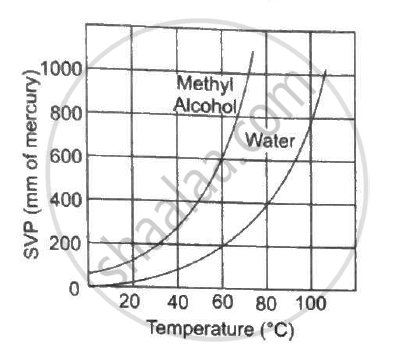
The human body has an average temperature of 98°F. Assume that the vapour pressure of the blood in the veins behaves like that of pure water. Find the minimum atmospheric pressure which is necessary to prevent the blood from boiling. Use figure for the vapour pressures.
Concept: undefined >> undefined
A barometer correctly reads the atmospheric pressure as 76 cm of mercury. Water droplets are slowly introduced into the barometer tube by a dropper. The height of the mercury column first decreases and then becomes constant. If the saturation vapour pressure at the atmospheric temperature is 0.80 cm of mercury, find the height of the mercury column when it reaches its minimum value.
Concept: undefined >> undefined
A faulty barometer contains certain amount of air and saturated water vapour. It reads 74.0 cm when the atmospheric pressure is 76.0 cm of mercury and reads 72.10 cm when the atmospheric pressure is 74.0 cm of mercury. Saturation vapour pressure at the air temperature = 1.0 cm of mercury. Find the length of the barometer tube above the mercury level in the reservoir.
Concept: undefined >> undefined
On a winter day, the outside temperature is 0°C and relative humidity 40%. The air from outside comes into a room and is heated to 20°C. What is the relative humidity in the room? The saturation vapour pressure at 0°C is 4.6 mm of mercury and at 20°C it is 18 mm of mercury.
Concept: undefined >> undefined
The temperature and humidity of air are 27°C and 50% on a particular day. Calculate the amount of vapour that should be added to 1 cubic metre of air to saturate it. The saturation vapour pressure at 27°C = 3600 Pa.
Use R = 8.3 J K-1 mol-1
Concept: undefined >> undefined
The temperature and relative humidity in a room are 300 K and 20% respectively. The volume of the room is 50 m3. The saturation vapour pressure at 300 K 3.3 kPa. Calculate the mass of the water vapour present in the room.
Use R = 8.3 J K-1 mol-1
Concept: undefined >> undefined
The temperature and the relative humidity are 300 K and 20% in a room of volume 50 m3. The floor is washed with water, 500 g of water sticking on the floor. Assuming no communication with the surrounding, find the relative humidity when the floor dries. The changes in temperature and pressure may be neglected. Saturation vapour pressure at 300 K = 3.3 kPa.
Use R = 8.31 J K-1 mol-1
Concept: undefined >> undefined
A bucket full of water is placed in a room at 15°C with initial relative humidity 40%. The volume of the room is 50 m3. (a) How much water will evaporate? (b) If the room temperature is increased by 5°C, how much more water will evaporate? The saturation vapour pressure of water at 15°C and 20°C are 1.6 kPa and 2.4 kPa respectively.
Use R = 8.3 J K-1 mol-1
Concept: undefined >> undefined
Assume that the total surface area of a human body is 1.6 m2 and that it radiates like an ideal radiator. Calculate the amount of energy radiated per second by the body if the body temperature is 37°C. Stefan constant σ is 6.0 × 10⁻⁸ W m−2 K−4.
Concept: undefined >> undefined
A solid aluminium sphere and a solid copper sphere of twice the radius are heated to the same temperature and are allowed to cool under identically surrounding temperatures. Assume that the emissivity of both the spheres in the same. Find the ratio of (a) the rate of heat loss from the aluminium sphere to the rate of heat loss from the copper sphere and (b) the rate of fall of temperature of the aluminium sphere to the rate of fall of temperature of the copper sphere. The specific heat capacity of aluminium = 900 J kg−1°C−1 and that of copper = 390 J kg−1°C−1. The density of copper = 3.4 times the density of aluminium.
Concept: undefined >> undefined
A spherical ball A of surface area 20 cm2 is kept at the centre of a hollow spherical shell B of area 80 cm2. The surface of A and the inner surface of B emit as blackbodies. Both A and B are at 300 K. (a) How much is the radiation energy emitted per second by the ball A? (b) How much is the radiation energy emitted per second by the inner surface of B? (c) How much of the energy emitted by the inner surface of B falls back on this surface itself?
Concept: undefined >> undefined
A cylindrical rod of length 50 cm and cross sectional area 1 cm2 is fitted between a large ice chamber at 0°C and an evacuated chamber maintained at 27°C as shown in the figure. Only small portions of the rod are inside the chamber and the rest is thermally insulated from the surrounding. The cross section going into the evacuated chamber is blackened so that it completely absorbs any radiation falling on it. The temperature of the blackened end is 17°C when steady state is reached. Stefan constant σ = 6 × 10⁻⁸ W m−2 K−4. Find the thermal conductivity of the material of the rod.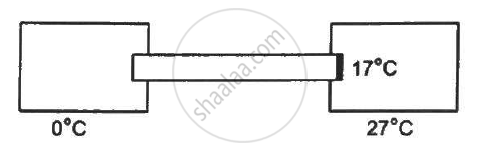
Concept: undefined >> undefined
Calculate the amount of heat radiated per second by a body of surface area 12 cm2 kept in thermal equilibrium in a room at temperature 20°C. The emissivity of the surface = 0.80 and σ = 6.0 × 10⁻⁸ W m−2 K−4.
Concept: undefined >> undefined
The variation of quantity A with quantity B, plotted in figure describes the motion of a particle in a straight line.
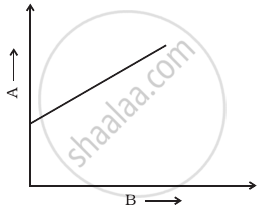
- Quantity B may represent time.
- Quantity A is velocity if motion is uniform.
- Quantity A is displacement if motion is uniform.
- Quantity A is velocity if motion is uniformly accelerated.
Concept: undefined >> undefined
A person of mass 50 kg stands on a weighing scale on a lift. If the lift is descending with a downward acceleration of 9 ms–2, what would be the reading of the weighing scale? (g = 10 ms–2)
Concept: undefined >> undefined
