Advertisements
Advertisements
Answer the following question.
What are the goals of RCH programme.
Concept: Concept of Reproductive Health
Describe the process of fertilization.
Concept: Fertilization in Humans
Meanrch, menstrual cycle, and menopause are controlled by ______.
Concept: Menstrual Cycle (Ovarian Cycle)
Name the hydrolytic enzyme secreted by the acrosome.
Concept: Sexually Transmitted Diseases (STD) or Sexually Transmitted Infections (STI)
Describe the structure of a Graafian follicle.
Concept: Menstrual Cycle (Ovarian Cycle)
Explain any three methods that can be used to overcome infertility.
Concept: Infertility
Explain the ovarian cycle with its different phases.
Concept: Menstrual Cycle (Ovarian Cycle)
Describe the process of spermatogenesis with the help of diagram.
Concept: Gametogenesis
When the ELISA test was conducted on an immune-suppressed person, he tested positive for a pathogen.
- Identify the disease the patient is suffering from.
- Name the causative entity.
- Mention the cells of the body that are attacked by the pathogen.
Concept: Sexually Transmitted Diseases (STD) or Sexually Transmitted Infections (STI)
Explain the mode of transmission of HIV.
Concept: Sexually Transmitted Diseases (STD) or Sexually Transmitted Infections (STI)
Identify the trophoblast cells which are in contact with the embryonal knob during blastulation.
Concept: Embryonic Development in Human
Identify A, B, C, D, in the given diagram of the human reproductive system:
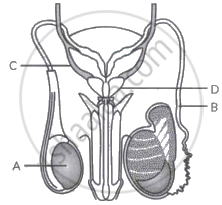
Concept: The Male Reproductive System
Sketch and label Human Male Reproductive System.
Concept: The Male Reproductive System
Write briefly about the Testis.
Concept: The Male Reproductive System
Which of the following is a hormone-releasing contraceptive?
Concept: Birth Control
Draw a neat and labelled diagram of spermatogenesis.
Concept: Gametogenesis
Give any four significances of fertilization in humans.
Concept: Fertilization in Humans
Mention the names of any two organs each derived from ectoderm and mesoderm.
Concept: Embryonic Development in Human
Write the long form of GIFT.
Concept: Infertility
In absence of fertilization, corpus luteum degenerates into ______.
Concept: The Female Reproductive System
