Advertisements
Advertisements
Complete the dialogue:
| Mohan: | Do you like to watch movies? |
| Sohan: | .......................................... |
| Mohan: | Which is your favourite movie? |
| Sohan: | .......................................... |
Concept: Dialogue Writing
Read the following passage and do the activities:
|
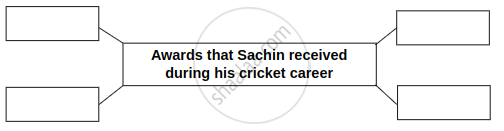
Sachin Ramesh Tendulkar who was born on 24th April 1973 in Mumbai is a former Indian International Cricketer and a former captain of the Indian National Team. He is regarded as one of the greatest batsmen of all time and is often referred as the ‘God of cricket’ by Indian Cricket followers. He made his debut on 15th November 1989 against Pakistan in ‘Karachi’ at the age of sixteen. He is the only player to have scored one hundred international centuries and only player to complete more than 30,000 runs in international cricket. He was trained under the able guidance of Ramakant Achrekar Sir. He received the Arjuna Award in 1994, Rajiv Gandhi Khel Ratna Award in 1997, Padma Shri and Padma Vibhushan Awards in 1999 and 2008 respectively, fourth and second highest civilian awards of India. He was also awarded the Bharat Ratna, highest civilian award of India in 2013. He is a devotee of the deity Ganesha. |
A1. Complete the following sentences from the passage: (2)
- Sachin was born on _____.
- Sachin is a devotee of the deity ______.
- He was trained under the able guidance of ______.
- He made debut on ______.
A2. Complete the web diagram: (2)
A3. Match the ‘Synonyms’: (2)
| ‘A’ | ‘B’ | ||
| i. | debut | a. | previous |
| ii. | received | b. | God |
| iii. | former | c. | got |
| iv. | deity | d. | first performance |
A4. Do as directed: (2)
- He made his debut. (Make ‘Simple Future Tense’.)
- He received the Arjuna Award. (Choose the correct Q-tag.)
- did he?
- didn’t he?
- doesn’t he?
A5. Do you like to play games? Why? (2)
Concept: Unseen Passage Comprehension
Read the following passage and do the activities:
A1. Complete the following sentences from the passage: (2)
- Kalam earned a degree in ______ engineering.
- DRDO stands for ______.
- Kalam was ______ of the SLV-III, the first satellite launch vehicle.
- Kalam served as lecturer at ______.
|
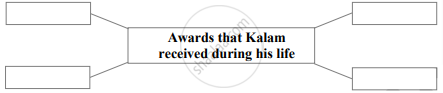
A.P.J. Abdul Kalam, in full Avul Pakir Jainulabdeen Abdul Kalam, (born October 15, 1931, Rameshwaram, India - died July 27, 2015, Shillong), Indian scientist who played a leading role in the development of India's missile and nuclear weapons programmes. He was President of India from 2002 to 2007. Kalam earned a degree in aeronautical engineering from the Madras Institute of Technology and in 1958 joined the Defence Research and Development Organisation (DRDO). In 1969, he moved to the Indian Space Research Organisation, where he was project director of the SLV-III, the first satellite launch vehicle that was both designed and produced in India. Rejoining DRDO in 1982, Kalam planned the programme that produced a number of successful missiles, which helped earn him the nickname “Missile Man”. Among those successes was Agni, India's first intermediate-range ballistic missile, which incorporated aspects of the SLVIII and was launched in 1989. Kalam remained committed using science and technology to transform India into a developed country and served as lecturer at several universities. Kalam wrote several books, including an autobiography, Wings of Fire (1999). He received the Padma Bhushan (1981), Padma Vibhushan (1990), Indira Gandhi award for National Integration (1997) and the India's highest civilian award Bharat Ratna (1997). |
A2. Complete the web diagram: (2)
A3. Fill in the blanks by using the suitable phrases/words from the bracket: (2)
[moved to, served as, launched, autobiography]
- Mr. Gunaji has ______ a Principal in this college.
- “The Story of My Experiments with Truth” is the ______ of Mahatma Gandhi.
- My teacher ______ to England for further studies.
- ISRO successfully ______ Chandrayaan-3 mission.
A4. Do as directed: (2)
- Kalam wrote several books. (Frame a Wh-type question to get the underlined part as answer)
- Kalam earned a degree in aeronautical engineering. (Begin the sentence with “A degree in…….)
A5. Who is your role model? Write few lines about him/her. (2)
Concept: Unseen Passage Comprehension
Make a meaningful sentence by using the following phrase.
to be afraid of
Concept: Vocabulary
Translate the following idiom/proverb into your medium of instruction.
Where there's a will, there's a way.
Concept: English Translation
Translate the following idiom/proverb into your medium of instruction.
Cut your coat according to your cloth.
Concept: English Translation
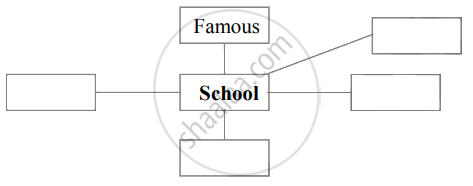
Write the related words as shown in the example:
Concept: Vocabulary
Translate the following word into your medium of instruction:
Imagine
Concept: English Translation
Translate the following sentence into your medium of instruction:
I saw something horrible.
Concept: English Translation
Translate the following sentence into your medium of instruction:
Cooking is a science.
Concept: English Translation
Translate the following sentence into your medium of instruction:
Make a study time table.
Concept: English Translation
Translate the following sentence into your medium of instruction:
He spoke most impressively.
Concept: English Translation
Translate the following idiom/proverb into your medium of instruction:
Service to man is service to God.
Concept: English Translation
Translate the following idiom/proverb into your medium of instruction:
As you sow, so shall you reap.
Concept: English Translation
Translate the following word into your medium of instruction:
Important
Concept: English Translation
Translate the following word into your medium of instruction:
Parents
Concept: English Translation
Translate the following word into your medium of instruction:
Route
Concept: English Translation
Translate the following word into your medium of instruction:
Refuse
Concept: English Translation
Translate the following word into your medium of instruction:
Competition
Concept: English Translation
Translate the following word into your medium of instruction:
Humanity
Concept: English Translation
