Advertisements
Advertisements
Assertion (A): Asoka inscribed his messages to his subjects and officials on stone surfaces.
Reason (R): He wanted to proclaim what religion should be followed by all.
Concept: An Early Empire
Choose the correct option from the following statements with reference to the Magadha empire.
Concept: The Earliest States
Who among the following was the best-known ruler of the Satavahana dynasty?
Concept: Social Differences: Within and Beyond the Framework of Caste
Identify the ruler of the Satavahana dynasty with the help of the following information:
|
Concept: Social Differences: Within and Beyond the Framework of Caste
Which one of the following statements is the correct explanation of ‘Endogamy’?
Concept: Kinship and Marriage: Many Rules and Varied Practices
Describe the familial relationship observed during the Mahabharat era.
Concept: Kinship and Marriage: Many Rules and Varied Practices
Describe the Social implications of access to Resources during the Mahabharat period.
Concept: Beyond Birth Resources and Status
How is Mahabharata a colossal epic to understand social behaviour of early historic period?
Concept: Handling Texts Historians and the Mahabharata
Analyse the role of Indian Sanskritist V.S. Suthankar and his team in the preparation of critical edition of Mahabharata.
Concept: The Critical Edition of the Mahabharata
Identify the picture from the given options.
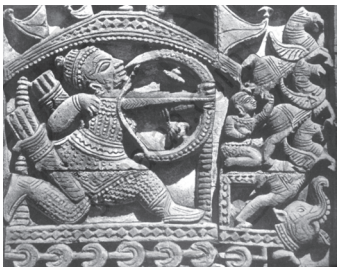
Concept: The Critical Edition of the Mahabharata
“Be lamps unto yourselves as all of you must work out your own liberation.” Identify the essence of the words of Buddha from the options given below.
Concept: The Teachings of the Buddha
Read the following source carefully and answer the questions that follow:
|
Sanchi in the nineteenth century |
|
The most wonderful ancient buildings in the state of Bhopal are at Sanchi Kanakhera, a small village under the brow of a hill some 20 miles northeast of Bhopal which we visited yesterday. We inspected the stone sculptures and statues of the Buddha and an ancient gateway. The ruins appear to be the object of great interest to European gentlemen. Major Alexander Cunningham stayed several weeks in this neighbourhood and examined these ruins most carefully. He took drawings of the place, deciphered the inscription, and bored shafts down these domes. The results of his investigations were described by him in an English work. |
|
From SHAHJAHAN BEGUM, NAWAB OF BHOPAL (ruled 1868-1901), Taj-ul Iqbal Tarikh Bhopal (A History of Bhopal), translated by H.D. Barstow, 1876. |
- Why was Sanchi an interest to Alexander Cunningham?
- How was Sanchi related with Buddhism?
- How did Shahjahan Begum conserve Sanchi's stupa?
Concept: A Glimpse of Sanchi
Ashoka erected a pillar at ______ to mark that he had visited that place.
Concept: Stupas
Who wrote the book Kitab-ul-Hind?
Concept: Al-biruni and the Kitab-ul-hind
Kitab ul Hind : Al-Biruni, Rihla : ______ :
Concept: Al-biruni and the Kitab-ul-hind
- François Bernier was closely associated with Prince Dara Shukoh.
- Bernier travelled to several parts of the country, and wrote accounts.
- He dedicated his major writing to the king of France and Aurangzeb.
Concept: Francois Bernier - a Doctor with a Difference
Analyze the concept of the Asiatic mode of production as stated by Karl Marx.
Concept: Bernier and the “Degenerate” East
Identify the name of the person from the information given below.
- He was born at Tangier in one of the most respectable and educated family.
- He considered experience gained through travel as a source of knowledge than books.
- He had travelled extensively in middle east and few trading ports on the coast of East Africa.
- He wrote a book named Rihia.
Concept: Ibn Battuta’s Rihla
Assertion (A): Lingayats did not practice funerary rites such as cremation, prescribed in the Dharmashastras.
Reason (R): Lingayats believe that on death, the devotee will be united with Shiva and will not return to this world.
Concept: The Virashaiva Tradition in Karnataka
Find out the correct chronological order of ‘the Chishti Silsila’ from the following options:
- Shaikh Nizamuddin Auliya
- Shaikh Fariduddin Ganj-Shakar
- Shaikh Nasiruddin Chiragh-i Delhi
- Shaikh Muinuddin Sijzi
Concept: The Chishtis in the Subcontinent
