Advertisements
Advertisements
Draw a block diagram of a detector for AM signal and show, using necessary processes and the waveforms, how the original message signal is detected from the input AM wave.
Concept: Amplitude Modulation (AM)
Explain the process of amplitude modulation.
Concept: Amplitude Modulation (AM)
Define the term 'amplitude modulation'
Concept: Amplitude Modulation (AM)
Explain any two factors which justify the need for modulating a low frequency base-band signal.
Concept: Amplitude Modulation (AM)
Draw a schematic sketch showing how amplitude modulated signal is obtained by superposing a modulating signal over a sinusoidal carrier wave.
Concept: Amplitude Modulation (AM)
Explain the term demodulation used in a communication system.
Concept: Basic Terminology Used in Electronic Communication Systems
Block diagram of a receiver is shown in the figure:
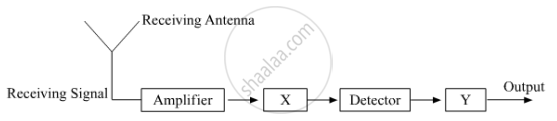
(a) Identify ‘X’ and ‘Y’.
(b) Write their functions.
Concept: Bandwidth of Signals
In the block diagram of a simple modulator for obtaining an AM signal, shown in the figure, identify the boxes A and B. Write their function.

Concept: Modulation and Its Necessity
Distinguish between ‘Analog and Digital signals’.
Concept: Bandwidth of Signals
How does the electric flux due to a point charge enclosed by a spherical Gaussian surface get affected when its radius is increased?
Concept: Electric Flux
- Define torque acting on a dipole of dipole moment \[\vec{p}\] placed in a uniform electric field \[\vec{E}\] Express it in the vector from and point out the direction along which it acts. Express it in the vector from and point out the direction along which it acts.
- What happens if the field is non-uniform?
- What would happen if the external field
\[\vec{E}\] is increasing (i) parallel to \[\vec{p}\] and (ii) anti-parallel to \[\vec{p}\]?
Concept: Electric Dipole
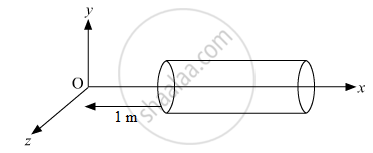
A hollow cylindrical box of length 1 m and area of cross-section 25 cm2 is placed in a three dimensional coordinate system as shown in the figure. The electric field in the region is given by `vecE = 50xhati` where E is NC−1 and x is in metres. Find
(i) Net flux through the cylinder.
(ii) Charge enclosed by the cylinder.
Concept: Electric Field >> Electric Field Due to a System of Charges
A charge ‘q’ is placed at the centre of a cube of side l. What is the electric flux passing through each face of the cube?
Concept: Gauss’s Law
Define dipole moment of an electric dipole. Is it a scalar or a vector?
Concept: Electric Dipole
An electric dipole of dipole moment `vecP` is placed in a uniform electric field `vecE` with its axis inclined to the field. Write an expression for the torque `vecT` experienced by the dipole in vector form. Show diagrammatically how the dipole should be kept in the electric field so that the torque acting on it is:
- maximum
- Zero
Concept: Dipole in a Uniform External Field
Answer the following question.
Derive an expression for the electric field at any point on the equatorial line of an electric dipole.
Concept: Electric Dipole
The electric flux through a closed Gaussian surface depends upon ______.
Concept: Electric Flux
Derive the expression for the torque acting on an electric dipole, when it is held in a uniform electric field. identify the orientation of the dipole in the electric field, in which it attains a stable equilibrium.
Concept: Dipole in a Uniform External Field
An electric dipole of length 2 cm is placed at an angle of 30° with an electric field 2 × 10⁵ N/C. If the dipole experiences a torque of 8 × 10⁻³ Nm, the magnitude of either charge of the dipole is ______.
Concept: Dipole in a Uniform External Field
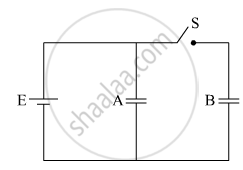
Two identical parallel plate capacitors A and B are connected to a battery of V volts with the switch S closed. The switch is now opened and the free space between the plates of the capacitors is filled with a dielectric of dielectric constant K. Find the ratio of the total electrostatic energy stored in both capacitors before and after the introduction of the dielectric.
Concept: Capacitors and Capacitance
