Please select a subject first
Advertisements
Advertisements
State on which side of capital account/current account will the following transactions be recorded and why:
(i) Interest on loan received from Nepal
(ii) Import of mobile phones from China
Concept: Concept of Balance of Payments >> Capital Account
Read the following statements carefully:
Statement 1: Export of financial services by India will be recorded on credit side of current account.
Statement 2: Foreign Direct Investments in India will be recorded on credit side of capital account.
In the light of the given statements, choose the correct alternative:
Concept: Concept of Balance of Payments >> Current Account
As per the Reserve Bank of India (RBI) press report, dated 29th December, 2022:
"Net external commercial borrowings to India recorded an outflow of US$ 0.4 billion in the second quarter (2022-23)"
The above transaction will be recorded in the _______ account on ______ side of Balance of payments account of India.
Concept: Concept of Balance of Payments >> Capital Account
Read the following chart carefully and choose the correct alternative:
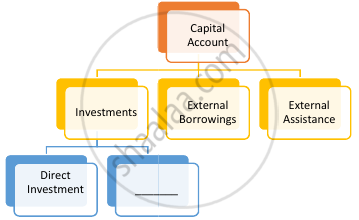
Concept: Concept of Balance of Payments >> Capital Account
‘Current account deficit in an economy must be financed by a corresponding capital account surplus’.
Do you agree with the given statement? Give valid reason(s) in support of your answer.
Concept: Concept of Balance of Payments >> Balance of Payments Surplus and Deficit
Identify the correct reason(s) that may affect the demand for foreign exchange in an economy.
- Imports of visibles
- Exports of invisibles
- Remittances by residents working abroad
- Purchase of assets abroad
Concept: Foreign Exchange Rate
Answer the following question in 120 − 150 words :
Everybody during the last lesson is filled with regret. Comment. (The Last Lesson)
Concept: The Last Lesson
Answer the following question in 120 − 150 words :
How different from usual was the atmosphere at school on the day of the last lesson? (The Last Lesson)
Concept: The Last Lesson
Answer the following question in 120-150 words :
How did the order from Berlin change the situation in the school ? (The Last Lesson)
Concept: The Last Lesson
The Last Lesson shows that people suddenly realised how precious their language was to them.
Comment.
Concept: The Last Lesson
Do you think that the third leve was a medium of escape for Charley? Why?
Concept: The Third Level
“You realise the true value of a thing only on losing it.” Comment on this statement in the light of the story, The Last Lesson.
Concept: The Last Lesson
‘It’s easy to judge others and give advice, but much more difficult to apply it to ourselves.’ Elaborate with reference to the character of Sam in The Third Level.
Concept: The Third Level
Read the given extract and answer the questions.
| Usually, when school began, there was a great bustle, which could be heard out in the street, the opening and closing of desks, lessons repeated in unison, very loud, with our hands over our ears to understand better, and the teacher’s great ruler rapping on the table. But now it was all so still! I had counted on the commotion to get to my desk without being seen; but, of course, that day everything had to be as quiet as Sunday morning. Through the window I saw my classmates, already in their places, and M. Hamel walking up and down with his terrible iron ruler under his arm. I had to open the door and go in before everybody. You can imagine how I blushed and how frightened I was. |
- List any two sensory details present in this extract. (1)
- Why does the protagonist feel anxious about entering the classroom on this particular day? (1)
- The classmates have started the lesson
- The teacher is in a bad mood
- The classroom is too quiet
- The protagonist is running late
- Complete the sentence appropriately. (1)
The phrase "as quiet as Sunday morning" suggests that ______. - Pick evidence from the extract that helps one infer that this was not the protagonist’s first time being late to school. (1)
- What does the term 'terrible iron ruler' indicate about M. Hamel? (1)
- Which of the following headlines best suggests the central idea of the extract? (1)
- The Fears of a Latecomer
- The Importance of Punctuality
- The Rigidity of the School System
- The Anxiety of a Young Student
Concept: The Last Lesson
Answer the following question in about 120-150 words.
In the story, ‘The Third Level’ by Jack Finney, Charley is obsessed with finding the third level. In an attempt to thrash out whether this obsession is a good quality or a harmful one, Charley’s wife expresses her thoughts in a diary entry.
As Louisa, Charley’s wife, write this diary entry. Support your response with reference to the story.
You may begin this way:
I have been married to Charley for a few years now and I have always known him to be an intelligent man with an imaginative mind. However, his recent obsession with finding the Third Level has …
Concept: The Third Level
Answer the following question in about 40-50 words.
What extraordinary experience did Charley have when he went to the Grand station?
Concept: The Third Level
Answer the following question in about 40-50 words.
What did Charley find in his collection of first-day covers?
Concept: The Third Level
Answer the following question in about 40-50 words.
Why did Charley buy old-style currency?
Concept: The Third Level
Read the extract given below and answer the questions that follow:
Far far from gusty waves these children's faces.
Like rootless weeds, the hair torn round their pallor;
The tall girl with her weighed-down head.
(a) Who are these children?
(b) Which figure of speech has been used in the first two lines?
(c) Why is the tall girl's head weighed down?
(d) What does the word, 'pallor' mean?
Concept: An Elementary School Classroom in a Slum
Answer the following question in 120−150 words: "For the children it is wrapped in wonder, for the elders it is a means of survival." What kind of life do the rag-pickers of Seemapuri lead?
Concept: Lost Spring
