Advertisements
Advertisements
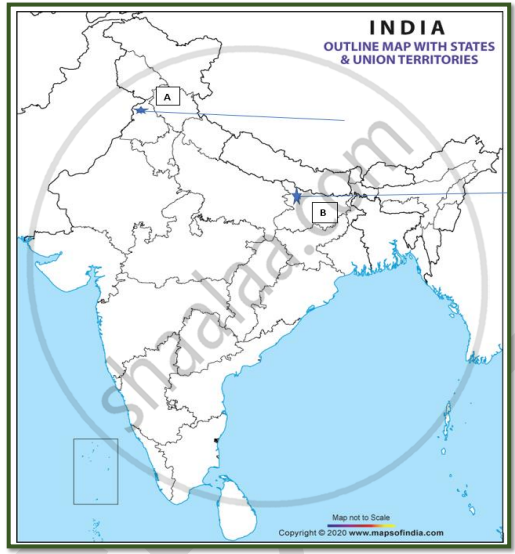
- On the given political map of India, locate and label the following with appropriate symbols:
- Kalibangan, a Harappan site
- Agra, a territory under Babur, Akbar, and Aurangzeb
- Sanchi, a Buddhist site
OR - Ajanta, a Buddhist site
- On the same outline map, two places have been marked as A and B, which are centres of the National movement. Identify them and write their correct names on the lines drawn near them.
Concept: Introduction to Harappan Civilisation
Read the source given below and answer the questions that follow.
|
“There cannot be any divided loyalty” Govind Ballabh Pant argued that in order to become loyal citizens people had to stop focusing only on the community and the self: For the success of democracy one must train himself in the art of self-discipline. In democracies, one should care less for himself and more for others. There cannot be any divided loyalty. All loyalties must exclusively be centred around the State. If in a democracy, you create rival loyalties, or you create a system in which any individual or group, instead of suppressing his extravagance, cares nought for larger or other interests, then democracy is doomed. |
- How did G.B Pant encourage citizens to make a unified nation?
- Why did he urge citizens for loyal towards nation?
- How was loyalty considered the base of the social pyramid?
Concept: The Earliest States
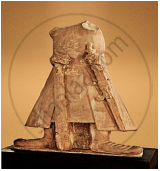
Identify the given image from the following options.
Concept: New Notions of Kingship
“Magadha was the most powerful Mahajanpada ‘. Examine the statement.
Concept: The Earliest States
Assertion (A): Asoka inscribed his messages to his subjects and officials on stone surfaces.
Reason (R): He wanted to proclaim what religion should be followed by all.
Concept: An Early Empire
Choose the correct option from the following statements with reference to the Magadha empire.
Concept: The Earliest States
Critically examine the limitations of the inscriptional evidence in understanding political and economic history of India.
Concept: The Limitations of Inscriptional Evidence
Who among the following was the best-known ruler of the Satavahana dynasty?
Concept: Social Differences: Within and Beyond the Framework of Caste
Identify the ruler of the Satavahana dynasty with the help of the following information:
|
Concept: Social Differences: Within and Beyond the Framework of Caste
Which one of the following statements is the correct explanation of ‘Endogamy’?
Concept: Kinship and Marriage: Many Rules and Varied Practices
Describe the familial relationship observed during the Mahabharat era.
Concept: Kinship and Marriage: Many Rules and Varied Practices
Describe the Social implications of access to Resources during the Mahabharat period.
Concept: Beyond Birth Resources and Status
How is Mahabharata a colossal epic to understand social behaviour of early historic period?
Concept: Handling Texts Historians and the Mahabharata
Analyse the role of Indian Sanskritist V.S. Suthankar and his team in the preparation of critical edition of Mahabharata.
Concept: The Critical Edition of the Mahabharata
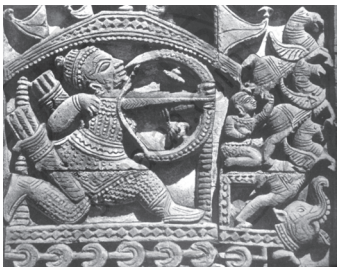
Identify the picture from the given options.
Concept: The Critical Edition of the Mahabharata
“The Mahabharata is an invaluable source available to historians to study social practices and norms in early societies”, Justify the statement.
Concept: Handling Texts Historians and the Mahabharata
“Be lamps unto yourselves as all of you must work out your own liberation.” Identify the essence of the words of Buddha from the options given below.
Concept: The Teachings of the Buddha
Read the following source carefully and answer the questions that follow:
|
Sanchi in the nineteenth century |
|
The most wonderful ancient buildings in the state of Bhopal are at Sanchi Kanakhera, a small village under the brow of a hill some 20 miles northeast of Bhopal which we visited yesterday. We inspected the stone sculptures and statues of the Buddha and an ancient gateway. The ruins appear to be the object of great interest to European gentlemen. Major Alexander Cunningham stayed several weeks in this neighbourhood and examined these ruins most carefully. He took drawings of the place, deciphered the inscription, and bored shafts down these domes. The results of his investigations were described by him in an English work. |
|
From SHAHJAHAN BEGUM, NAWAB OF BHOPAL (ruled 1868-1901), Taj-ul Iqbal Tarikh Bhopal (A History of Bhopal), translated by H.D. Barstow, 1876. |
- Why was Sanchi an interest to Alexander Cunningham?
- How was Sanchi related with Buddhism?
- How did Shahjahan Begum conserve Sanchi's stupa?
Concept: A Glimpse of Sanchi
Ashoka erected a pillar at ______ to mark that he had visited that place.
Concept: Stupas
Read the following source carefully and answer the questions that follow.
|
The world beyond the palace Just as the Buddha’s teachings were compiled by his followers, the teachings of Mahavira were also recorded by his disciples. These were often in the form of stories, which could appeal to ordinary people. Here is one example, from a Prakrit text known as the Uttaradhyayana Sutta, describing how a queen named Kamalavati tried to persuade her husband to renounce the world: If the whole world and all its treasures were yours, you would not be satisfied, nor would all this be able to save you. When you die, O king and leave all things behind, dhamma alone, and nothing else, will save you. As a bird dislikes the cage, so do I dislike (the world). I shall live as a nun without offspring, without desire, without the love of gain, and without hatred …Those who have enjoyed pleasures and renounced them, move about like the wind, and go wherever they please, unchecked like birds in their flight … Leave your large kingdom … abandon what pleases the senses, be without attachment and property, then practise severe penance, being firm of energy…. |
- Identify the person who persuaded the king to renounce the world.
- “Oh king, dhamma alone and nothing else will save you”- What does the word “dhamma” signifies and whose teachings was followed by the disciple.
- Under which context the following statement “unchecked like birds in their flight…….” was told by the disciple of Mahavira?
Concept: Beyond Worldly Pleasures: the Message of Mahavira
