Advertisements
Advertisements
Which one among the following pairs is correctly matched?
Concept: National Parties
Describe the role of political parties in India.
Concept: Role of Political Parties in a Democracy
Describe the necessity or utility of political parties in democratic countries.
Concept: Role of Political Parties in a Democracy
Two places A and B have been marked on the given outline map of India.
Identify them and write their correct names on the lines drawn near them.
- Indian National Congress session at this place in 1920.
- The place where Mahatma Gandhi broke Salt Law.

Concept: National Parties
Explain the role of Election Commission regarding recognition of Political Parties in India.
Concept: National Parties
How do Political Parties influence public opinion? Examine.
Concept: Role of Political Parties in a Democracy
Examine any two features of Bi-Party system.
Concept: Number of Political Parties
Analyze the need to Political Parties in the Democracy.
Concept: Role of Political Parties in a Democracy
Explain the role of Regional Parties in Indian democracy.
Concept: State Parties
The emergence of _______ is directly connected to the rise of political parties.
Concept: Role of Political Parties in a Democracy
Which of the following statements is correct keeping the requirement of formation of government in view.
Statement i: It is possible for independent candidates to form a government.
Statement ii: Government formation is exclusively reserved for political parties.
Statement iii: The formation of government is limited to only elected political parties.
Statement iv: Government can only be formed by political parties that are elected and hold a majority.
Concept: Role of Political Parties in a Democracy
Analyse the role of a multiparty system in a democratic country like India.
Concept: Number of Political Parties
Evaluate the significant distinction between the national and regional parties and assess the requirements for a regional party to become a national party.
Concept: National Parties
Two places A and B have been marked on the given outline map of India.
a) Identify them and write their correct names on the lines drawn near them.
- Indian National congress session at this place in 1920.
- The place where Mahatma Gandhi broke the salt law.
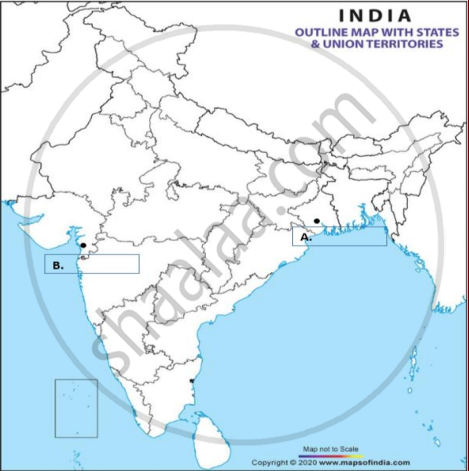
b) On the same outline map of India locate and label any 3 of the following with suitable symbols.
- A Coal mine in Tamil Nadu.
- A dam built on river Chenab in India.
- A largest natural major seaport located at Andhra Pradesh.
- Noida software technology park.
Concept: National Parties
Assertion (A): Modern democracy cannot function without political parties.
Reason (R): Elected representatives will be accountable only to their constituencies, not towards the country.
Concept: Role of Political Parties in a Democracy
Democracy’s ability to generate its own support is itself an outcome that cannot be ignored.’ Support the statement with examples.
Concept: Assessment of Democracy’s Outcomes
‘There is an overwhelming support for the idea of democracy in South Asia.’ Support the statement with examples.
Concept: Assessment of Democracy’s Outcomes
There are two statements marked as Assertion (A) and Reason (R). Mark your answer as per the codes provided below:
Assertion (A): Democracy is an accountable, responsive, and legitimate government.
Reason (R): Democracies have regular, free and fair elections and decision-making is based on norms and procedures.
Concept: Accountable, Responsive and Legitimate Government
Differentiate between democratic and non-democratic government.
Concept: Accountable, Responsive and Legitimate Government
“Democracy is attentive to the needs and demands of the people.” Justify the statement.
Concept: Accountable, Responsive and Legitimate Government
