Advertisements
Advertisements
Identify the correct option that describes the act given below.
- The Act was passed by the Imperial Legislative Council.
- It gave power to the government to repress political activities.
- It empowered the government to detain political prisoners without trial.
Concept: The Rowlatt Act
Arrange the following statements in sequential order based on the events that shaped the Non-cooperation movement.
- General Dyer opened fire at the large crowd gathered in the enclosed ground of Jallianwala Bagh.
- “Forced recruitment” carried out by the British government and the economic hardships faced by the people during the first world war.
- The defeat of the Ottoman Emperor of Turkey led to the formation of the Khilafat movement.
- Gandhiji launched a nationwide satyagraha against the Rowlatt act.
Concept: The First World War, Khilafat and Non-cooperation
Read the source given below and answer the questions that follow:
|
It is said of “passive resistance” that it is the weapon of the weak, but the power which is the subject of this article can be used only by the strong. This power is not passive resistance; indeed, it calls for intense activity. The movement in South Africa was not passive but active… 'Satyagraha is not physical force. A satyagrahi does not inflict pain on the adversary; he does not seek his destruction … In the use of satyagraha, there is no ill will whatever. 'Satyagraha is pure soul force. Truth is the very substance of the soul. That is why this force is called satyagraha. The soul is informed with knowledge. In it burns the flame of love.… Nonviolence is the supreme dharma …' It is certain that India cannot rival Britain or Europe in force of arms. The British worship the war god and they can all of them become, as they are becoming, bearers of arms. The hundreds of millions in India can never carry arms. They have made the religion of non-violence their own … In his famous book Hind Swaraj (1909) Mahatma Gandhi declared that British rule was established in India, with the cooperation of Indians, and had survived only because of this cooperation. If Indians refused to cooperate, British rule will collapse within a year. |
- Why did Gandhiji say that passive resistance is not the weapon of the weak?
- “Satyagraha is pure soul-force.” Substantiate this statement in 20 words.
- What according to Mahatma Gandhi is the best weapon to use to collapse British rule in India?
Concept: The Idea of Satyagraha
Choose the correct option, related to the founders of the ‘Swaraj Party’ within the Congress.
Concept: Towards Civil Disobedience
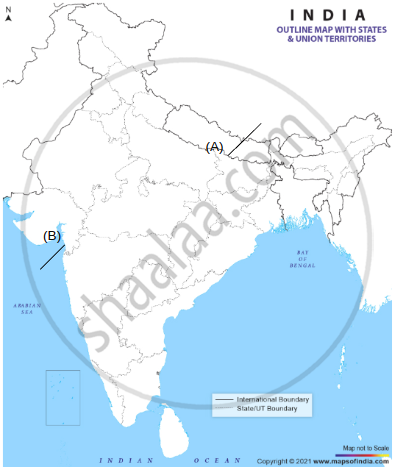
(a) Two places, 'A' and 'B', have been marked on the given political outline map of India. Identify them with the help of the following information and write their correct names on the lines drawn near them:
- The place where Gandhiji started Satyagraha for indigo peasants. (1)
- The place where Gandhiji broke the Salt Law. (1)
(b) On the same political outline map of India, locate and label any three of the following with suitable symbols: (3)
- Naharkatiya - Oil field
- Talcher - Major Coal Mines
- Narora - Atomic Power Plant
- Tuticorin - Major Sea Port
Concept: The Idea of Satyagraha
How did people belonging to different communities, regions or language groups develop a sense of collective belonging in the National Movement? Explain with examples.
Concept: The Sense of Collective Belonging
What helped in the colonisation of Asian and African countries? Identify the correct statement from the following options.
Concept: Role of Technology
Explain any two methods that were used by the Europeans for the recruitment of the indentured labours.
Concept: Indentured Labour Migration from India
How did the 'small pox' prove as the most powerful weapon of the Spanish conquerors in the mid-sixteenth century? Explain.
Concept: Concept of the Pre-modern World
Mention any two changes that occurred in West Punjab in the 19th century.
Concept: A World Economy Takes Shape
Mention any two advantages of the Silk route in the pre-modern trade.
Concept: Concept of the Pre-modern World
"The most powerful weapon of the Spanish conqueror was not a conventional military weapon at all.” Justify the above statement by giving two reasons.
Concept: Concept of the Pre-modern World
“Traders and travelers introduced new crops to lands they travelled. “Substantiate this statement with illustrations.
Concept: Concept of the Pre-modern World
______ from India and Southeast Asia travelled through ‘Silk Route’ to other parts of the world.
Concept: Concept of the Pre-modern World
Why was the cotton textile industry concentrated in the cotton growing belt in the early years? Explain.
Concept: The Peculiarities of Industrial Growth
Which logo of quality is marked on the packaged food items?
Concept: Market for Goods
Read the source given below and answer the question that follows:
|
Will Thorne is one of those who went in search of seasonal work, loading bricks and doing odd jobs. He describes how job-seekers walked to London in search of work: 'I had always wanted to go to London, and my desire… was stimulated by letters from an old workmate… who was now working at the Old Kent Road Gas Works… I finally decided to go… in November 1881. With two friends I started out to walk the journey, filled with the hope that we would be able to obtain employment, when we get there, with the kind assistance of my friend… we had little money when we started, not enough to pay for our food and lodgings each night until we arrived in London. Some days we walked as much as twenty miles, and other days less. Our money was gone at the end of the third day… For two nights we slept out - once under a haystack, and once in an old farm shed… On arrival in London we tried to find… my friend… but… were unsuccessful. Our money was gone, so there was nothing for us to do but walk around until late at night, and then try to find someplace to sleep. We found an old building and slept in it that night. The next day, Sunday, late in the afternoon, we got to the Old Kent Gas Works and applied for work. To my great surprise, the man we had been looking for was working at the time. He spoke to the foreman and I was given a job.’ |
- Analyse the major factor which led London to become an attractive place for job seekers.
- Analyse the reason for the appointment of Will Thorne by the Old Kent Gas works.
- Examine the preference of hand labour over machines by the industrialists of Victorian Britain.
Concept: Before the Industrial Revolution
Give reasons for the following.
The Roman Catholic Church began keeping an Index of Prohibited books from the mid-sixteenth century.
Concept: The Nineteenth Century
Which of the following newspaper was started by Bal Gangadhar Tilak?
Concept: Print and Censorship
Arrange the following in chronological order:
- The print culture created the conditions for the French Revolution.
- Martin Luther’s writings led to the beginning of the Protestant Reformation.
- Menocchio reinterpreted the message of the Bible.
- Johann Gutenberg invented the Printing press.
Concept: Print Comes to Europe
