Definitions [5]
Define complementary goods.
Complementary goods are those goods that are used jointly or consumed together, like cars and petrol or gas and gas stoves. In the case of complementary goods, an increase in the price of one good decreases the demand for the other goodits complementary good.
Define substitute goods.
Substitute goods are ones that can be used in place of the others.
Substitute goods are those goods which can be used in place of one another.
- Marshall: “Amount demanded increases with a fall in price and diminishes with a rise in price, other things being equal.”
- Samuelson: “People buy more at lower prices and less at higher prices, ceteris paribus.”
- Ferguson: “The quantity demanded varies inversely with price.”
Define contraction of demand (or decrease in quantity demanded).
When the quantity demanded of a commodity falls due to a rise in its own price of the commodity, other factors remaining constant, it is called a contraction of demand or a decrease in the quantity demanded.
Define decrease in demand.
When there is a fall in demand due to changes in factors other than the own price of the commodity, it is called a decrease in demand.
Formulae [1]
Dx = f(Px, Pn, Y, T)
Where Dx = Demand for commodity x,
Px = Price of the commodity x,
Pn = Price of related commodities,
Y = Income of the consumer,
T = Taste.
Theorems and Laws [2]
State and explain the ‘law of demand’ with its exceptions.
Prof. Alfred Marshall introduced the law of demand in his book, ‘Principles of Economics,’ published in 1890. The law explains the functional relationship between price and quantity demanded.
- Statement of the Law: According to Prof. Alfred Marshall, “Other things being equal, the higher the price of a commodity, the smaller the quantity demanded, and the lower the price of a commodity, the larger the quantity demanded.” Explanation: Other factors remain constant: when the price of a commodity rises, demand for it falls, and when the price of a commodity falls, demand for it rises. Thus, there is an inverse relationship between price and quantity demanded.
- Demand Schedule: The law of demand is explained with the help of the following demand schedule:
Demand Schedule Price of commodity
‘x’ (in ₹)Quantity demanded
per week (in kg)10 1 8 2 6 3 4 4 2 5 - From the above schedule, it can be observed that when the price of the commodity is ₹ 10, the demand is 1 kg.
- When the price falls from ₹ 10 to ₹ 8, the demand rises from 1 kg to 2 kg.
- Similarly, as the price falls from ₹ 8 to 6 and from ₹ 6 to 4, the demand rises from 2 kg to 3 kg and 3 kg to 4 kg, respectively.
- If we look at the schedule from bottom to top, when the price rises from ₹ 2 to ₹ 4, the demand falls from 5 kg to 4 kg.
- Thus, we can conclude that as the price of a commodity falls, the quantity demanded rises, and when the price of the commodity rises, the quantity in demand falls.
- This shows an inverse relationship between price and quantity demanded.
- Demand Curve: The law of demand can be further explained with the help of the following demand curve:

In the above diagram, the Y-axis represents price, and the X-axis represents quantity demanded. DD is the demand curve that slopes downward from left to right. It represents the inverse relation between price and quantity in demand. - Exceptions: The exceptions to the law are as follows:
- Giffen’s paradox: Giffen Goods are inferior or low-quality goods like vanaspati ghee (Dalda), low-quality rice, etc. These are goods whose demand does not rise, even if their price falls. This happens because every person wants to increase their standard of living constantly.
Sir Robert Giffen observed this behaviour related to bread (an inferior good) in England. People had limited money, so they consumed more bread (a cheaper commodity) and less meat (a costlier commodity). He observed that when the price of bread decreased, less bread was demanded than before. The people saved money and used it to purchase meat, and thus, the demand for meat increased. This behaviour is called “Giffen’s paradox”. There is a direct relationship between price and quantity demanded in the case of Giffen goods. The demand curve for Giffen goods slopes upward from left to right. - Speculation: The law of demand does not hold true when people expect prices to rise further. In this case, although prices have risen today, consumers will demand more in anticipation of a further rise in the price. For example, during the epic lockdown in March 2020, people expected the prices of goods to rise in the future. Therefore, they purchased goods in large quantities, even at high prices.
- Habitual Goods: If a person is habituated to or addicted to certain goods, his demand for these goods will continue to be the same even if the price of such goods rises. For example, people addicted to social media like FB, TikTok, Instagram, etc., will not reduce their usage even if the data packs or internet usage rates are increased.
- Illusion of Price: Consumers may believe that high-priced goods are of better quality; therefore, demand for such goods tends to increase with an increase in their prices. For example, expensive branded products are in demand, even at high prices.
- Prestige Goods: Prestige goods are regarded as a status symbol in society. Rich people may demand more of these goods when their prices rise to show off. E.g. Gold, diamonds, expensive watches, luxury cars, etc.
- Fashion: A product that is out of fashion (e.g., keypad phones) will have less demand even if the price falls. A product in fashion (e.g., smartphones) will have a high demand even if the price rises. Thus, it is an exception to the law.
- Ignorance: Sometimes, people buy more of a commodity at high prices due to ignorance. This may happen because the consumer is not aware of the cost of the commodity at other places.
- Necessities: The demand for specific necessities like basic foodstuffs (wheat, salt, dal, etc.) will not change due to a change in their prices.
- Demonstration Effect: The tendency of the low-income group to imitate the consumption pattern of high-income groups is known as the demonstration effect. For example, the T-shirts “Being Human” by Salman Khan are in very high demand despite their high prices.
- Giffen’s paradox: Giffen Goods are inferior or low-quality goods like vanaspati ghee (Dalda), low-quality rice, etc. These are goods whose demand does not rise, even if their price falls. This happens because every person wants to increase their standard of living constantly.
Introduction: The law of demand was introduced by Prof. Alfred Marshall in his book ‘Principles of Economics’, published in 1890. The law explains the functional relationship between price and quantity demanded.
Statement of the Law: According to Prof. Alfred Marshall, “Other things being equal, higher the price of a commodity, smaller is the quantity demanded and lower the price of a commodity, larger is the quantity demanded.”
In other words, other factors remaining constant, if the price of a commodity rises, demand for it falls and when price of a commodity falls demand for the commodity rises. Thus, there is an inverse relationship between price and quantity demanded.
Exceptions to the Law of Demand: There are certain exceptions to the law of demand. It means that under exceptional circumstances, consumer buys more when the price of commodity rises and buys less when price of commodity falls. In such cases, demand curve slopes upwards from left to right. i.e. the demand curve has a positive slope as shown in figure.
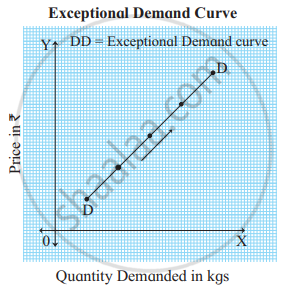
Following are the exceptions to the law of demand:
- Giffen’s paradox: Inferior goods or low-quality goods are those goods whose demand does not rise even if their price falls. At times, demand decreases when the price of such commodities falls. Sir Robert Giffen observed this behaviour in England regarding bread. He noted that, when the price of bread declined, people did not buy more because of an increase in their real income or purchasing power. They preferred to buy superior goods like meat. This is known as Giffen’s paradox.
- Prestige goods: Expensive goods like diamonds, gold, etc., are status symbols. So rich people buy more of it, even when their prices are high.
- Speculation: The law of demand does not hold true when people expect prices to rise still further. In this case, although prices have risen today, consumers will demand more in anticipation of a further price rise. For example, prices of oil, sugar, etc., tend to rise before Diwali. So people continue purchasing more at high prices, anticipating that prices may rise during Diwali.
- Price illusion: Consumers believe that high-priced goods are of better quality. Therefore, the demand for such goods tends to increase with a rise in their prices. For example, expensive branded products are in demand even at high prices.
- Ignorance: Sometimes, due to ignorance, people buy more of a commodity at a high price. This may happen when consumer is ignorant about the price of that commodity at other places.
- Habitual goods: Due to habitual consumption, certain goods, such as tea, are purchased in required quantities even at higher prices.
State the law of demand.
The law of demand states the inverse relationship between the price and quantity demanded of a commodity. According to this law, other things being equal, when the price of a commodity increases, its demand falls and when the price falls, demand increases. Note that the law of demand indicates only the 'direction' of change and not the ‘magnitude’ of change in demand. Further, there is no proportionate relationship between price and demand. If the price of a commodity rises by 20%, its demand may fall by any proportion (i.e. by more or less than 20%). Law of demand, thus, is a qualitative concept, as it does not indicate the magnitude of change in demand. It is important to note here that the law of demand states the effect of change in price on demand and not the effect of change in demand on price.
- According to Marshall, “The amount demanded increases with a fall in price and diminishes with a rise in price.”
- According to Bilas, “The law of demand states that other things being equal, the quantity demanded per unit of time will be greater, lower the price and smaller, higher the price.”
The law of demand states that, other things being equal, the quantity demanded of a good rises when its price drops and falls when its price increases. This shows an inverse relationship between a product’s price and the quantity consumers are willing to buy.
Key Points
- The demand curve represents the law of demand visually.
- There are two types: individual and market demand curves.
- The market demand curve is derived by summing individual curves at each price.
- Movements along the curve are due to price changes; curve shifts are due to outside factors.
- The market demand curve is the sum of all buyers' demands at each price.
- It slopes downwards: lower price → higher quantity demanded.
- Useful for market analysis and price setting.
- The demand curve for an individual consumer slopes downward from left to right, demonstrating that lower prices lead to higher quantities demanded.
- Demand is affected by individual preferences, income, and prices of related goods (substitutes and complements).
- Only price changes cause movement along the demand curve; other factors cause the curve to shift.
- Demand is affected by many factors, not just price.
- A change in any determinant—like income, preferences, or population—can shift demand.
- Some factors (like climate or government taxes) have seasonal or policy-based effects.
- Related goods can be substitutes (used instead) or complements (used with).
- Real-life decisions—like bulk buying before a GST rise—are practical examples of demand determinants at work.
- There is an inverse relation between price and quantity demanded.
- All other factors must remain constant for the law to apply.
- The demand curve always slopes downwards.
- Not all goods follow the law of demand; some have exceptions.
- Giffen and Veblen goods are classic exceptions.
- Be aware of context (exam and real-world) when citing examples.
- Change in demand occurs due to factors other than price.
- Increase in demand: Demand curve shifts right (favourable factors).
- Decrease in demand: Demand curve shifts left (unfavourable factors).
Important Questions [13]
- Distinguish between Normal goods and Inferior goods.
- With suitable examples differentiate between complementary goods and substitute goods.
- With help of an example explain the term complementary goods.
- Explain clearly two factors which determine demand.
- If a buyer buys less of a commodity when his income falls, how will his demand curve change? Illustrate your answer with a diagram.
- State and explain the law of demand with the help of a hypothetical schedule and graph.
- State the law of demand.
- Briefly explain any two reasons for the occurrence of the law of demand.
- Explain briefly anyone determinant of an exceptional demand curve.
- What is meant by an increase in demand?
- If Coke and Fanta are close substitutes to each other, a rise in price of Coke will lead to ______ for Fanta.
- What is meant by the contraction in demand?
- Mention any two factors that cause a rightward shift of the demand curve.
