Definitions [19]
A solution is a homogeneous mixture of two or more substances in the same or different physical phases. The substances that form the solution are called its components.
Solute + Solvent = Solution
Define the term solution.
Homogeneous mixtures of two or more than two components are known as solutions.
Define the term:
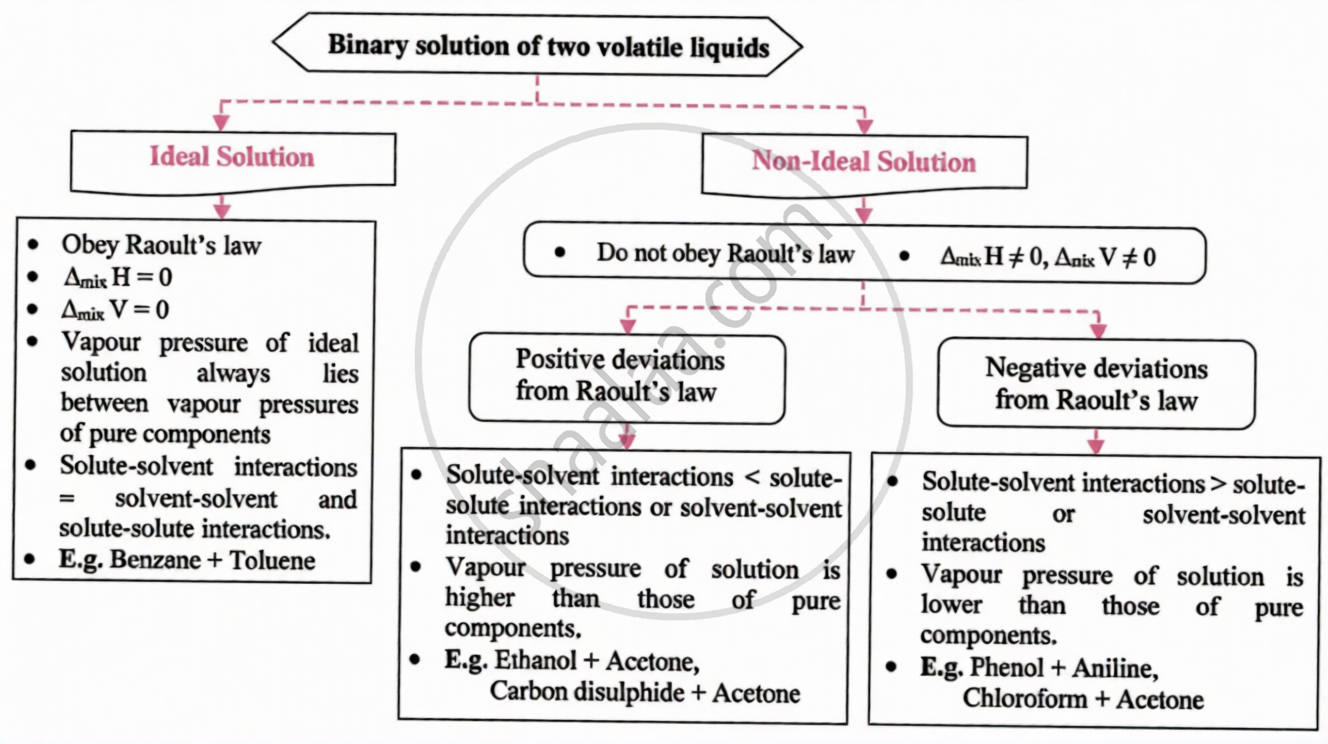
Ideal solution
It is characterised as a solution that adheres to Raoult's Law, with no interactions between the molecules and no volume or heat change during mixing.
For an ideal solution, Enthalpy of mixing of the pure components to form the solution is Δmix H = 0 and the volume of mixing is Δmix V = 0.
A solution which contains more solute than would be necessary to saturate it at a given temperature is called a supersaturated solution.
Define isotonic solutions.
Two or more solutions exerting the same osmotic pressure are called isotonic solutions.
When two solutions are separated by a semipermeable membrane and no osmosis occurs, i.e., there is no net flow of water on either side through the membrane, the solutions are said to be isotonic solutions. If the membrane is perfectly semipermeable, the two solutions possess the same osmotic pressure and are also referred to as iso-osmotic solutions.
A solution in which more solute can be dissolved without raising the temperature is called an unsaturated solution.
A solution in which no solute can be dissolved further at a given temperature is called a saturated solution.
It is defined as the amount of solute that can be dissolved in 100 g of the solvent at the given conditions. It is also expressed as the maximum quantity of solute moles that can be dissolved in solvent to form 1 dm³ of solution.
Define ebullioscopic constant.
Ebullioscopic constant or molal elevation constant, is the elevation in the boiling point produced when one mole of the solute is dissolved in one kilogram of solvent.
ΔTb = Kb × m
ΔTb = Kb if m = 1 molal
Where Kb = Molal elevation constant
ΔTb = Elevation in boiling point.
If a pressure larger than the osmotic pressure is applied to the solution side, then pure solvent from the solution passes into the pure solvent side through the semipermeable membrane. This phenomenon is called reverse osmosis.
or
Osmosis is a flow of solvent through a semipermeable membrane into the solution. The direction of osmosis can be reversed by applying a pressure larger than the osmotic pressure. This is called reverse osmosis.
Osmotic pressure is the minimum pressure which needs to be applied to a solution to prevent the inward flow of its pure solvent across a semipermeable membrane.
\[\pi=\frac{n_2RT}{V}=\mathrm{CRT}\]
\[\pi=\frac{w_2RT}{\mathrm{M}_2V}\]
Define Osmosis.
The net spontaneous flow of solvent molecules into the solution or from more dilute solution to more concentrated solution through a semipermeable membrane is called osmosis.
Define the following term:
Hypotonic solution
The solution having lower osmotic pressure as compared to some other solution is referred to as a hypotonic solution.
Define osmotic pressure.
Osmotic pressure may be defined as the external pressure which should be applied to the solution in order to stop the phenomenon of osmosis, i.e., to stop the flow of solvent into the solution when the two are separated by a semipermeable membrane.
Define Semipermeable membrane
Semipermeable membrane: It is a membrane which allows the solvent molecules, but not the solute molecules, to pass through it.
Semipermeable membrane is a film such as cellophane which has pores large enough to allow the solvent molecules to pass through them.
Define the following term:
isotonic solution
Two or more solutions exerting the same osmotic pressure are called an isotonic solution.
Define reverse osmosis.
The process of moving a solvent from a solution to a pure solvent through a semipermeable membrane while applying excessive pressure on the solution side is known as reverse osmosis.
It is a thin film, such as cellophane, which has pores large enough to allow the solvent molecules to pass through them.
or
When a solution and pure solvent or two solutions of different concentrations are separated by a semipermeable membrane, the solvent molecules pass through the membrane this is called osmosis.
It is the net spontaneous flow of solvent molecules into the solution or from a more dilute solution to a more concentrated solution through a semipermeable membrane.
Theorems and Laws [5]
Statement: The solubility of a gas in a liquid is directly proportional to the pressure of the gas over the solution.
S = KH⋅P
Where S = solubility (mol L⁻¹), P = pressure (bar), KH = Henry's law constant (mol L⁻¹ bar⁻¹).
Gases like NH₃ and CO₂ do NOT obey Henry's law (they react with water).
State Raoult’s law for the solutions of non-volatile solutes in volatile solvents.
The vapour pressure of a solution containing a non-volatile solute at a particular temperature is directly proportional to the mole fraction of the solvent in the solution.
According to Raoult’s law,
`P = P_"solvent" = P^circ * chi_"solvent"` ...(i)
For a binary mixture,
`chi_"solute" + chi_"solvent" = 1`
∴ `chi_"solvent" = 1 - chi_"solute"`
Putting this value in the equation (i), we have
`P = P^circ xx (1 - chi_"solute")`
or `P/P^circ = 1 - chi_"solute"`
or `1 - P/P^circ = chi_"solute"`
or `(P^circ - P)/P^circ = chi_"solute"`
In the above equation, the term (P° − P) represents the lowering of vapour pressure in the formation of the solution. The term `(P^circ - P)/P^circ`is called the relative lowering of vapour pressure of the solution.
State Raoult’s law for solutions containing volatile solutes.
For a solution of volatile liquids, the partial vapour pressure of each component in the solution is directly proportional to its mole fraction.
If pi is the partial vapour pressure of ith component in a solution and χi is its mole fraction in the solution, then according to Raoult’s law,
pi ∝ χi
or pi = constant × χi ...(i)
If we consider the component in its pure state, then
`p_i = p_i^circ` and
χi = 1
Where Pi is the vapour pressure of the ith component in the pure state. In the case of the pure ith component, we shall have a 100% pure component, and χi will be equal to 1. Substituting the values in Eq. (i), we have
pi = constant × 1
or constant = `p_i^circ`
Again putting the value of the constant in Eq. (i), we have
`p_i = p_i^circ* chi_i`
State Raoult’s law.
Raoult’s law states that the partial vapour pressure of any volatile component of a solution is equal to the vapour pressure of the pure component multiplied by its mole fraction in the solution.
For a solution of volatile liquids, the partial vapour pressure of each component in the solution at a particular temperature is equal to the product of the vapour pressure of the component in the pure state and its mole fraction in the solution.
Mathematically, for a binary solution:
\[\ce{P_A = P{^{\circ}_{A}}\chi_A}\] and
\[\ce{P_B = P{^{\circ}_{B}}\chi_B}\]
The total vapour pressure is:
\[\ce{P_{total} = P_A + P_B = P{^{\circ}_{A}}\chi_A + P{^{\circ}_{B}}\chi_B}\]
Statement: The partial vapour pressure of any volatile component of a solution is equal to the vapour pressure ofthe pure component multiplied by its mole fraction in the solution.
For a binary solution of two volatile components:
\[\mathrm{P}_{1}=\mathrm{P}_{1}^{0}x_{1}\quad\mathrm{and}\quad\mathrm{P}_{2}=\mathrm{P}_{2}^{0}x_{2}\]
Raoult's law Using Dalton's law of partial pressures, Total vapour pressure (P) is given by:
\[\mathrm{P}=\mathrm{P}_{1}+\mathrm{P}_{2}=\mathrm{P}_{1}^{0}x_{1}+\mathrm{P}_{2}^{0}x_{2}=\left(\mathrm{P}_{2}^{0}-\mathrm{P}_{1}^{0}\right)x_{2}+\mathrm{P}_{1}^{0}\]
Composition of vapour phase: If y1 and y2 are the mole fractions of the components 1 and 2, respectively, in the vapour phase; then using Dalton's law of partial pressures: P1 = y1P and P2 = y2P
Key Points
A solution is a homogeneous mixture of two or more components whose concentration can be varied within certain limits.
- Solute — the component present in a smaller amount (dissolved)
- Solvent — the component present in a larger amount (dissolving medium)
- A binary solution contains only two components: one solute + one solvent.
Classification of Mixtures
| Homogeneous Mixture | Heterogeneous Mixture |
|---|---|
| Uniform composition | Non-uniform composition |
| True solution | Colloid, Suspension |
Based on the physical states of solute and solvent, there are 9 types of solutions:
| S.No. | Solute | Solvent | Example |
|---|---|---|---|
| 1 | Solid | Liquid | Sea water, sugar in water, benzoic acid in benzene |
| 2 | Solid | Solid | Alloys — brass, bronze |
| 3 | Solid | Gas | Iodine in air |
| 4 | Liquid | Liquid | Ethanol in water, gasoline |
| 5 | Liquid | Solid | Amalgam (mercury in silver) |
| 6 | Liquid | Gas | Chloroform in nitrogen |
| 7 | Gas | Liquid | Carbonated water (CO₂ in water), O₂ in water |
| 8 | Gas | Solid | H₂ in palladium |
| 9 | Gas | Gas | Air (O₂, N₂, Ar mixture) |
Based on the amount of solute dissolved at a given temperature:
| Solution | Description |
|---|---|
| Unsaturated | Contains less solute than can be dissolved at given temperature |
| Saturated | Contains the maximum (equilibrium) quantity of solute at that temperature |
| Supersaturated | Contains more solute than the equilibrium amount (unstable) |
Factors Affecting Solubility
| Factor | Effect |
|---|---|
| Nature of solute & solvent | "Like dissolves like" — similar chemical character dissolves easily |
| Temperature (solid in liquid) | Endothermic: solubility increases with T; Exothermic: solubility decreases with T |
| Temperature (gas in liquid) | Solubility decreases with increase in temperature |
| Pressure (solid/liquid in liquid) | No effect (incompressible) |
| Pressure (gas in liquid) | Solubility increases with increasing pressure |
Electrolytes dissociate in solution → produce more particles → colligative properties are greater than expected. Observed molar masses are less than formula mass.
van't Hoff factor (i):
\[i=\frac{\text{Colligative property of electrolyte solution}}{\text{Colligative property of non-clectrolyte solution of same concentration}}\]
\[i=\frac{(\Delta T_f)_o}{(\Delta T_f)_t}=\frac{(\Delta T_b)_o}{(\Delta T_b)_t}=\frac{(\Delta P)_o}{(\Delta P)_t}=\frac{\pi_o}{\pi_t}=\frac{M_{\text{theoretical}}}{M_{\mathrm{observed}}}\]
| Type | Value of i | Example |
|---|---|---|
| Non-electrolyte | i = 1 | Glucose, urea |
| Electrolyte (dissociates) | i > 1 | NaCl (i ≈ 2), CaCl₂ (i ≈ 3) |
| Strong electrolyte | i = n (no. of ions after dissociation) | — |
| Weak electrolyte | Degree of dissociation α = (i − 1)/(n − 1) | — |
Modified Colligative Expressions:
\[\Delta P=i\cdot P_1^0\cdot x_2\]
\[\Delta T_{b}=iK_{b}m=\frac{i1000K_{b}w_{2}}{M_{2}W_{1}}\]
\[\Delta T_{f}=iK_{f}m=\frac{i1000\times K_{f}\times w_{2}}{M_{2}W_{1}}\]
\[\pi=i\cdot MRT=\frac{i\cdot W_{2}RT}{M_{2}V}\]
Concepts [11]
- Concept of Solution
- Types of Solutions
- Capacity of Solution to Dissolve Solute
- Solubility
- Vapour Pressure of Solutions of Liquids in Liquids
- Colligative Properties of Nonelectrolyte Solutions
- Vapour Pressure Lowering
- Boiling Point Elevation
- Depression in Freezing Point
- Osmosis and Osmotic Pressure
- Colligative Properties of Electrolytes
