Definitions [11]
A relation from set A to set B is any subset of the Cartesian product \[A \times B\].
So, if \[R \subseteq A \times B\], then R is a relation from A to B.
- Domain: The set of all first components of the ordered pairs in a relation R is called the domain of the relation R.
-
Codomain: If R is a relation from A to B, then the set B is called the co–domain of the relation R.
-
Range: The set of all second components of all ordered pairs in a relation R is called the range of the relation.
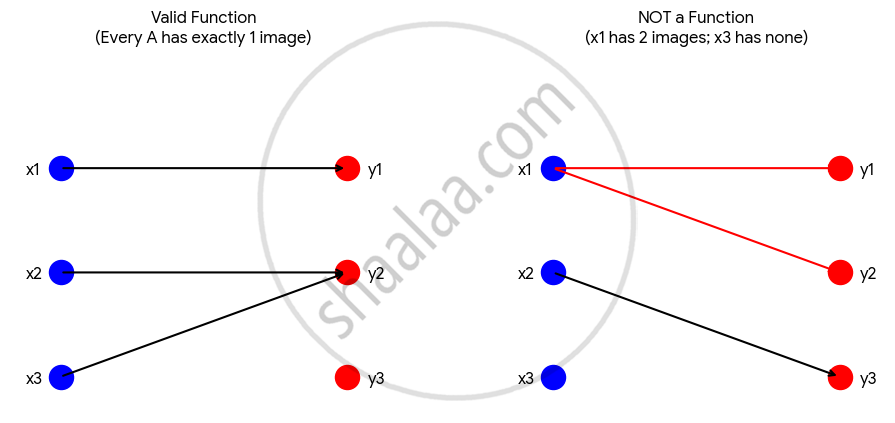
A function from set A to set B is a relation in which every element of A has exactly one image in B.
Condition for a Function
-
every element of the domain must be used
-
no element of the domain can have more than one image
-
different elements may have the same image
If A and B are two non-empty sets, then their Cartesian product is written as \[A \times B\].
-
It is the set of all ordered pairs \[(a, b)\] such that \[a \in A\] and \[b \in B\].
-
\[A \times B = \{(a, b) : a \in A, b \in B\}\].
An ordered pair is a pair of objects whose components occur in a special order. It is written by listing the two components in the specified order, separating them by a comma and enclosing the pair in parentheses. In the ordered pair (a, b), a is called the first component and b the second component.
-
Two ordered pairs are equal only if their corresponding components are equal, so (a,b) = (c,d) if and only if a = c and b = d.
-
In general, (a,b) ≠ (b,a).
- Range: Set of actual output values of f
- Range ⊆ Codomain
f: X → Y is a function if each element of X is associated with a unique element of Y
- Domain (X): Set of all input values
- Codomain (Y): Set of all possible outputs
Define an equivalence relation ?
A relation R on set A is said to be an equivalence relation if
(i) it is reflexive,
(ii) it is symmetric and
(iii) it is transitive.
Relation R on set A satisfying all the above three properties is an equivalence relation.
Define a transitive relation ?
A relation R on a set A is said to be transitive if
(a, b) ∈ R and (b, c) ∈ R
⇒ (a, c) ∈ R for all a, b , c ∈ R
i.e. aRb and bRc
⇒ aRc for all a, b, c ∈ R
Define a symmetric relation ?
A relation R on a set A is said to be symmetric if
(a, b) ∈ R
⇒ (b, a) ∈ R for all a b ∈ A
i.e. aRb ⇒ bRa for all a , b ∈ A
Key Points
| Term | Meaning |
|---|---|
| Ordered Pair | Pair of elements written in a fixed order |
| Cartesian Product | Set of all ordered pairs from two sets |
| Relation | Subset of a Cartesian product |
| Domain | Set of first elements of a relation/function |
| Codomain | Target set into which mapping occurs |
| Range | Actual set of output values obtained |
| Function | Relation assigning exactly one output to each input |
-
Empty relation and universal relation are called trivial relations.
-
Identity relation always contains all self-pairs and is always reflexive.
-
To check reflexivity, see whether every (a,a) is present in the relation.
-
To check symmetry, see whether every (a,b) has the reverse pair (b,a).
-
To check transitivity, see whether (a,b) and (b,c) together give (a,c).
-
A relation is an equivalence relation only when all three properties—reflexive, symmetric, and transitive—are satisfied together.
One-Minute Revision
\[ \text{Reflexive: } (a,a) \in R \quad \forall a \in A \]
\[ \text{Symmetric: } (a,b) \in R \Rightarrow (b,a) \in R \]
\[ \text{Transitive: } (a,b),(b,c) \in R \Rightarrow (a,c) \in R \]
\[ \text{Equivalence: Reflexive} + \text{Symmetric} + \text{Transitiv} \]
