Theorems and Laws [2]
Statement:
The locus of a point which is equidistant from two fixed points is the perpendicular bisector of the line segment joining the two fixed points.
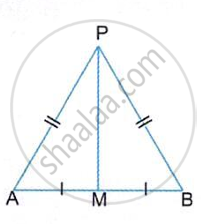
Given:
- A and B are two fixed points
- P is a point such that PA = PB
To Prove:
-
P lies on the perpendicular bisector of AB
Construction:
- Join AB
- Let M be the midpoint of AB
- Join PM
Proof:
-
In ΔPMA and ΔPMB,
PA = PB (given), MA = MB (M is the midpoint of AB), PM = PM (common). -
∴ ΔPMA ≅ ΔPMB (SSS).
-
∴ ∠PMA = ∠PMB (c.p.c.t.).
-
∠PMA + ∠PMB = 180° (straight line AB).
-
∴ ∠PMA = ∠PMB = 90°.
-
Hence, PM ⟂ AB passes through midpoint M.
Thus, P lies on the perpendicular bisector of AB.
Statement:
Every point on the perpendicular bisector of a line segment is equidistant from the two fixed points.
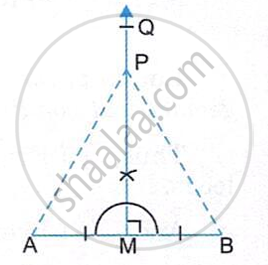
Given:
- A and B are two fixed points
- MQ is the perpendicular bisector of AB
- P is any point on MQ
To Prove:
PA = PB
Construction:
-
Join PA and PB
Proof:
-
In ΔPMA and ΔPMB,
MA = MB (M is the midpoint of AB), PM = PM (common),
∠PMA = ∠PMB = 90° (MQ ⟂ AB). -
∴ ΔPMA ≅ ΔPMB (SAS).
-
∴ PA = PB (c.p.c.t.).
Conclusion:
Hence, every point on the perpendicular bisector of AB is equidistant from A and B.
Concepts [7]
- Basic Concept of Construction
- Squares and Rectangles
- Constructing Squares and Rectangles
- An Exploration in Rectangles
- Constructing Complex Figures
- Exploring Diagonals of Rectangles and Squares
- Points Equidistant from Two Given Points
