Definitions [15]
What is light? Define it.
Light is a form of Energy i. e. The external physical cause that affects our eye to produce the sensation of vision.
Define reflection.
The bouncing of light by any smooth or polished surface is called.
The phenomenon of bouncing back of light rays in the same medium on striking a surface is called reflection of light.
Define Regular reflection.
The phenomenon due to which a parallel beam of light traveling through a certain medium, on striking some polished surface, bounces off from it, as a parallel beam, in some other direction, is called regular reflection.
Define the term Principle axis.
The principal axis is the straight line passing through the pole and the centre of curvature.
Define the following term
Normal
Normal: The perpendicular line drawn from, the point of incidence to the plane of reflecting surface is called normal.
Define the following term
Incident ray
Incident ray- The ray of light that falls on the surface of the reflection materials.
Define the following term
Angle of incidence
Angle of incidence: The angle formed between the incident ray PO and the normal ‘ON’ is angle of incidence.
Define the following term
Reflected ray
Reflected ray: The ray of light that comes from the point when the incident ray falls on the reflection material.
By drawing a neat diagram define the following:
Mirror
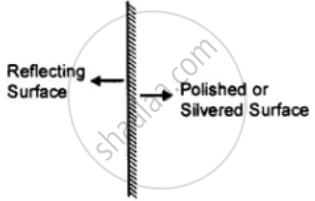
The mirror is a highly polished and smooth surface that reflects almost the entire light falling on it. A plane mirror is made by silvering one side of a glass plate as shown in the figure.
Representation of plane mirror
Explain the following term:
Normal Draw
diagram/diagrams to show them.
Normal: The perpendicular drawn at the point of incidence, to the surface of the mirror is called normal.

Define the following terms :
Incident ray, Refracted ray, Angle of incidence, Angle of refraction.
INCIDENT RAY AB: The ray light AB which is in air strikes the glass slab at B.
Or
“A ray of light falling on the surface separating the two media.”
REFRACTED RAY BK: A ray of light which after passing the first medium is in second medium i.e. ray BK.
“A ray of light travelling in other medium in the changed direction.”
ANGLE OF INCIDENCE: “The angle which the incident ray makes with the normal is called angle of incidence.”
i.e. ∠i
ANGLE OF REFRACTION: “The angle which the refracted ray makes with the normal is called angle of refraction.”
i.e. ∠r

Define opaque material.
Materials that are not able to allow light to pass through, are called opaque material.
Define transparent materials.
Materials that allow light to pass through completely are known as transparent materials.
The refractive index of a medium is defined as the ratio of the speed of light in vacuum (or air) to the speed of light in that medium.
Formulae [1]
n = \[\frac {360°}{θ}\]
- If n is even → N = n − 1
- If n is odd → N = n (object not on bisector); N = n − 1 (object on bisector)
- If n is a fraction → N = integral part of n
Theorems and Laws [2]
- The angle of incidence ∠i = angle of reflection ∠r.
- The incident ray, reflected ray, and normal lie in one plane; both rays are on either side of the normal.
- The angle of reflection is equal to the angle of incidence.
- The incident ray, the reflected ray, and the normal lie in the same plane.
- The incident ray and the reflected ray are on opposite sides of the normal.
Key Points
- Reflection occurs when light bounces off a smooth surface like a mirror, following fixed laws.
- Plane mirrors always form virtual, erect, and same-sized images that are laterally inverted.
- Curved surfaces (like a spoon) act as spherical mirrors, changing the image size and orientation depending on the object's position.
- Refractive index (µ) = c / V, where c is the speed of light in vacuum and V is the speed in the medium.
- The refractive index of a medium is always > 1 because the speed of light in any medium is less than in a vacuum.
- If µ₁ = µ₂ or the angle of incidence = 0°, the ray of light passes undeviated.
- Wavelength in medium A′ = A / µ; wavelength decreases in denser medium and increases in rarer medium.
- Refractive index decreases with decreasing speed of light, and is maximum for violet light and minimum for red light.
Concepts [13]
- Climatic Factors > Light
- Reflection of Light
- Plane Mirror
- Terms Used in Reflection of Light
- Law of Reflection of Light
- Verification of the Law of Reflection of Light
- Reflection of a Ray of Light Normally Incident on a Plane Mirror
- Images Formed by a Plane Mirrors
- Formation of Image by Reflection: Real and Virtual Image
- Lateral Inversion
- Types of Reflection
- Speed of Light in Different Media
- Colour
