- An extrinsic semiconductor is formed by adding a small impurity (doping) to increase conductivity.
- In n-type, a pentavalent impurity gives one extra free electron; electrons are the majority carriers.
- In p-type, a trivalent impurity creates a hole; holes are the majority carriers.
- Donor levels lie just below the conduction band, and acceptor levels lie just above the valence band.
- In doped semiconductors, electron and hole concentrations follow:
nenh = ni2.
Definitions [19]
Definition: Hole
The vacancy left in the valence band when an electron leaves it behaves like a positive charge carrier in semiconductor theory.
Definition: Intrinsic Carrier Concentration
The concentration of charge carriers in an intrinsic semiconductor, where the number of electrons equals the number of holes.
Definition: Intrinsic Semiconductor
A pure semiconductor in which no impurity is added intentionally.
Definition: Extrinsic Semiconductor
A doped semiconductor is called an extrinsic semiconductor or impurity semiconductor.
Definition: Dopant
The impurity added is called a dopant.
Definition: Host
The semiconductor to which the dopant is added is called the host.
Definition: Doping
Intrinsic semiconductors have very low conductivity at room temperature. Therefore, they are not useful for constructing electronic devices. Their electrical conductivity can be increased by adding a suitable impurity. This process is called doping.
Definition: p-n Junction Diode
A basic semiconductor device that controls the flow of electric current in a circuit, which when forward biased behaves as a closed circuit and when reverse biased behaves as an open circuit, is called a p-n Junction Diode.
Definition: Rectification
- The conversion of AC voltage into a DC voltage is called Rectification.
- The process of converting an alternating current into a direct current is called rectification.
Definition: Rectifier
- The electronic circuit which rectifies AC voltage is called a Rectifier.
- The device used to convert an alternating current into a direct current is called a rectifier.
Definition: Zener Diode
A unique form of a bipolar device which permits the current flow in the reverse direction when the voltage applied is above a certain characteristic value called Zener voltage or breakdown voltage, most commonly used in voltage regulators to protect other semiconductor devices from fluctuations in voltage, is called a Zener Diode.
Definition: Photodiode
A special purpose junction diode that converts light energy into electrical current, works on the principle of the photoelectric effect, operates in reverse bias, and generates a current when exposed to light (proportional to the intensity of incident light), is called a Photodiode.
What is a solar cell?
It is a semiconductor device used to convert photons of solar light into electricity. It generates emf when solar radiation falls on the p-n junction. A p-type silicon wafer of about 300 μm is taken over which a thin layer of n-type silicon is grown on one side by the diffusion process.

Definition: Energy Bond
An energy band is the wide range of energies possessed by an electron in a solid.
Definition: Semiconductor
A material with a small energy gap (about 1 eV) between valence and conduction bands, allowing limited conduction at room temperature.
Definition: Valence Band
The highest occupied energy band containing valence electrons.
OR
Valence band is the wide range of energies possessed by the valence electrons. Valence band is the highest energy band, occupied by the valence electrons. It is completely filled for inert gases, but partially filled for other materials.
Definition: Conductor
A material having a partially filled valence band (or overlapping valence and conduction bands), allowing electrons to move easily and conduct electricity.
Definition: Conduction Band
An empty or partially filled band above the valence band in which electrons can move freely and conduct current.
OR
Conduction band is the wide range of energies possessed by the conduction band electrons. It is the lowest unfilled band, for insulators. But it is partially filled for conductors. Current conduction is due to the electrons in this band.
Definition: Insulator
A material in which the valence band is completely filled and the conduction band is empty, separated by a large energy gap (a few eV), so electrons cannot move freely.
Theorems and Laws [1]
Energy Band Theory
Formation of Energy Bands
In a single isolated atom, electrons occupy discrete, well-defined energy levels (like rungs of a ladder).
When atoms are packed together in a crystal lattice, electrons are shared among neighbouring atoms. This causes:
- Each discrete energy level splits into closely spaced levels
- These closely spaced levels collectively form an energy band
Analogy: Think of a single tuning fork producing one frequency. When thousands of tuning forks are placed close together, they create a continuous range (band) of frequencies, not a single note.
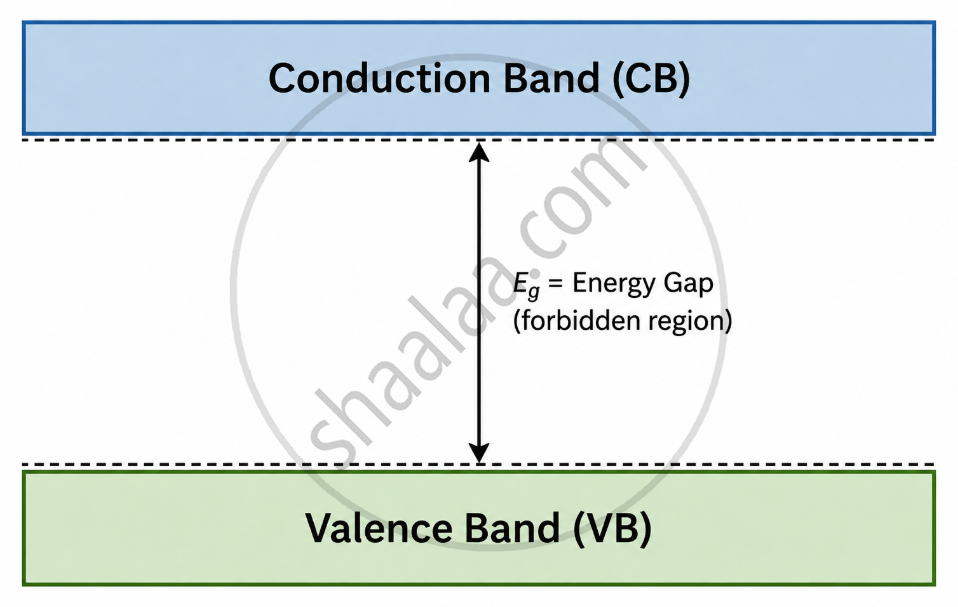
Key Energy Bands
| Band | Description |
|---|---|
| Valence Band (VB) | The highest-energy band that is completely or partially filled with electrons at 0 K. Electrons here are bound to atoms. |
| Forbidden Energy Gap (E_g) | Energy region with no allowed states. Electrons cannot exist here. Also called the Band Gap. |
| Conduction Band (CB) | Energy band above the valence band. Electrons here are free to move and conduct electricity. |
Key Points
Key Points: Concept of Semiconductor Electronics
- Electronic circuits are built using devices that allow controlled flow of electrons.
- Before 1948, vacuum tubes or valves were commonly used.
- Electrons in vacuum tubes come from a heated cathode and move in the vacuum.
- Vacuum tube devices are bulky, high-power, high-voltage, with limited lifetime and low reliability.
- Semiconductor devices work within the solid itself.
- Semiconductor devices do not require external heating or a large evacuated space.
- Semiconductor devices are small, low-power, low-voltage, long-life, and highly reliable.
Key Points: Energy Bands in Solids
| Aspect | Conductors | Insulators | Semiconductors |
|---|---|---|---|
| Band gap | None (bands overlap) | Large (~10 eV) | Small (~1 eV) |
| Electron transition | Free movement | Not possible easily | Possible with small energy |
| Energy requirement | None | Very high | Low |
| Energy Band Structure | 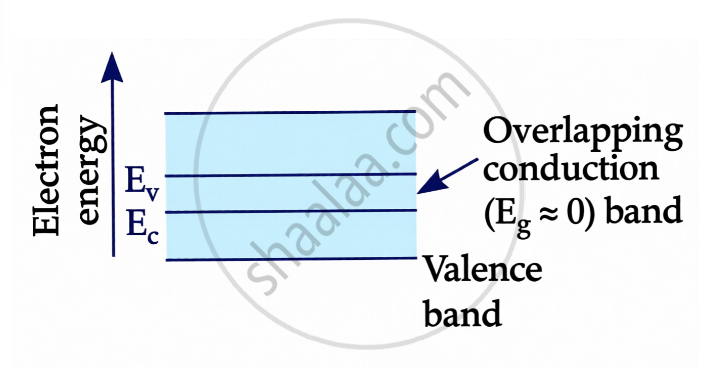 |
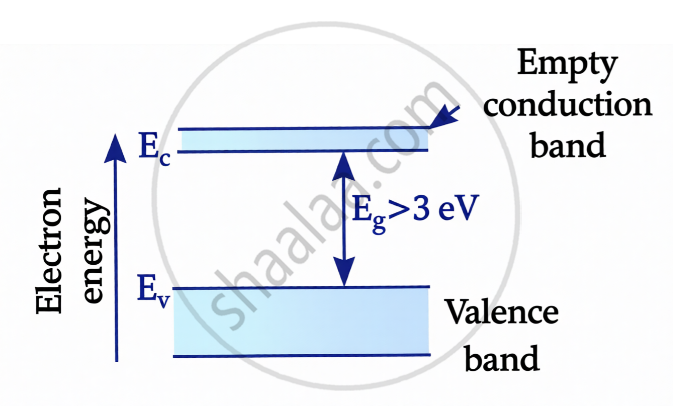 |
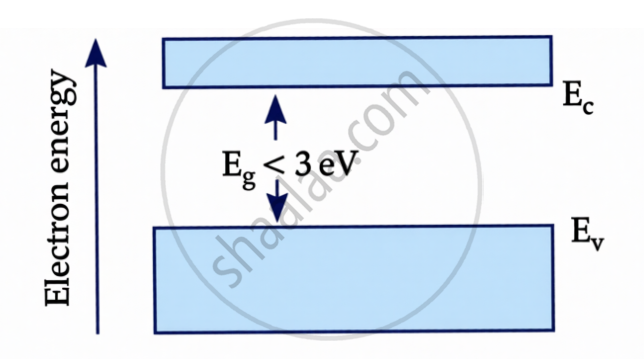 |
Key Points: Extrinsic Semiconductor
- Intrinsic semiconductors have very low conductivity at room temperature.
- Doping increases conductivity.
- A doped semiconductor is called an extrinsic semiconductor.
- The impurity added is called a dopant.
- The semiconductor receiving the impurity is called the host.
- The dopant size should be nearly the same as that of the host atom.
- Pentavalent and trivalent impurities are used as dopants.
- Extrinsic semiconductors are of two types: n-type and p-type.
Key Points: p-n Junction Diode as a Rectifier
- A rectifier is a circuit which converts an AC supply into a unidirectional DC supply.
- A p-n junction diode acts as a rectifier because it allows current to flow in one direction only.
- The bridge rectifier circuit uses semiconductor diodes for converting AC, as it allows current to flow in one direction only.
- Input to the rectifier is AC \[(V_{IN})\]; output is DC \[(V_{OUT})\] — shown as a full-wave rectified signal.
- Rectification is the fundamental principle behind power supply circuits in electronic devices.
Key Points: Electrical Materials
- Conductors have many free electrons, so electric current flows easily; insulators have almost no free electrons, so current does not flow easily.
- In conductors, resistance increases with temperature, whereas in semiconductors it decreases.
- Semiconductors have properties between conductors and insulators, and at absolute zero, they behave like insulators.
Key Points: Extrinsic Semiconductors
Key Points: Intrinsic Semiconductors
- An intrinsic semiconductor is a pure semiconductor (like silicon or germanium) without impurities.
- At low temperatures, it behaves like an insulator because all electrons are bound in covalent bonds.
- At room temperature, some bonds break and create electron–hole pairs.
- In an intrinsic semiconductor, the number of electrons equals the number of holes (ne = nh = ni).
- Its conductivity increases with temperature because more electron–hole pairs are produced.
Key Points: Electrons and Holes in Semiconductors
- Semiconductors have a small energy gap (about 1 eV) between the valence band and conduction band.
- At absolute zero, they act like insulators because the valence band is full and the conduction band is empty.
- At room temperature, some electrons move into the conduction band, leaving holes, and both contribute to conduction; conductivity increases with temperature.
Key Points: Energy Bands in Materials
Important Questions [3]
Concepts [17]
- Concept of Semiconductor Electronics
- Materials-Conductors, Insulators and Semiconductors
- Energy Bands in Materials
- Classification of Metals, Conductors and Semiconductors
- Electrons and Holes in Semiconductors
- Intrinsic Semiconductor
- Extrinsic Semiconductor
- Distinction Between Intrinsic and Extrinsic Semiconductors
- N-type VS P-type Semiconductors
- Electric Current in an Intrinsic Semiconductor
- Electric Conductivity and Resistivity of an Intrinsic Semiconductor
- Formation of P-N Junction
- Flow of Current Across Junction Diode: Forward and Reverse Biasings of Junction
- I-V characteristics in Forward and Reverse Biased P-N Junction Diode
- p-n Junction Diode as a Rectifier
- Special Purpose P-n Junction Diodes
- Overview: Semiconductor Electronics
