Definitions [2]
Any reaction that involves both oxidation and reduction occurring simultaneously is called an oxidation-reduction reaction or simply a redox reaction.
or
The chemical reaction in which both oxidation and reduction occur simultaneously is called a redox reaction.
The functional group is defined as an atom or group of atoms joined in a specific manner which is responsible for the characteristic chemical properties of the organic compounds.
Key Points
- Used for detection of: Nitrogen (N), Sulfur (S), Chlorine (Cl), Bromine (Br), Iodine (I)
- Cannot detect Fluorine (AgF is soluble, so no precipitate forms)
- Principle: Small amount of organic compound + sodium metal → fused → plunged in distilled water → boiled → filtered → Sodium Fusion Extract (SFE) obtained
- SFE is boiled with freshly prepared FeSO₄ solution, then acidified with conc. HCl, then 2–3 drops of FeCl₃ added
- Prussian blue colour confirms nitrogen
Reactions:
- FeSO₄ + 2NaOH → Fe(OH)₂ + Na₂SO₄
- 6NaCN + Fe(OH)₂ → Na₄[Fe(CN)₆] + 2NaOH
- 3Na₄[Fe(CN)₆] + 4FeCl₃ → Fe₄[Fe(CN)₆]₃ (Prussian blue) + 12NaCl
Exceptions: Test NOT given by compounds lacking C atoms that contain N (e.g., NH₂NH₂, NH₂OH) because CN⁻ ion won't form. Also NOT given by diazonium compounds.
When BOTH N and S are present:
- If Na is in insufficient amount → NaSCN (thiocyanate) forms instead of NaCN
- SCN⁻ + Fe³⁺ → [Fe(SCN)]²⁺ → Blood red colour (instead of Prussian blue)
Test 1 — Sodium nitroprusside test:
- SFE + sodium nitroprusside → Deep violet colour confirms sulfur
- S²⁻ + [Fe(CN)₅NO]²⁻ → [Fe(CN)₅NOS]⁴⁻ (violet)
Test 2 — Lead acetate test:
- SFE + acetic acid → acidify + Pb(CH₃COO)₂ → Black precipitate (PbS) confirms sulfur
- Pb(CH₃COO)₂ + S²⁻ → PbS↓ + 2CH₃COO⁻
SFE is first acidified with HNO₃ (to remove CN⁻ and S²⁻ by boiling with conc. HNO₃/glacial acetic acid), then treated with AgNO₃:
- NaCN + HNO₃ → NaNO₃ + HCN (removed)
- Na₂S + 2HNO₃ → 2NaNO₃ + H₂S↑ (removed)
| Halogen | Precipitate with AgNO₃ | Solubility in NH₄OH |
|---|---|---|
| Cl⁻ | AgCl↓ — white, curdy | Soluble |
| Br⁻ | AgBr↓ — pale yellow | Partially soluble |
| I⁻ | AgI↓ — yellow | Insoluble |
Fluorine cannot be detected by Lassaigne's test since AgF is soluble.
If N or S is present, they must be removed first to prevent interference (AgCN or Ag₂S may form).
Compound is heated with oxidising agent (sodium peroxide) → phosphorus oxidised to phosphate → solution boiled with HNO₃ → then treated with ammonium molybdate [(NH₄)₂MoO₄] + HNO₃ and boiled → canary yellow precipitate of ammonium phosphomolybdate [(NH₄)₃PO₄·12MoO₃] confirms phosphorus.
Na₃PO₄ + 3HNO₃ → H₃PO₄ + 3NaNO₃
\[ \begin{aligned} \mathrm{H}_3\mathrm{PO}_4 + \underset{\substack{\text{Ammonium} \\ \text{molybdate}}}{12(\mathrm{NH}_4)_2\mathrm{MoO}_4} + 21\mathrm{HNO}_3 \longrightarrow{} & \underset{\substack{\text{Ammonium} \\ \text{Phosphomolybdate}}}{(\mathrm{NH}_4)_3\mathrm{PO}_4 \cdot 12\mathrm{MoO}_3} \\ & + 21\mathrm{NH}_4\mathrm{NO}_3 + 12\mathrm{H}_2\mathrm{O} \end{aligned} \]
Mohr's Salt:
- Formula: FeSO₄(NH₄)₂SO₄·6H₂O (ferrous ammonium sulphate)
- Preparation: Dissolve equimolar quantities of hydrated ferrous sulphate and ammonium sulphate in water containing a small amount of dil. H₂SO₄ (to prevent hydrolysis of Fe²⁺ ions) → concentrate → cool → light blue or green crystals
- FeSO₄·7H₂O + (NH₄)₂SO₄ → FeSO₄(NH₄)₂SO₄·6H₂O + H₂O
- It is a double salt and a primary standard in volumetric analysis
- Does NOT lose water of crystallisation on exposure to air; not oxidised in the solid state
Potash Alum:
- Formula: K₂SO₄·Al₂(SO₄)₃·24H₂O → also written as KAl(SO₄)₂·12H₂O
- Preparation: Dissolve equimolar quantities of hydrated aluminium sulphate and potassium sulphate in a minimum amount of water + dil. H₂SO₄ → concentrate → cool → colourless octahedral crystals
- K₂SO₄ + Al₂(SO₄)₃·18H₂O + 6H₂O → K₂SO₄·Al₂(SO₄)₃·24H₂O (Potash Alum)
- Alums = double sulphates (general formula X₂SO₄·M₂(SO₄)₃·24H₂O, where X = monovalent cation, M = trivalent cation)
- Alums are isomorphous, crystalline, soluble in water; they undergo hydrolysis (aqueous solution is acidic)
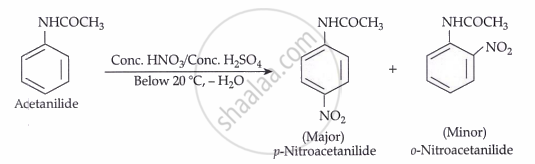
- Prepared by nitration of acetanilide with HNO₃/H₂SO₄ (below 20°C)
- The acetamido (–NHCOCH₃) group is bulky → causes steric hindrance at ortho → para product is major
- Products: p-Nitroacetanilide (major) + o-Nitroacetanilide (minor)
- On recrystallisation from ethyl alcohol: p-nitroacetanilide separates as crystals; o-isomer remains in solution
- Uses: poultry medicines, anti-oxidants, gasoline, pesticides, rubber chemicals
- Also called para-aminoazobenzene
- First azo dye obtained by coupling reaction; belongs to azo dye family (–N=N– linkage)
- Preparation:
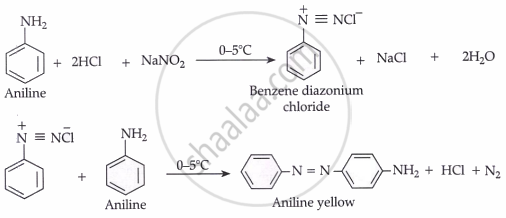
- Product: Ph–N=N–Ph–NH₂ (para-aminoazobenzene)
- Uses: pyrotechnics (yellow smoke), yellow pigments and inks (inkjet printers), insecticides, lacquers, varnishes, waxes, oil stains, styrene resins
- Titration = a definite volume of standard solution of acid (or base) is allowed to neutralise the same volume of base (or acid) solution of the same normality
- Heat of neutralisation = amount of heat evolved when 1 gram equivalent of acid completely neutralises 1 gram equivalent of base in a dilute solution
- For strong acid + strong base: H⁺(aq) + OH⁻(aq) → H₂O + 57.36 kJ
Redox Reactions:
- A substance that oxidises another substance (and is itself reduced) is called an oxidising agent.
- A substance that reduces another substance (and is itself oxidised) is called a reducing agent.
What is Oxidation and Reduction?
| Perspective | Oxidation | Reduction |
|---|---|---|
| In terms of oxygen | Gain of one or more O atoms | Loss of one or more O atoms |
| In terms of hydrogen | Loss of hydrogen | Gain of hydrogen |
| In terms of electropositive element | Loss of electropositive element | Gain of electropositive element |
| In terms of electronegative element | Gain of electronegative element | Loss of electronegative element |
| In terms of electrons | Loss of electrons | Gain of electrons |
| In terms of oxidation number | Increase in oxidation number | Decrease in oxidation number |
Redox in Terms of Electron Transfer:
A reaction in which electrons are lost by one substance and gained by another is called a redox reaction.
- Oxidising agent = electron acceptor
- Reducing agent = electron donor
Example:
(Hg₂²⁺ gains electrons → reduced; Sn²⁺ loses electrons → oxidised)
- Active H atoms = those attached to electronegative atoms like O, N, S, X, C(sp), and active methylene
- Reaction: A–H + Na → ½H₂↑ + A⁻Na⁺
- Examples that give H₂ gas:
\[ \begin{aligned} &\text{1. } \mathrm{R}-\mathrm{NH}_2 \xrightarrow{\mathrm{Na}} \mathrm{R}-\mathrm{NH}^-\mathrm{Na}^+ + \frac{1}{2}\mathrm{H}_2 \uparrow \\[1ex] &\text{2. } \mathrm{R}-\mathrm{COOH} \xrightarrow{\mathrm{Na}} \mathrm{R}-\mathrm{COO}^-\mathrm{Na}^+ + \frac{1}{2}\mathrm{H}_2 \uparrow \\[1ex] &\text{3. } \mathrm{R}-\mathrm{OH} + \mathrm{Na} \longrightarrow \mathrm{R}-\mathrm{O}^-\mathrm{Na}^+ + \frac{1}{2}\mathrm{H}_2 \uparrow \\[1ex] &\text{4. } \mathrm{R}-\mathrm{C} \equiv \mathrm{CH} + \mathrm{Na} \longrightarrow \mathrm{R}-\mathrm{C} \equiv \mathrm{C}^-\mathrm{Na}^+ + \frac{1}{2}\mathrm{H}_2 \uparrow \\[1ex] &\text{5. } \mathrm{R}-\mathrm{CH}_2-\mathrm{O}-\mathrm{CH}_3 + \mathrm{Na} \longrightarrow \text{No reaction.} \end{aligned} \] - No reaction: R–CH₂–O–CH₃ (simple ethers — no acidic H)
- Terminal alkynes (R–C≡CH): have acidic hydrogen
- With AgNO₃ in ammonia:
\[ \mathrm{R} - \mathrm{C} \equiv \mathrm{CH} \xrightarrow{\mathrm{AgNO}_3 + \mathrm{NH}_4\mathrm{OH}} \mathrm{R} - \mathrm{C} \equiv \mathrm{CAg} \downarrow + \mathrm{NH}_4\mathrm{NO}_3 \] - With ammonical Cu₂Cl₂ (Cu⁺): R – C ≡ CH → R – C ≡ C – Cu↓ → Red precipitate
- Internal alkynes do NOT react with either reagent (no acidic H)
- Acetylene (ethyne): gives both white ppt. with AgNO₃/NH₃ AND red ppt. with Cu₂Cl₂/NH₃
Cerric Ammonium Nitrate Test (Group Reagent for all alcohols):
Alcohols + (NH₄)₂[Ce(NO₃)₆] (cerric ammonium nitrate / CAN) → Red coloured complex
Lucas Test (distinguish 1°, 2°, 3°):
1° alcohol:
\[ \mathrm{R}_2\mathrm{CH} - \mathrm{OH} \xrightarrow{\text{Conc. HCl} + \text{anhyd. ZnCl}_3} \] No reaction (no turbidity at room temperature)
2° alcohol:
\[ \mathrm{R}_2\mathrm{CH} - \mathrm{OH} \xrightarrow{\text{Conc. HCl} + \text{anhyd. ZnCl}_2} \mathrm{R}_2\mathrm{CH} - \mathrm{Cl} \]
Turbidity in ~5 minutes
3° alcohol:
\[ \mathrm{R}_2\mathrm{CH} - \mathrm{OH} \xrightarrow{\text{Conc. Hcl} + \text{anhyd. ZnCl}_2} \mathrm{R}_3\mathrm{CCl} \]
Immediate turbidity
Benzyl and allyl alcohols react as rapidly as tertiary (exceptions)
Victor-Meyer's Test:
-
1° alcohol → Nitric acid derivative → red colour (with NaOH)
\[ \begin{aligned} & \mathrm{RCH}_2-\mathrm{OH} \xrightarrow{\mathrm{P}+\mathrm{I}_2} \mathrm{RCH}_2-\mathrm{I} \xrightarrow{\mathrm{AgNO}_2} \mathrm{RCH}_2-\mathrm{NO}_2 \\[1ex] & \xrightarrow{\mathrm{HONO}} \underset{\text{Nitrolic acid}}{\mathrm{R} - \underset{\underset{\displaystyle \mathrm{NOH}}{||}}{\mathrm{C}} - \mathrm{NO}_2} \xrightarrow{\mathrm{NaOH}} \underset{\text{(Blood red colouration)}}{\mathrm{R} - \underset{\underset{\displaystyle \mathrm{NO}^- \mathrm{Na}^+}{||}}{\mathrm{C}} - \mathrm{NO}_2} \end{aligned} \] -
2° alcohol → blue colour
\[ \begin{aligned} & \mathrm{R}_2\mathrm{CHOH} \xrightarrow{\mathrm{P}+\mathrm{I}_2} \mathrm{R}_2\mathrm{CH} - \mathrm{I} \xrightarrow{\mathrm{AgNO}_2} \mathrm{R}_2\underset{\underset{\displaystyle \mathrm{N=O}}{|}}{\mathrm{CH}} - \mathrm{NO}_2 \\[1ex] & \xrightarrow{\mathrm{HONO}} \mathrm{R}_2\mathrm{C} - \mathrm{NO}_2 \xrightarrow{\mathrm{NaOH}} \text{Blue colouration} \end{aligned} \] -
3° alcohol → no colour
\[ \begin{aligned} & \mathrm{R}_3\mathrm{C} - \mathrm{OH} \xrightarrow{\mathrm{P} + \mathrm{I}_2} \mathrm{R}_3\mathrm{C} - \mathrm{I} \xrightarrow{\mathrm{AgNO}_2} \mathrm{R}_3\mathrm{H} - \mathrm{NO}_2 \\[1ex] & \xrightarrow{\mathrm{HONO}} \text{No reaction} \xrightarrow{\mathrm{NaOH}} \text{Colourless} \end{aligned} \]
Iodoform Test:
- Organic Compounds + 4I₂ + 6NaOH → yellow ppt.
The above reaction is known as the Iodoform test. - Positive for: CH₃CHO (ethanal), CH₃COCH₃ (acetone), CH₃CHOH–R (2° alcohols with CH₃CHOH–), ethanol only among primary alcohols (CH₃CH₂OH)
- Diethyl ketone does NOT give iodoform test
- To give iodoform: must contain CH₃CO– or CH₃CHOH– group
FeCl₃ Test:
-
Phenol + neutral FeCl₃ solution → violet colour (iron phenoxide complex)
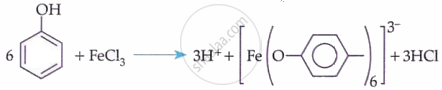
-
Note: m, p-hydroxy benzoic acid and di/trinitrophenols DO NOT give this test; alcohols do not give this test either
Bromine Water Test:
Phenol + Br₂ water → white precipitate of 2,4,6-tribromophenol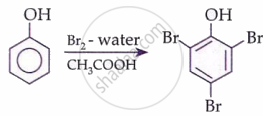
Liebermann's Nitroso Reaction:
-
Phenol + NaNO₂ + conc. H₂SO₄ → deep green or blue colour (changes to red on dilution with water; alkaline with NaOH → original green/blue restored)
-
Used as a test for phenol.
Azo dye formation / Azo-dye test:
- 1° aromatic amines + NaNO₂ + HCl → diazonium salt → coupled with β-naphthol in alkaline solution → orange-red azo dye
- Also confirms phenols (phenol is the coupling partner)
| Test | Reagent | Observation | Inference |
|---|---|---|---|
| Schiff's Reagent test | Dilute solution of rosaniline hydrochloride (pink discharged by SO₂) | Violet/pink (magenta) colour within 2 minutes | Aldehyde present |
| Tollen's Reagent | [Ag(NH₃)₂]OH (ammoniacal AgNO₃) | Silver mirror / black precipitate | Aldehyde present |
| Fehling's Solution test | CuSO₄ + alkaline sodium potassium tartrate | Red–brown crystals of Cu₂O | Aldehyde present |
| Benedict's Solution | CuSO₄ + alkaline sodium citrate | Red-brown precipitate (Cu₂O) | Aldehyde present |
| Sodium bisulphite | Saturated NaHSO₃ solution | White crystalline precipitate | Aldehyde present |
Tests for Acids (Carboxylic acids):
| Test | Observation | Inference |
|---|---|---|
| NaHCO₃ test | Brisk CO₂ effervescence | Presence of –COOH (acid) |
| Fluorescein reaction | Heated with conc. H₂SO₄ + Resorcinol → red solution with intense green fluorescence | Dicarboxylic acid |
| Anhydride formation | White shiny needles on sides of inverted funnel | Dicarboxylic acid |
Distinction: Alcohol vs Phenol vs Carboxylic Acid:
- Alcohol: reacts with Na → H₂ gas; does NOT react with NaOH or NaHCO₃
- Phenol: reacts with Na + NaOH → H₂; does NOT react with NaHCO₃
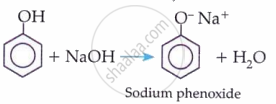
- Carboxylic acid: reacts with Na, NaOH, and NaHCO₃ (gives CO₂)
Tests for Esters:
- \[ \mathrm{RCOOR}' + \mathrm{NaOH} + \text{Phenolphthalein (Pink)} \xrightarrow{\Delta} \mathrm{RCOOH} + \mathrm{R}'\mathrm{OH} \text{ (Colorless solution)} \]
- Esters have sweet/fruity smell
Test for Acid amide:
Acid amides (1°) give smell of ammonia when with alkali.
\[ \mathrm{R} - \overset{\displaystyle \mathrm{O}}{\overset{||}{\mathrm{C}}} - \mathrm{NH}_2 \xrightarrow[\Delta]{\mathrm{NaOH}} \mathrm{R} - \overset{\displaystyle \mathrm{O}}{\overset{||}{\mathrm{C}}} - \mathrm{ONa} + \mathrm{NH}_3 \]
NaNO₂ + aq. HCl Test:
-
1° Aliphatic amine:
\[ \mathrm{R} - \mathrm{CH}_2\mathrm{NH}_2 \xrightarrow{\mathrm{NaNO}_2 + \text{aq, HCl}} \mathrm{R} - \mathrm{CH}_2 - \mathrm{OH} + \mathrm{N}_2 \uparrow \] -
1° Aromatic amine:
\[ \mathrm{Ph} - \mathrm{NH}_2 \xrightarrow[(0-5^\circ\mathrm{C})]{\mathrm{NaNO}_2 + \text{aq. HCl}} \mathrm{Ph} - \overset{+}{\mathrm{N}}_2\overset{\ominus}{\mathrm{Cl}} \text{ (diazonium salt)} \] -
All secondary amine give yellow oily liquid with nitrous acid i.e. NaNO₂ + HCI
\[ 2^\circ \text{ Amine \%: } \mathrm{R} - \mathrm{NH} - \mathrm{R} \xrightarrow{\mathrm{NaNO}_2 + \text{aq. HCl}} \mathrm{R}_2\mathrm{N} - \mathrm{NO} \]
yellow oily liquid (N-Nitroso amine)
\[ 3^\circ \text{ Amine: } \mathrm{R}_3\mathrm{N} \xrightarrow{\mathrm{NaNO}_2 + \text{aq. HCl}} \text{unstable nitrite} \]
Carbylamine Test (Isocyanide Test):
-
Only 1° amines give this test
-
\[ \mathbf{1^\circ \text{ Amine : }} \mathrm{R} - \mathrm{CH}_2 - \mathrm{NH}_2 \xrightarrow{\mathrm{CHCl}_3 + \mathrm{KOH}} \mathrm{R} - \mathrm{CH}_2 - \mathrm{N} \equiv \mathrm{C} + 3\mathrm{KCl} + 3\mathrm{H}_2\mathrm{O} \text{ (unpleasant smell of isocyanide)} \]
-
\[ \mathrm{Ph} - \mathrm{NH}_2 \xrightarrow{\mathrm{CHCl}_3 + \mathrm{KOH}} \mathrm{Ph} - \mathrm{N} \equiv \mathrm{C} \]
-
2° and 3° amines do NOT give this test
Hofmann Mustard Oil Test (CS₂ test):
Test for 1° amine and aniline

2° amine reacts with CS2

3° amine + CS₂ → no reaction
Hinsberg Reagent (Benzenesulphonyl chloride, C₆H₅SO₂Cl):
-
1° amine:
\[ \mathrm{R} - \mathrm{NH}_2 + \mathrm{PhSO}_2\mathrm{Cl} \xrightarrow{\text{Pyridine}} \mathrm{R} - \mathrm{NH} - \mathrm{SO}_2 - \mathrm{Ph} \xrightarrow{\text{Base}} \text{Compound is soluble in base.} \] -
2° amine:
\[ \mathrm{R}_2\mathrm{NH} + \mathrm{PhSO}_2\mathrm{Cl} \xrightarrow{\text{Pyridine}} \mathrm{R}_2\mathrm{N} - \mathrm{SO}_2 - \mathrm{Ph} \xrightarrow{\text{Base}} \text{Compound is insoluble in base.} \] -
3° amine:
\[ \mathrm{R}_3\mathrm{N} + \mathrm{PhSO}_2\mathrm{Cl} \xrightarrow{\text{Pyridine}} \text{No reaction.} \]
Azo-dye test:
1° aromatic amines + NaNO₂ + HCl → diazonium salt → couple with alkaline β-naphthol → orange-red dye
Used to detect the presence of nitro group (–NO₂)
\[ \mathrm{R} - \mathrm{NO}_2 \xrightarrow[\Delta]{\mathrm{Zn} - \mathrm{NH}_4\mathrm{Cl}} \mathrm{R} - \mathrm{NHOH} \xrightarrow[\text{T.R.}]{\mathrm{AgNO}_3 + \mathrm{NH}_4\mathrm{OH}} \underset{\text{black ppt}}{\mathrm{Ag} \downarrow} \]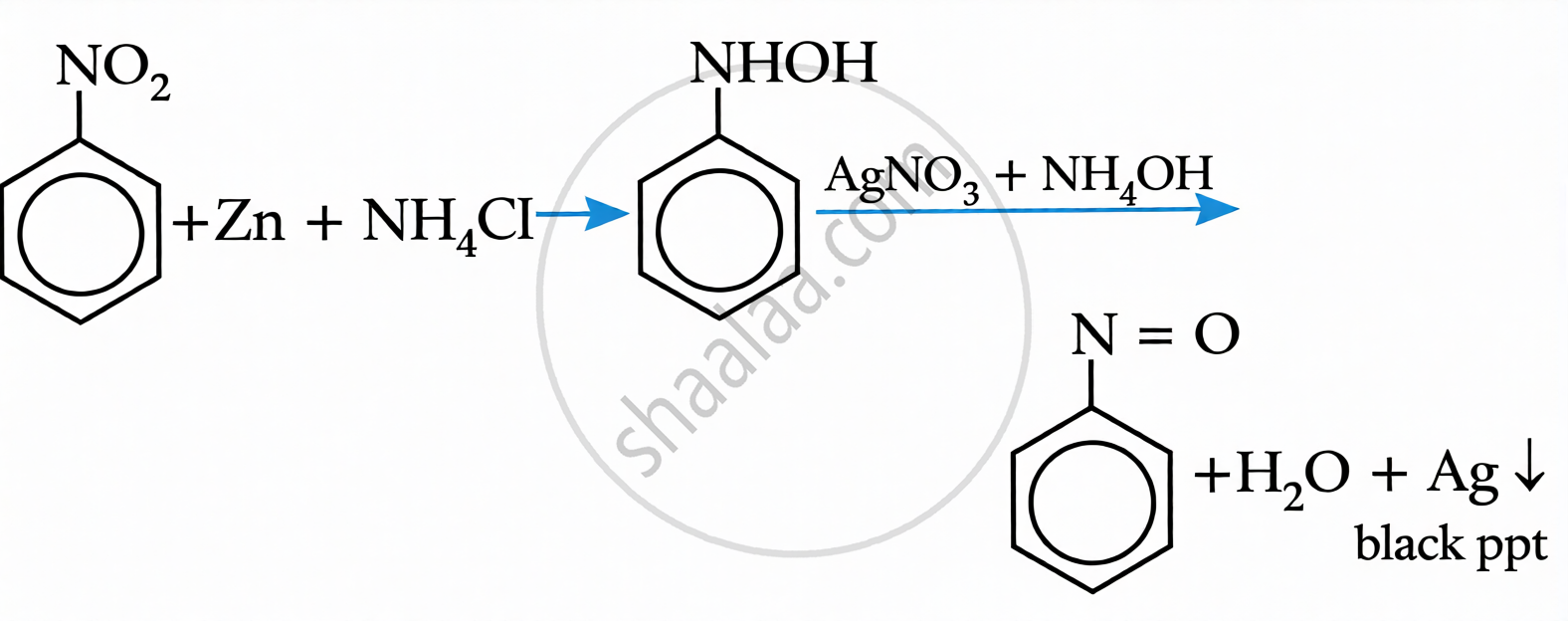
This is also called Mulliken's test
Molisch test:
Molisch's test is a chemical test that detects the presence of carbohydrates in a sample.
- One or two drops of an alcoholic solution of α-naphthol are added to 2 mL of glucose solution.
- 1 mL of conc. H2SO4 solution is added carefully along the sides of the test tube.
The formation of a violet ring at the junction of two liquids confirms the presence of a carbohydrate or sugar.
Ninhydrin Test:
- Amino acids react with ninhydrin at pH = 4 → purple (violet) colour
- Proline and hydroxyproline → yellow colour (exception)
Xanthoproteic Test:
- \[ \text{Solution} \xrightarrow{\mathrm{HNO}_3} \text{Yellow colour} \xrightarrow{\mathrm{NaOH}} \text{orange - yellow color} \]
- Detects amino acids with phenolic or indole groups: tyrosine, tryptophan, phenylalanine, glutamic acid
Millon's Test:
-
Millon's reagent = mixture of Hg(NO₃)₂ and Hg(NO₂)₂
-
\[ \text{Solution} \xrightarrow{\text{Millon's agent}} \text{white precipitate} \xrightarrow{\text{boiling}} \text{brick - red color} \]
-
Detects proteins/amino acids with phenolic –OH group (e.g., tyrosine, phenylalanine, β-naphthol)
-
Not specific to proteins; positive for any phenolic compound
Biuret Test:
-
\[ \text{Protien} + \mathrm{CuSO}_4 \xrightarrow{\mathrm{NaOH}} \text{Copper cation complex (purple to violet)} \]
-
Detects peptide bonds (not for amino acids alone)
-
Examples: gelatin, casein, albumin
Group A (Dil. H₂SO₄ Test):
| Observation | Gas | Anion |
|---|---|---|
| Colourless, odourless gas; turns lime water milky | CO₂ | CO₃²⁻, HCO₃⁻ |
| Colourless gas, sulphur smell; turns K₂Cr₂O₇ paper green | SO₂ | SO₃²⁻ |
| Colourless gas, rotten egg smell; turns lead acetate paper black | H₂S | S²⁻ |
| Pungent reddish-brown gas; turns starch-iodide paper blue | NO₂ | NO₂⁻ |
| Colourless gas, vinegar smell | CH₃COOH | CH₃COO⁻ |
Group B (Conc. H₂SO₄ Test):
| Observation | Gas | Anion |
|---|---|---|
| White fumes with a glass rod dipped in NH₃; pungent smell | HCl | Cl⁻ |
| Reddish-brown fumes; intensity increases with MnO₂ | Br₂ | Br⁻ |
| Violet vapours; turn starch paper blue | I₂ | I⁻ |
| Brown fumes; increase with Cu turnings; + FeSO₄ + H₂SO₄ → brown ring | NO₂ | NO₃⁻ |
| Colourless gas turns lime water milky; burns with blue flame at CaCl₂ | C₂O₄²⁻ gas | C₂O₄²⁻ |
Group III Anions (SO₄²⁻, PO₄³⁻): No gas with dil. HCl or conc. H₂SO₄ → detected by precipitation.
| Anion | Confirmatory Test | Observation |
|---|---|---|
| CO₃²⁻ | Add MgSO₄ to the water extract | White precipitate |
| SO₃²⁻ | Add BaCl₂ to water extract → add dil. HCl | White ppt. disappears on adding HCl |
| S²⁻ | (i) Sodium nitroprusside (ii) Lead acetate | (i) Purple/violet (ii) Black precipitate |
| NO₂⁻ | Boil with dil. H₂SO₄ + KI + starch | Deep blue colour |
| Cl⁻ | AgNO₃ to water extract | White ppt. soluble in NH₄OH |
| Br⁻ | AgNO₃ to water extract | Yellow ppt. partially soluble in NH₄OH |
| I⁻ | AgNO₃ to water extract | Yellow ppt. insoluble in NH₄OH |
| NO₃⁻ | FeSO₄ solution + one drop conc. H₂SO₄ (side of test tube) | Brown ring at the junction |
| CH₃COO⁻ | Conc. H₂SO₄ + ethanol | Fruity smell (ester formation) |
| C₂O₄²⁻ | Acetic acid + CaCl₂ → water extract | White ppt. dissolves in dil. HNO₃ |
| SO₄²⁻ | BaCl₂ to water extract | White ppt. insoluble in conc. HCl |
| PO₄³⁻ | dil. HNO₃ + ammonium molybdate + boil | Yellow crystalline ppt. |
| Group | Cations | Group Reagent | Precipitate Colour |
|---|---|---|---|
| 0 (Zero) | NH₄⁺ | Dil. NaOH (heat) | NH₃ gas (no ppt.) |
| I | Pb²⁺, Ag⁺, Hg₂²⁺ | Dil. HCl | White (PbCl₂, AgCl, Hg₂Cl₂) |
| IIA | Hg²⁺, Pb²⁺, Bi³⁺, Cu²⁺, Cd²⁺ | H₂S in presence of dil. HCl | Black (HgS, PbS, Bi₂S₃, CuS), Yellow (CdS) |
| IIB | As³⁺, Sb³⁺, Sn²⁺, Sn⁴⁺ | H₂S in presence of dil. HCl | Yellow (As₂S₃), Orange (Sb₂S₃), Brown (SnS), Yellow (SnS₂) |
| III | Fe³⁺, Al³⁺, Cr³⁺ | NH₄OH in presence of NH₄Cl | Red-brown [Fe(OH)₃], White [Al(OH)₃], Green [Cr(OH)₃] |
| IV | Co²⁺, Ni²⁺, Mn²⁺, Zn²⁺ | H₂S in presence of NH₄OH | Black (CoS, NiS), Buff/Dirty pink (MnS), White (ZnS) |
| V | Ca²⁺, Sr²⁺, Ba²⁺ | (NH₄)₂CO₃ in presence of NH₄OH | White (CaCO₃, SrCO₃, BaCO₃) |
| VI | Mg²⁺ | Na₂HPO₄ | White [Mg(NH₄)PO₄] |
Test: Salt + NaOH → heat → NH₃ gas evolved (pungent smell; turns moist red litmus blue)
Nessler's Reagent test: NH₄Cl + NaOH →(Δ)→ NH₃ + NaCl + H₂O
- NH₃ + Nessler's reagent (K₂HgI₄ + KOH) → yellow–brown precipitate (iodide of Millon's base)
- [OHg₂NH₂]I (brown ppt.)
Paper soaked in CuSO₄ solution becomes deep blue due to complex with NH₃: CuSO₄ + 4NH₃ → [Cu(NH₃)₄]SO₄
Analysis of Group I Cations (Pb²⁺, Ag⁺, Hg₂²⁺):
Reagent: dil. HCl; precipitate: AgCl, PbCl₂, Hg₂Cl₂ (all white)
PbCl₂ is soluble in hot water (distinguishes Pb²⁺ from Ag⁺ and Hg₂²⁺)
On residue (AgCl + Hg₂Cl₂): add NH₄OH:
- Ag⁺ → Ag(NH₃)₂Cl (soluble, colourless)
- Hg₂²⁺ → Hg + Hg(NH₂)Cl (black precipitate)
Test for Pb²⁺:
- K₂CrO₄ → yellow ppt. of PbCrO₄ (soluble in hot NaOH)
- KI → yellow ppt. of PbI₂ (reversible on cooling)
- dil. H₂SO₄ → white ppt. of PbSO₄
- H₂S → black ppt. of PbS
- NH₃ solution → white ppt. of Pb(OH)₂ (soluble in excess NaOH → [Pb(OH)₄]²⁻, amphoteric)
Group IIA (HgS, PbS, CuS, Bi₂S₃, CdS):
Dissolve in dil. HNO₃ → then dil. H₂SO₄ → Pb²⁺ precipitates as PbSO₄ (white)
Remaining sulphates of Bi³⁺, Cu²⁺, Cd²⁺ → NH₄OH (excess):
- Bi³⁺ → white Bi(OH)₃ precipitate
- Cu²⁺ → deep blue [Cu(NH₃)₄]SO₄ (tetramminecopper II) — confirms Cu²⁺
- Cd²⁺ → colourless solution → add H₂S → yellow CdS precipitate
Test for Cu²⁺ Ion:
- With NH₃ (excess): deep blue solution (tetrammine copper II complex)
- With K₄[Fe(CN)₆]: chocolate brown ppt. of Cu₂[Fe(CN)₆]
- With KCN (sparingly): yellow ppt. of Cu(CN)₂ (quickly decomposes → Cu₂(CN)₂; excess KCN → colourless [CuCN₄]³⁻)
- With NaOH (cold): blue ppt. of Cu(OH)₂ → heated → black CuO
- With KI: white CuI ppt. (intensely brown due to I₃⁻ formation)
Group IIB (As₂S₃, As₂S₅, Sb₂S₃, SnS, SnS₂):
- Soluble in yellow ammonium sulphide [(NH₄)₂Sx]
- Distinction: As₂S₃ insoluble in conc. HCl; Sb₂S₃ and SnS₂ soluble in conc. HCl
Analysis of Group III Cations (Fe³⁺, Al³⁺, Cr³⁺):
- Group reagent: NH₄OH in presence of NH₄Cl
- Precipitates: Al(OH)₃ (white), Fe(OH)₃ (red-brown), Cr(OH)₃ (green, cotton-like)
- Add H₂O + Na₂O₂ to filtrate: Cr³⁺ oxidised → CrO₄²⁻ (yellow filtrate) confirms Cr
- Only Al(OH)₃ and Cr(OH)₃ are soluble in NaOH (amphoteric); Fe(OH)₃ is insoluble
Test for Fe³⁺ Ion:
- KCNS (potassium thiocyanate): Fe³⁺ + SCN⁻ → [Fe(SCN)]²⁺ → blood red colour
- K₄[Fe(CN)₆] (potassium ferrocyanide): 4FeCl₃ + 3K₄[Fe(CN)₆] → Fe₄[Fe(CN)₆]₃ → Prussian blue (insoluble in dil. acids; NaOH converts to Fe(OH)₃ red + [Fe(CN)₆]³⁻)
Test for Al³⁺ Ion:
- Ammonium sulphide: 2Al³⁺ + 3S²⁻ + 6H₂O → 2Al(OH)₃↓ + 3H₂S (white ppt.) → litmus paper turns red (acidic H₂S)
- Lake test: Al(OH)₃ + blue litmus indicator → adsorbs blue dye → blue floating mass in colourless liquid (called "lake")
NH₄NO₃ cannot replace NH₄Cl in Group III because NO₃⁻ ions will oxidise Mn²⁺ → Mn⁴⁺ → MnO₂ precipitate (Mn will then precipitate in Group III instead of IV)
(NH₄)₂SO₄ cannot replace NH₄Cl because SO₄²⁻ will precipitate barium as BaSO₄ in Group V
Analysis of Group IV Cations (Zn²⁺, Mn²⁺, Ni²⁺, Co²⁺):
- Group reagent: H₂S in presence of NH₄OH
- Precipitate colours: ZnS (white), MnS (buff/dirty pink), NiS (black), CoS (black)
Test for Zn²⁺ ion:
- ZnCl₂ + 2NaOH → Zn(OH)₂↓ (white ppt.) → soluble in excess NaOH → Na₂ZnO₂ (confirms Zn²⁺)
- Pass H₂S → white ZnS ppt. forms
- K₄[Fe(CN)₆] after neutralisation with NH₄OH → white or bluish white ppt. of zinc ferrocyanide
Test for Ni²⁺ ion:
- NiS (black) dissolves in aqua regia: NiS + 4HNO₃ + 6HCl → NiCl₂ + NO + ...
- Dimethylglyoxime (DMG) added after making alkaline with NH₄OH → brilliant red precipitate (Ni–DMG complex)
Test for Mn²⁺ ion:
- Mn(OH)₂ (white ppt.) with NaOH
- NaHCO₃ + heat → MnCO₃ → NaOH + Br₂ → boil → black ppt. of Mn₂O₃ (MnO₂)
Analysis of Group V Cations (Ba²⁺, Ca²⁺, Sr²⁺):
- Group reagent: (NH₄)₂CO₃ in presence of NH₄OH
- All precipitate as white carbonates (BaCO₃, CaCO₃, SrCO₃)
- Dissolve in CH₃COOH + add K₂CrO₄ → yellow ppt. of BaCrO₄ (Ba²⁺ confirmed); SrCO₃ and CaCO₃ remain
- Test for Ba²⁺: K₂CrO₄ → yellow BaCrO₄↓; also (NH₄)₂SO₄ → white BaSO₄ (insoluble even in conc. HNO₃)
- Test for Sr²⁺: dissolve ppt. in CH₃COOH + NH₄OH + (NH₄)₂SO₄ → white SrSO₄ precipitate
- Test for Ca²⁺: (NH₄)₂C₂O₄ (ammonium oxalate) → white CaC₂O₄ precipitate; CaC₂O₄ soluble in dil. HCl → solution + K₄[Fe(CN)₆] → white ppt. of calcium potassium ferrocyanide
Flame Test:
- Ba²⁺ → Green flame
- Sr²⁺ → Crimson red flame
- Ca²⁺ → Brick red flame
- A known weight of solid CuSO₄·5H₂O is dissolved in a known volume of water in a calorimeter
- Temperature change is noted
- If Q = heat absorbed when 1 g of solid CuSO₄·5H₂O is dissolved: heat of solution = Q/w × M × 4.184 J/mol
(where M = molar mass of CuSO₄·5H₂O) - In this experiment: 1 mole of solute dissolved per 400 moles of water; 7.0 g CuSO₄ dissolved in 200 mL of water.
- Heat of neutralisation = amount of heat evolved when 1 g equivalent of acid completely neutralises 1 g equivalent of base in dilute solution
- H⁺(aq) + OH⁻(aq) → H₂O + 57.36 kJ (for all strong acid–strong base reactions, same value)
- Method: definite volume of standard HCl solution is neutralised with same volume of NaOH of same normality in a thermos flask → temperature rise noted with 1/10th degree thermometer
- Heat evolved = calculated → heat of 1 gram equivalent neutralisation extrapolated
- Crystalloids: Crystalline in nature; dissolved state → easily pass through the vegetable/animal membrane; e.g., NaCl, urea, sugar → form true solutions
- Colloids: Non-crystalline; do NOT diffuse or diffuse slowly through membranes; e.g., starch, ghee, gelatin → form colloidal solutions
- Colloidal particle size: 1–100 nm (can pass through filter paper but NOT parchment/animal membrane)
- True solution particle size: < 1 nm (pass through filter paper AND parchment membrane)
- Suspension particle size: > 100 nm (cannot pass through filter paper)
- Colloidal solution = heterogeneous mixture of dispersed phase (1–100 nm particles) in dispersion medium
- Dispersed phase = component present in small proportion (colloidal dimension particles)
- Dispersion medium = medium in which colloidal particles are dissolved
- Example: sulphur in water → sulphur = dispersed phase; water = dispersion medium
- 8 types of colloids are possible based on the physical state of both phases (gas cannot form a colloid with gas, as a mixture is always homogeneous)
| Feature | Lyophilic Sols | Lyophobic Sols |
|---|---|---|
| Meaning | "solvent-loving" | "solvent-hating" |
| Affinity | High affinity for dispersion medium | No affinity for dispersion medium |
| Formation | Direct mixing (intrinsic colloids) | By indirect methods (extrinsic colloids) |
| Stability | Stable; not easily coagulated | Less stable; easily coagulated by electrolytes/heating |
| Examples | Starch, gum, albumin | As₂S₃, Fe(OH)₃, gold |
| Reversibility | Can be brought back to colloidal state by agitating with dispersion medium (reversible) | Cannot be brought back easily (irreversible) |
| Water as a medium | Hydrophilic sols | Hydrophobic sols |
| Stabiliser needed | No | Yes (stabilising substance needed) |
In acidic medium: H₂O₂ + 2I⁻ + 2H⁺ → I₂ + 2H₂O (H₂O₂ oxidises I⁻ to I₂)
The iodine produced is immediately reduced back by sodium thiosulfate:
- I₂ + 2S₂O₃²⁻ → S₄O₆²⁻ + 2I⁻
This continues until all S₂O₃²⁻ is consumed
- After that, any I₂ produced reacts with starch → deep blue complex (I₂ + starch → blue)
- Time for blue colour to appear indicates the rate of I₂ formation → clock reaction
- The rate of reaction changes with a change in the concentration of iodide ions
- As the thiosulphate amount added is fixed and the time for blue colour is measured → rate of I₂ production is determined
Concepts [46]
- Detection of Elements: Lassaigne's Test
- Detection of Nitrogen
- Detection of Sulfur
- Detection of Halogen
- Detection of Phosphorus
- Chemistry Involved in Preparation of Inorganic Compounds
- p-Nitro Acetanilide
- Aniline Yellow
- Titration
- Concept of Redox Reactions
- Redox Titrations
- Tests for Acidic Hydrogen and Unsaturation
- Distinguishing Test of Terminal and Non-Terminal Alkynes
- Detection of Alcohols
- Iodoform Test
- Detection of Phenols
- Tests for Aldehydes
- Tests for Acids, Esters and Amides
- Test for Amines
- Hofmann Mustard Oil Test
- Hinsberg Reagent
- Mulliken- Barker's Test: Test of Nitro group
- Test for Carbohydrates and Sugars
- Test for Proteins
- Tests for Ketones
- Tests for Aromatic Alcohol (Phenol)
- Identification of Functional Groups
- Qualitative Analysis> Systematic Analysis of Anions
- Confirmatory Test for Anions
- Analysis of Cations
- Analysis of Zero Group Cation
- Analysis of Group-I Cations
- Analysis of Group-II Cations
- Analysis of Group-II A Cations
- Analysis of Group-II B Cations
- Analysis of Group-III Cations
- Analysis of Group-IV Cations
- Analysis of Group-V Cations
- Analysis of Group-VI Cations
- Confirmatory Tests for Cations
- Enthalpy of Solution of Solid Copper Sulphate
- Enthalpy of Neutralisation of a Strong Acid with Strong Base
- Crystalloids and Colloids
- Dispersed Phase and Dispersion Medium
- Lyophilic and Lyophobic Sols
- Study of Rate of Reaction between Hydrogen peroxide and Iodine Ion
