Definitions [6]
A secant is a straight line that passes through the circle and intersects it at two distinct points.

line AB cuts the circle at points M and N ⇒ AB is a secant.
A tangent is a straight line that touches a circle at exactly one point only, without cutting through it. This single point where the tangent touches the circle is called the point of contact or point of tangency.
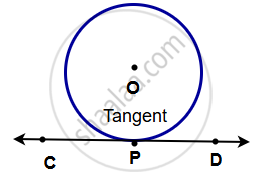
Line CD touches the circle at point P only ⇒ CD is a tangent
Point P is the point of contact.
Central Angle: An angle whose vertex is the centre of the circle is called a central angle.
Two circles are touching if they intersect at exactly one point.
Types:
-
Externally touching circles
Distance between centres = sum of radii -
Internally touching circles
Distance between centres = difference of radii
An inscribed angle is an angle whose vertex lies on the circle and whose arms intersect the circle at two other distinct points.
The arc of the circle intercepted by the arms of the angle is called the intercepted arc of the inscribed angle.
Theorems and Laws [5]
If AB and CD are the common tangents in the circles of two unequal (different) radii, then show that seg AB ≅ seg CD.
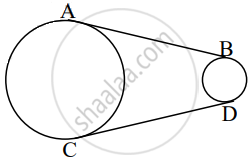
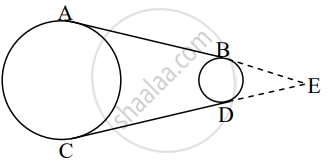
Given: AB and CD are tangents to both circles.
To prove: seg AB ≅ seg CD
Construction: Extend seg AB and seg CD to intersect each other at point E, such that A – B – E, C – D – E.
Proof: In above figure,
`{:(AE = CE),(BE = DE):}}` ...(i) [Tangent segment theorem]
Consider, AE = CE
∴ AB + BE = CD + DE ...[A – B – E, C – D – E]
∴ AB + DE = CD + DE ...[From (i)]
∴ AB = CD
∴ seg AB ≅ seg CD
Prove the following theorem:
Tangent segments drawn from an external point to the circle are congruent.

Given: A is the center of the circle. Tangents through external point D touch the circle at the points P and Q.
To prove: seg DP ≅ seg DQ
Construction: Draw seg AP, seg AD, and seg AQ.
Proof: In ΔPAD and ΔQAD,
seg PA ≅ seg QA ...[Radii of the same circle]
seg AD ≅ seg AD ...[Common side]
∠APD = ∠AQD = 90° ...[Tangent theorem]
∴ ΔPAD ≅ ΔQAD ...[By Hypotenuse side test]
∴ seg DP ≅ seg DQ ...[Corresponding sides of congruent triangles]
In the given figure, chord AB ≅ chord CD, Prove that, arc AC ≅ arc BD.
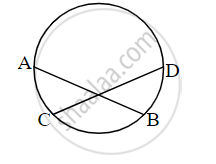
Chord AB ≅ Chord CD ...(Given)
∴ Arc ACB ≅ Arc CBD ...(Arcs corresponding to congruent chords.)
∴ m(arc ACB) = m(arc CBD) ...(1)
But m(arc ACB) = m(arc AC) + m(arc CB) ...(2)
and m(arc CBD) = m(arc CB) + m(arc BD) ...(3)
From (1), (2) and (3), we get,
m(arc AC) + m(arc CB) = m(arc CB) + m(arc BD)
∴ m(arc AC) = m(arc BD)
∴ arc AC ≅ arc BD
Hence, proved.
Chords Intersecting Inside:
AE × EB = CE × ED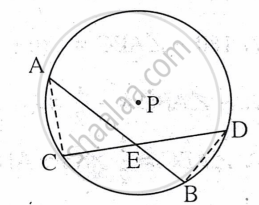
Chords Intersecting Outside:
AE × EB = CE × ED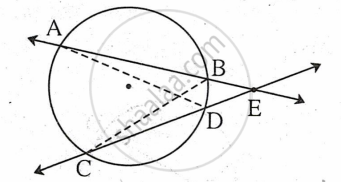
Tangent–secant segments:
EA × EB = ET2
Statement:
The measure of an inscribed angle is half of the measure of the arc intercepted by it.
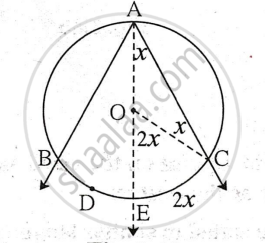
Measure of an inscribed angle = `1/2` × measure of intercepted arc
- Angles inscribed in the same arc are congruent.
- An angle inscribed in a semicircle is a right angle.
Key Points
-
Arc Definition: An arc is a curved portion of a circle's circumference between two points.
-
Two Types: Minor arc (< 180°) and Major arc (> 180°).
-
Semicircle: When the arc angle is exactly 180°, it's called a semicircle.
-
Complete Circle: Minor arc + Major arc = 360° (complete circumference).
A cyclic quadrilateral: All four vertices lie on the same circle
Key properties:
-
Opposite angles are supplementary
-
Exterior angle = interior opposite angle
Two arcs are congruent if:
-
They belong to the same or congruent circles
-
They have equal radii
-
They have equal measures
Congruent arcs ⇔ congruent chords
-
An angle whose vertex is the centre of a circle is called a central angle.
-
Measure of minor arc = measure of its central angle
-
Measure of major arc = 360° − minor arc
- The measure of a semicircle is 180°
-
Full circle = 360°
1) Chords intersect inside the circle
Angle = `1/2` (sum of intercepted arcs)
(2) Secants intersect outside the circle
Angle = `1/2`(difference of intercepted arcs)
(3) Tangent–secant angle
Angle = `1/2` (intercepted arc)
These concepts unify angles + arcs.
Important Questions [11]
- Choose the Correct Alternative: If the Points, A, B, C Are Non-collinear Points, Then How Many Circles Can Be Drawn Which Passes Through Points A, B, and C?
- In the Above Figure, the Circles with P, Q, and R Intersect at Points B, C, D, and E as Shown. Lines Cb and Ed Intersect in Point M. Lines Are Drawn from Point M to Touch
- The Perpendicular Height of a Cone is 12 Cm and Its Slant Height is 13 Cm. Find the Radius of the Base of the Cone.
- Prove the following theorem: Tangent segments drawn from an external point to the circle are congruent.
- In the given figure, M is the centre of the circle and seg KL is a tangent segment. L is a point of contact. If MK = 12, KL = 63, then find the radius of the circle.
- Prove that, tangent segments drawn from an external point to the circle are congruent.
- A circle touches side BC at point P of the ΔABC, from outside of the triangle. Further extended lines AC and AB are tangents to the circle at N and M respectively.
- In the given figure, m(arc NS) = 125°, m(arc EF) = 37°, find the measure ∠NMS.
- Chord AB and chord CD of a circle with centre 0 are congruent. If m(arc AB) = 120°, then find the m(arc CD).
- In the figure given above, O is the centre of the circle. Using given information complete the following table: Type of arc Name of the arc Measure of the arc Minor arc □ □ Major arc □ □
- Find the Equation of a Lined Passage Through (3,6) and Making Intercepts Equal Magnitude but Opposite in Sign-on Both the Axes.
Concepts [17]
- Properties of Chords of a Circle
- Circles Passing Through One, Two, Three Points
- Secant and Tangent
- Tangent Theorem
- Tangent Segment Theorem
- Touching Circles
- Arc of the Circle
- Central Angle and the Measure of an Arc
- Congruence of Arcs
- Property of Sum of Measures of Arcs
- Inscribed Angle & Intercepted Arc
- Cyclic Quadrilateral
- Overview of Circle
- Theorem of Angle between Tangent and Secant
- Theorem of Internal Division of Chords
- Theorem of External Division of Chords
- Tangent Secant Segments Theorem
