Definitions [10]
If A and B are non-singular square matrices of the same order such that AB = BA = I (where I is the identity matrix of the same order as A and B), then A and B are called inverses of each other.
We write A⁻¹ = B and B⁻¹ = A.
i.e. AA⁻¹ = A⁻¹A = I.
- If |A| ≠ 0, then A⁻¹ exists.
- If the inverse of a square matrix exists, then it is unique. A matrix can not have more than one distinct inverse.
The adjoint of A is defined as the transpose (i.e. interchange rows and columns) of the cofactor matrix, and it is denoted by adj (A).
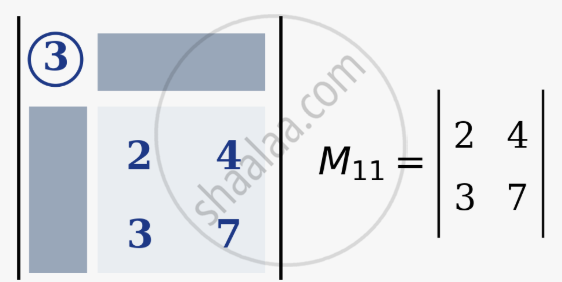
Let A = [aij] be a square matrix of order n. Then, the cofactor Cij (or Aij) of aij in A is (−1)i+j times Mij, where Mij is the minor of aij in A.
∴ Cij = (−1)i+j Mij
Let A = [aij] be a square matrix of order n. Then, the minor Mij of aij in A is the determinant obtained by deleting the ith row and the jth column in which element aij lies. It is denoted by Mij of A.
The adjoint of A is defined as the transpose (i.e. interchange rows and columns) of the cofactor matrix, and it is denoted by adj (A).
If A and B are non-singular square matrices of the same order such that AB = BA = I (where I is the identity matrix of the same order as A and B), then A and B are called inverses of each other.
We write A⁻¹ = B and B⁻¹ = A.
i.e. AA⁻¹ = A⁻¹A = I.
- If |A| ≠ 0, then A⁻¹ exists.
- If the inverse of a square matrix exists, then it is unique. A matrix can not have more than one distinct inverse.
The transpose of a matrix is obtained by interchanging its rows and columns.
-
If a matrix is A, its transpose is denoted by AT
-
If A is of order m × n, then
AT is of order n × m - First row of A becomes first column of AT, and so on.
A determinant is a single real number associated with a square matrix only.
- Denoted by det A or ∣A∣ or Δ
A square matrix \[A = [a_{ij}]_{n \times n}\] is called symmetric if
i.e., \[a_{ij} = a_{ji}\] for all i and j.
A square matrix \[A = [a_{ij}]_{n \times n}\] is called skew-symmetric if \[A^T = -A\]
i.e.,\[a_{ij} = -a_{ji}\] for all i and j.
Formulae [3]
For \[ A = \begin{bmatrix} a & b \\ c & d \end{bmatrix}, \]
\[ \boxed{\text{adj } A = \begin{bmatrix} d & -b \\ -c & a \end{bmatrix}} \]
Shortcut
For a \[2 \times 2\] matrix:
- Interchange the diagonal elements.
- Change the signs of the off-diagonal elements.
For \[ A = \begin{bmatrix} a & b \\ c & d \end{bmatrix}, \]
\[ \boxed{\text{adj } A = \begin{bmatrix} d & -b \\ -c & a \end{bmatrix}} \]
Shortcut
For a \[2 \times 2\] matrix:
- Interchange the diagonal elements.
- Change the signs of the off-diagonal elements.
Order 1 (1×1 matrix):
∣A∣ = a
Order 2 (2×2 matrix):
∣A∣ = ad − bc
Order 3 (3×3 matrix):
\[A= \begin{bmatrix} a_{11} & a_{12} & a_{13} \\ a_{21} & a_{22} & a_{23} \\ a_{31} & a_{32} & a_{33} \end{bmatrix}\]
\[|A|=a_{11}(a_{22}a_{33}-a_{32}a_{23})-a_{12}(a_{21}a_{33}-a_{31}a_{23})+a_{13}(a_{21}a_{32}-a_{31}a_{22})\]
- If |A| = 0
A matrix is called a Singular Matrix - If |A| ≠ 0
Matrix is called a Non-Singular Matrix
Theorems and Laws [3]
If A and B are symmetric matrices, prove that AB – BA is a skew symmetric matrix.
If A and B are symmetric matrices.
∴ A’ = A and B’ = B
(AB – BA) = (AB)’ – (BA)’ ...[∵ (X – Y) = X’ – Y’]
= B’A’ – A’B’ ...[∵ (XY) = Y’X’]
= BA – AB ...[∵ B’ = B, A’ = A]
= –(AB – BA)
∴ AB – BA is a skew symmetric matrix.
Theorem 2: Any square matrix can be expressed as the sum of a symmetric and a skew-symmetric matrix.
Proof: Let A be a square matrix, then we can write
\[\mathrm{A=\frac{1}{2}(A+A^{\prime})+\frac{1}{2}(A-A^{\prime})}\]
From Theorem 1, we know that (A + A′) is a symmetric matrix and (A − A′) is a skew-symmetric matrix.
Multiplying by \[\frac{1}{2}\] does not change these properties.
Since for any matrix A, (kA)′ = kA′, it follows that \[\frac{1}{2}(\mathrm{A}+\mathrm{A}^{\prime})\] is symmetric matrix and \[\frac{1}{2}(\mathrm{A}-\mathrm{A}^{\prime})\] is skew symmetric matrix.
Thus, any square matrix can be expressed as the sum of a symmetric and a skew-symmetric matrix.
Theorem 1: For any square matrix A with real number entries, A + A′ is a symmetric matrix and A − A′ is a skew-symmetric matrix.
Proof:
Part 1: Symmetric Matrix
Let B = A + A′, then
Take transpose on both sides:
B′ = (A + A′)′
= A′ + (A′)′ (as (A + B)′ = A′ + B′)
= A′ + A (as (A′)′ = A)
= A + A′ (as A + B = B + A)
= B
Therefore, B = A + A′ is a symmetric matrix
Part 2: Skew-Symmetric Matrix
Now let
C = A − A′
C′ = (A − A′)′ = A′ − (A′)′ (Why?)
= A′ − A (Why?)
= −(A − A′) = −C
Therefore
C = A − A′ is a skew-symmetric matrix.
Key Points
| Operation | Symbol | Meaning |
|---|---|---|
| Row interchange | \[R_i\leftrightarrow R_j\] | Swap rows |
| Column interchange | \[C_i\leftrightarrow C_j\] | Swap columns |
| Multiply row | \[R_i\to kR_i\] | Multiply row by non-zero k |
| Multiply column | \[C_i\to kC_i\] | Multiply column by non-zero k |
| Row operation | \[R_i\to R_i+kR_j\] | Add multiple rows of another row |
| Column operation | $$C_i\to C_i+kC_j$$ | Add a multiple of another column |
| Concept | Formula / Rule |
|---|---|
| Adjoint | adjA= transpose of cofactor matrix |
| 2×2 Adjoint | \[ \text{adj} \begin{bmatrix} a & b \\ c & d \end{bmatrix} = \begin{bmatrix} d & -b \\ -c & a \end{bmatrix} \] |
| Fundamental Property | \[ A(\text{adj } A) = (\text{adj } A)A = |A|I_n \] |
| Singular Matrix | if ∣A∣ = 0 |
| Non-Singular Matrix | if \[ |A| \neq 0 \] |
| For a square matrix A of order n | \[ |\text{adj } A| = |A|^{n-1} \] |
| Invertibility | A is invertible iff \[ |A| \neq 0 \] |
| Inverse | \[ A^{-1} = \frac{1}{|A|}\ \text{adj } A \] |
-
Minor \[M_{ij}\]: determinant of the matrix obtained by deleting row i and column j.
-
Cofactor \[C_{ij}\]: \[C_{ij} = (-1)^{i+j}M_{ij}\].
-
Determinant expansion along row i: \[|A| = \sum_{j=1}^{n} a_{ij}C_{ij}\].
-
Determinant expansion along column j: \[|A| = \sum_{i=1}^{n} a_{ij}C_{ij}\].
-
Determinant value is the same for any choice of row or column for expansion.
-
Mixed row/column property: \[\sum_{j=1}^{n} a_{ij}C_{kj} = 0\] for \[i \neq k\].
| Concept | Formula / Rule |
|---|---|
| Adjoint | adjA= transpose of cofactor matrix |
| 2×2 Adjoint | \[ \text{adj} \begin{bmatrix} a & b \\ c & d \end{bmatrix} = \begin{bmatrix} d & -b \\ -c & a \end{bmatrix} \] |
| Fundamental Property | \[ A(\text{adj } A) = (\text{adj } A)A = |A|I_n \] |
| Singular Matrix | if ∣A∣ = 0 |
| Non-Singular Matrix | if \[ |A| \neq 0 \] |
| For a square matrix A of order n | \[ |\text{adj } A| = |A|^{n-1} \] |
| Invertibility | A is invertible iff \[ |A| \neq 0 \] |
| Inverse | \[ A^{-1} = \frac{1}{|A|}\ \text{adj } A \] |
-
Transpose = interchange rows and columns.
-
If A is \[m \times n\], then A' is \[n \times m\].
-
Standard notation: A' or \[A^T\].
-
Key properties: (A')' = A, (kA)' = kA', (A + B)' = A' + B', (AB)' = B'A'.
-
A square matrix is symmetric if \[A^T = A\].
-
A square matrix is skew-symmetric if \[A^T = -A\].
-
In a skew-symmetric matrix, all diagonal elements are zero.
-
For any square matrix A:
-
\[A + A^T\] is symmetric.
-
\[A - A^T\] is skew-symmetric.
-
-
Any square matrix A can be written as
-
The decomposition into symmetric and skew-symmetric parts is unique.
Method of Inversion
- Given: AX = B
- Multiply both sides by A⁻¹
Result:
- X = A⁻¹B
Key Steps:
- Pre-multiply by A⁻¹
- Use property: A⁻¹A = I
- Final solution: X = A⁻¹B
Method of Reduction
- No need to find A⁻¹
- Apply elementary row operations to the matrix. Process:
- Convert the matrix into upper triangular form
- System reduces to:
- b₁₁x + b₁₂y + b₁₃z = b₁′
- b₂₂y + b₂₃z = b₂′
- b₃₃z = b₃′
Final Step:
- Solve using back substitution:
- First find z
- Then y
- Then x
| Condition | Non-Homogeneous (B ≠ 0) | Homogeneous (B = 0) |
|---|---|---|
| |A| ≠ 0 | Consistent, unique solution (X = A⁻¹B) | Consistent, only a trivial solution |
| |A| = 0 | If adj(A)·B ≠ 0 → Inconsistent (no solution) | Consistent |
| |A| = 0 | If adj(A)·B = 0 → Infinite solutions | Infinite (non-trivial) solutions |
| Equations < Variables | May have infinite solutions | A non-trivial solution exists |
