Advertisements
Advertisements
प्रश्न
Write a balanced chemical equation for the following:
Preparation of methane from iodomethane.
Advertisements
उत्तर
CH3I + 2[H] → CH4 + H
APPEARS IN
संबंधित प्रश्न
How is the following salt prepared:
Sodium nitrate from sodium hydroxide.
Explain why fused calcium chloride is used in the preparation of FeCI3?
Write the balanced equation for the preparation of the following compounds, starting from iron and using other substance: Iron (II) chloride
Write the equation for the laboratory preparation of sodium sulphate using dilute sulphuric acid.
Choosing the correct words given in brackets, complete the sentence given below: Copper sulphate from copper.
The diagram given below is to prepare iron (III) chloride in the laboratory.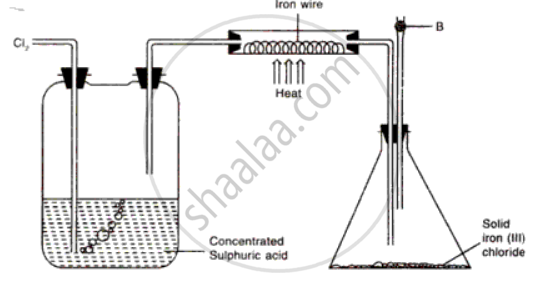
(i) What is substance B?
(ii) What is the purpose of B?
(iii)Why is iron (III) chloride to be stored in a closed container?
(iv) Write the equation for the reaction between iron and chloride ?
Give the equation for the preparation of the following salt from the starting material given.
Copper sulphate from copper (II) oxide
What is the difference between the chemical nature of an aqueous solution of HCl and an aqueous solution of NH3
Explain the following method with example.
Direct combination
Explain why Anhydrous FeCl3 cannot be prepared by heating hydrated iron (III) chloride.
