Advertisements
Advertisements
प्रश्न
Write an explanatory answer :
What is the price elasticity of demand? Explain the types of price elasticity of demand.
Advertisements
उत्तर
Price Elasticity of Demand :
The variation in demand in response to a variation in price is called price elasticity of demand. It may also be defined as the ratio of the percentage change in demand to the percentage change in the price of a particular commodity
According to Samuelson :
"Price elasticity is a concept for measuring how much the quantity demanded response to changing the price.” It is clear from the above definitions that elasticity of demand is a technical term that describes the responsiveness of change in the quantity demanded to a fall or rise in its price. In other words, it is the ratio of the percentage change in quantity demanded of a commodity to a percentage change in price.
Types of Price Elasticity of Demand Degrees of Elasticity of Demand are :
(i) Infinite/Perfectly Elastic Demand
When a change in price leads to an infinite change in quantity demanded, it is known as infinite elastic demand. When demand is infinitely elastic, the demand curve is a horizontal straight line parallel to X-axis. Symbolically, Ed =∞ Perfectly elastic demand is only a theoretical possibility.
Infinite/Perfectly Elastic Demand Curve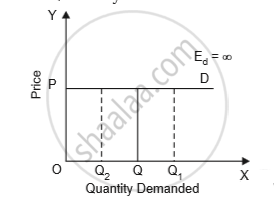
(ii) Perfectly Inelastic Demand
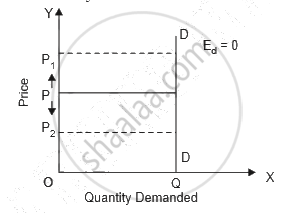
Irrespective of change in price, when demand remains the same, it is called perfectly inelastic demand. For example: as shown in the figure below, at price OP demand is OQ, whereas at price OP1 (Higher) and OP2 (Lower) the demand is OQ only. It means demand does not change at all. When demand is perfectly inelastic, the demand curve is represented by a vertical straight line parallel to Y-axis as shown in the diagram. Symbolically, Ed=0. In practice, such situation occurs occasionally, such as demand for salt.
Perfectly Inelastic Demand Curve
(iii) Unitary Elastic Demand
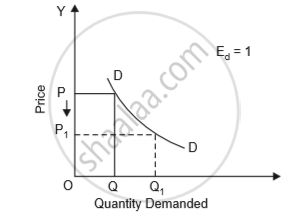
When a change in price leads to proportionate change in quantity demanded then demand is unitary elastic. For example: if the price falls by 50%, the demand will rise by 50%. In the figure, the change in price is PP1 and the change in demand is QQ1. Both the changes are proportional to each other. So the demand curve DD shows unitary elastic demand. Symbolically, Ed = 1.
Unitary Elastic Demand Curve
In this type, the slope of the demand curve is flatter.
(v) Relatively Inelastic Demand
When a change in price leads to less than proportionate change in quantity demanded, the demand is relatively inelastic. For example: if the price falls by 50%, the demand will rise by 25%, i.e., less than the percentage change in price. In the above figure, the change in price is from OP to OP1 is greater than change is demand from OQ to OQ1.
Relatively Inelastic Demand Curve
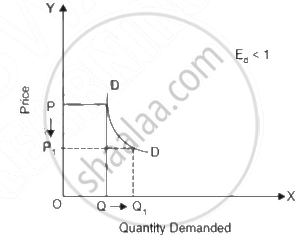
Therefore, DD is the demand curve which represents inelastic demand. Symbolically, Ed < 1. The slope of the demand curve is steeper.
