Advertisements
Advertisements
प्रश्न
Work out the formulae for the following compounds:
Calcium carbonate
Advertisements
उत्तर
Valency of Calcium = 2
Valency of Carbonate ion = −2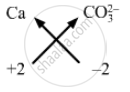
Formula for calcium carbonate can be worked out by crossing the valencies of the constituent elements/ions. +2 positive charge of calcium neutralizes the −2 negative charge of carbonate ion.
Therefore, formula for calcium carbonate is: CaCO3.
APPEARS IN
संबंधित प्रश्न
Which postulate of Dalton’s atomic theory can explain the law of definite proportions?
Which postulate of Dalton's atomic theory is the result of law of conservation of mass given by Lavoisier ?
Name any two laws of chemical combination.
Give one major drawback of Dalton's atomic theory of matter.
The atomic theory of matter was proposed by :
In an experiment, 4.90 g of copper oxide was obtained from 3.92 g of copper. In another experiment, 4.55 g of copper oxide gave, on reduction, 3.64 g of copper. Show with the help of calculations that these figures verify the law of constant proportions.
What do we call those particles which have more electrons than the normal atoms ?
Work out the formulae for the following compounds :
Sodium oxide
In water, hydrogen and oxygen are combined in the ratio of _____ by mass.
Ruthresh, Hari, Kanishka, and Thahera collected different samples of water from a well, a pond, a river, and underground water. All these samples were sent to a testing laboratory. The test result showed the ratio of hydrogen to oxygen as 1:8.
- What conclusion would you draw from the above experiment?
- Which law of chemical combination does it obey?
