Advertisements
Advertisements
प्रश्न
With reference to the newspaper article, answer the questions that follow:
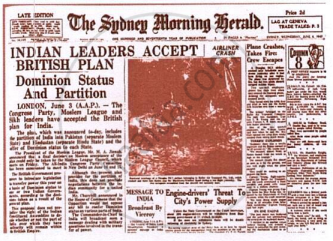
- Which Plan is referred to in the given newspaper article? State any two features of this Plan.
- How was the Plan supposed to solve the communal problem existing in India?
- Why did Congress accept the Plan? State three reasons to justify its acceptance.
विस्तार में उत्तर
Advertisements
उत्तर
- Plan and its Features:
- Plan Referred to: This article refers to the Mountbatten Plan (also famously known as the 3rd June Plan of 1947).
- Two Features of the Plan:
- Partition of the Country: India would be partitioned into two independent dominions, the Union of India and the Dominion of Pakistan.
- Boundary Commission: A Boundary Commission (led by Sir Cyril Radcliffe) would be set up to demarcate the international borders, specifically dividing the provinces of Bengal and Punjab.
- Solution to the Communal Problem:
The Mountbatten Plan aimed to resolve India’s deep-rooted communal deadlock by acknowledging that the coexistence of the Indian National Congress and the All-India Muslim League under a single unified government had become unworkable.- It sought to end the widespread communal riots and impending civil war by granting the Muslim League its long-standing demand for a separate sovereign Muslim-majority nation (Pakistan).
- To ensure democratic self-determination along communal lines, it mandated that the legislative assemblies of Punjab and Bengal vote on partition, and arranged for plebiscites in disputed areas like the North-West Frontier Province (NWFP) and the Sylhet district of Assam.
- Reasons for Congress Accepting the Plan:
The Indian National Congress reluctantly accepted the Mountbatten Plan due to the following three reasons:- Failure of the Interim Government: The working of the Interim Government proved that cooperation between the Congress and the Muslim League was impossible. The League used obstructionist tactics inside the cabinet, paralysing the day-to-day administration of the country.
- Avoidance of an All-Out Civil War: Widespread communal violence and bloodbaths across regions like Punjab, Bengal, and Noakhali convinced Congress leaders that forcing a unified India would lead to a permanent, uncontrollable civil war.
- Need for a Strong Central Power: Leaders like Sardar Patel and Jawaharlal Nehru felt that a smaller India with a strong, highly secure central government was far better than a larger, weak federation prone to constant internal subversion and fragmentation.
shaalaa.com
क्या इस प्रश्न या उत्तर में कोई त्रुटि है?
