Advertisements
Advertisements
प्रश्न

“While shopping for fruits in the local market you see many seller selling fruits”. In this context answer the following:
- What is the type of market referred to?
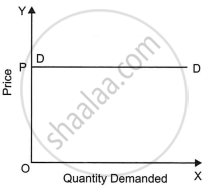
- State and draw the type of demand curve faced by the market above.
- Differentiate between the market indicated above and monopoly on the basis of:
- No. of sellers
- Market price
- Entry and exit of firms in the market
Advertisements
उत्तर
a. This type of market is referred to as the perfectly competitive market.
b. Perfectly elastic demand curve: It is a situation in which a small change in price causes an infinitely large change in quantity demanded. A small rise in price on the part of the seller reduces the demand to zero. A small reduction in price, will increase the demand to infinity (i.e., no seller is able to satisfy this demand at the reduced price). In our real life, we do not have any such commodity which has perfectly elastic demand. Here, elasticity of demand is equal to infinity and demand curve becomes parallel to X-axis as shown in diagram. Alternatively speaking, here quantity demanded is independent of price. Price is given.
Demand for a good can be perfectly elastic only when there are some perfect substitutes of the good are available in the market. But perfect substitutes are not found in real life.
c.
| Basis | Perfect Competition | Monopoly |
| 1. No. of Sellers: | A large number of small sellers. | There exists only a single seller. |
| 2. Market price: | Uniform price prevails in the entire market and every firm here is a price-taker. | A monopoly firm may or may not charge uniform prices from their different buyers. The firm here is a price-maker. |
| 3. Entry and Exit: | A firm can freely enter into or exit from the market. | The monopoly firm has substantial control over the market price. Thus, each firm is a price maker here. |
APPEARS IN
संबंधित प्रश्न
Identify the market having a single buyer and many sellers from the following:
Following is not the feature of perfect competition:
Differentiated products is a characteristic of ______.
Match the following:
| Column I | Column II | ||
| A. | Demand curve under perfect competition | (i) | Indeterminate demand curve |
| B. | Demand curve under monopoly | (ii) | Downward sloping but less elastic |
| C. | Demand curve under monopolistic competition | (iii) | Horizontal straight line |
| D. | Demand curve under oligopoly | (iv) | Elastic demand curve |
Which type of market structure is the following? Give reason.
Mobile phone services
Which type of market structure is the following? Give reason.
Soft drinks
Product differentiation is practised in monopolistic competition? Give reasons.
What is meant by the term ‘price taker’?
What is the effect on price when a perfectly competitive firm tries to sell more?
What is the difference between perfect and imperfect oligopoly?
