Advertisements
Advertisements
प्रश्न
Verify that 3, -2, 1 are the zeros of the cubic polynomial `p(x) = (x^3 – 2x2 – 5x + 6)` and verify the relation between it zeros and coefficients.
Advertisements
उत्तर
The given polynomial is `p(x) = (x^3 – 2x^2 – 5x + 6)`
`∴ p(3) = (3^3 – 2 × 3^2 – 5 × 3 + 6) = (27 – 18 – 15 + 6) = 0`
`p(-2) = [ (– 2^3) – 2 × (– 2)^2 – 5 × (– 2) + 6] = (–8 –8 + 10 + 6) = 0`
`p(1) = (1^3 – 2 × 1^2 – 5 × 1 + 6) = ( 1 – 2 – 5 + 6) = 0`
∴ 3, –2 and 1are the zeroes of p(x),
Let 𝛼 = 3, 𝛽 = –2 and γ = 1. Then we have:
(𝛼 + 𝛽 + γ) = (3 – 2 + 1) = 2 = `(-("Coefficient of" x^2))/(("Coefficient of" x^2))`
(𝛼𝛽 + 𝛽γ + γ𝛼) = (–6 –2 + 3) = `−5/1 = ("Coefficient of x")/("Coefficient of x"^2)`
𝛼𝛽γ = { 3 × (-2) × 1}=`(-6)/1= -(("Constant term"))/(("Coefficient of" x^3))`
APPEARS IN
संबंधित प्रश्न
Find the zeroes of the following quadratic polynomial and verify the relationship between the zeroes and the coefficients.
6x2 – 3 – 7x
Find a quadratic polynomial each with the given numbers as the sum and product of its zeroes respectively.
`1/4 , -1`
If a and are the zeros of the quadratic polynomial f(x) = 𝑥2 − 𝑥 − 4, find the value of `1/alpha+1/beta-alphabeta`
If 𝛼 and 𝛽 are the zeros of the quadratic polynomial p(x) = 4x2 − 5x −1, find the value of α2β + αβ2.
If α and β are the zeros of the quadratic polynomial f(x) = x2 − p (x + 1) — c, show that (α + 1)(β +1) = 1− c.
Find the zeroes of the quadratic polynomial f(x) = 4x2 - 4x - 3 and verify the relation between its zeroes and coefficients.
Find the zeroes of the quadratic polynomial `(5y^2 + 10y)` and verify the relation between the zeroes and the coefficients.
If 2 and -2 are two zeroes of the polynomial `(x^4 + x^3 – 34x^2 – 4x + 120)`, find all the zeroes of the given polynomial.
The product of the zeros of x3 + 4x2 + x − 6 is
What should be subtracted to the polynomial x2 − 16x + 30, so that 15 is the zero of the resulting polynomial?
Case Study -1
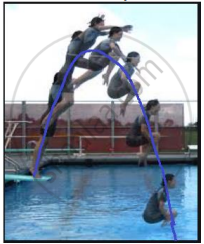
The figure given alongside shows the path of a diver, when she takes a jump from the diving board. Clearly it is a parabola.
Annie was standing on a diving board, 48 feet above the water level. She took a dive into the pool. Her height (in feet) above the water level at any time ‘t’ in seconds is given by the polynomial h(t) such that h(t) = -16t2 + 8t + k.
The zeroes of the polynomial r(t) = -12t2 + (k - 3)t + 48 are negative of each other. Then k is ______.
If all three zeroes of a cubic polynomial x3 + ax2 – bx + c are positive, then at least one of a, b and c is non-negative.
Find the zeroes of the following polynomials by factorisation method and verify the relations between the zeroes and the coefficients of the polynomials:
5t2 + 12t + 7
Find the zeroes of the following polynomials by factorisation method and verify the relations between the zeroes and the coefficients of the polynomials:
`2s^2 - (1 + 2sqrt(2))s + sqrt(2)`
The only value of k for which the quadratic polynomial kx2 + x + k has equal zeros is `1/2`
If α and β are the zeros of a polynomial f(x) = px2 – 2x + 3p and α + β = αβ, then p is ______.
Find the zeroes of the quadratic polynomial x2 + 6x + 8 and verify the relationship between the zeroes and the coefficients.
