Advertisements
Advertisements
प्रश्न
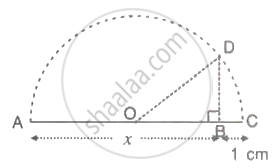
Using the following figure, show that BD = `sqrtx`.
संख्यात्मक
Advertisements
उत्तर
AB = x and BC = 1
AC = AB + BC
= x + 1
diameter = x + 1
radius OA = OD = OC = OB = OC - BC
`= (x + 1)/2 - 1 = (x + 1 -2)/2 = (x - 1)/2`
Using pythagoras in ΔBOD
P2 + B2 = H2
`"P"^2 + ((x - 1)/2)^2 = ((x + 1)/2)^2`
`"P"^2 = ((x + 1)/2)^2 - ((x - 1)/2)^2`
= `((x + 1)^2 - (x - 1)^2)/4`
`= ((x^2 + 1 + 2x) - (x^2 + 1 - 2x))/4`
`= (x^2 + 1 + 2x - x^2 - 1 + 2x)/4`
`"P"^2 = (4x)/4`
P2 = x
P = `sqrtx`
shaalaa.com
Simplifying an Expression by Rationalization of the Denominator
क्या इस प्रश्न या उत्तर में कोई त्रुटि है?
अध्याय 1: Rational and Irrational Numbers - Exercise 1 (D) [पृष्ठ २३]
