Advertisements
Advertisements
प्रश्न
Using the phenomenon of polarisation, show how the transverse nature of light can be demonstrated.
Advertisements
उत्तर
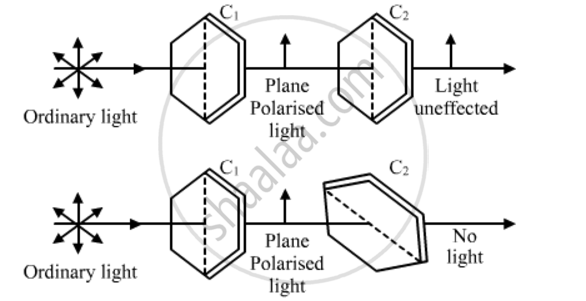
Suppose that an ordinary light is incident normally on a pair of crystals C1 and C2. When the ordinary light passes through C1, it gets plane polarised in the direction perpendicular to the length of crystal. Now, we observe that when the axes of two crystals are parallel, the intensity of the emerging light will be maximum. When the second crystal is placed perpendicular w.r.t the first crystal, the intensity of light observed is zero. This is because the electric field of the plane polarised light obtained from C1 can vibrate only in one direction. Hence, when the axis of the crystal is perpendicular to its direction of vibration of electric field, it gets blocked. This depicts the transverse nature of light.
APPEARS IN
संबंधित प्रश्न
If the polarising angle for a given medium is 60°, then the refractive index of the medium is.................
What is a Polaroid?
Draw a neat labelled diagram showing the plane of vibration and plane of polarisation for polarised light.
What is the Brewster angle for air to glass transition? (Refractive index of glass = 1.5)
Show using a proper diagram how unpolarised light can be linearly polarised by reflection from a transparent glass surface.
Unpolarised light is incident on a polaroid. How would the intensity of transmitted light change when the polaroid is rotated?
A beam of light is incident at the polarizing angle of 35° on a certain glass plate. The refractive index of the glass plate is :
Consider a light beam incident from air to a glass slab at Brewster’s angle as shown in figure. A polaroid is placed in the path of the emergent ray at point P and rotated about an axis passing through the centre and perpendicular to the plane of the polaroid.

Can reflection result in plane polarised light if the light is incident on the interface from the side with higher refractive index?
To ensure almost 100 per cent transmissivity, photographic lenses are often coated with a thin layer of dielectric material. The refractive index of this material is intermediated between that of air and glass (which makes the optical element of the lens). A typically used dielectric film is MgF2 (n = 1.38). What should the thickness of the film be so that at the center of the visible spectrum (5500 Å) there is maximum transmission.
