Advertisements
Advertisements
प्रश्न
Using the concept of free electrons in a conductor, derive the expression for the conductivity of a wire in terms of number density and relaxation time. Hence obtain the relation between current density and the applied electric field E.
Advertisements
उत्तर
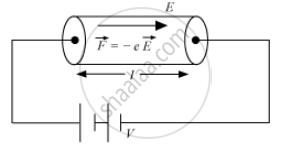
The drift velocity of electrons in a conductor is given as
V_d = `(eEr)/m` ...(1)
where,
E = electric field set up across a conductor
m = mass of the electron
τ" data-mce-style="display: inline; font-style: normal; font-weight: 400; line-height: normal; font-size: 16px; text-indent: 0px; text-align: left; text-transform: none; letter-spacing: normal; word-spacing: 0px; word-wrap: normal; white-space: nowrap; float: none; direction: ltr; max-width: none; max-height: none; min-width: 0px; min-height: 0px; border: 0px; padding: 0px; margin: 0px; color: #212121; font-family: Roboto, sans-serif; font-variant-ligatures: normal; font-variant-caps: normal; orphans: 2; widows: 2; -webkit-text-stroke-width: 0px; background-color: #ffffff; text-decoration-style: initial; text-decoration-color: initial; position: relative;" data-mce-tabindex="0">ττ = average relaxation time
Now the current flowing in the conductor can be derived as
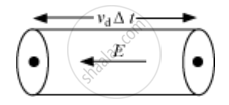
Electron drift to a small distance in a time Δt = VdΔt
Amount of charge passing through the area A in time Δt, q = IΔt
IΔt = neAvdΔt
or I = neAvd ...(2)
Where,
n → Number of free electrons per unit volume or number density.
Now from equation (1) and (2), we get
`I = ("ne"^2ArE)/m` ....3
Since the resistivity of a conductor is given as
`rho = m/("ne"^2r)`
Now, we know that conductivity of a conductor is mathematically defined as the reciprocal of resistivity of the conductor. Thus
`rho = 1/sigma` ....(4)
where `sigma = `conductivity of the conductor. Thus, from equation (3) and (4), we get
`sigma = ("ne"^2r)/m` ...(5)
Now, from equation (3) and (5), we have
`I/A = sigmaE .....(6)`
and the current density is given as
`J = I/A`
Thus `J =sigmaE`
