Advertisements
Advertisements
प्रश्न
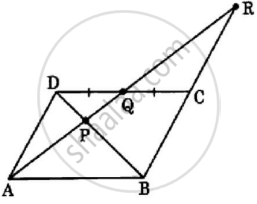
Through the mid-point Q of side CD of a parallelogram ABCD, the line AR is drawn which intersects BD at P and produced BC at R.
Prove that
- AQ = QR
- AP = 2PQ
- PR = 2AP
Advertisements
उत्तर
Given: A parallelogram ABCD and Q is the mid-point of CD
i. In ΔAQD and ΔRQC
∠DQA = ∠CQR ...[Vertically opposite angles]
∠DAQ = ∠CRQ ...[AD || BC and alternate interior angles]
⇒ ΔAQD ∼ ΔRQC ...[AA similarity]
⇒ `(AQ)/(QR) = (DQ)/(CQ)`
But CQ = DQ
⇒ AQ = QR ...(1)
Hence, proved.
ii. In ΔAPB and ΔQPD
∠APB = ∠QPD ...[Vertically opposite angles]
∠PQD = ∠PAB ...[CD || AB and alternate interior angles]
⇒ ΔAPB ∼ ΔQPD
⇒ `(AP)/(PQ) = (AB)/(QD)`
But AB = CD = 2QD
⇒ `(AP)/(PQ) = (2QD)/(QD) = 2/1`
⇒ AP = 2PQ ...(2)
Hence, proved.
iii. Since, PR = PQ + QR
PQ + AQ ...(From 1)
PQ + AP + PQ = 2PQ + AP
= AP + AP ...(From 2)
= 2AP
Hence, proved.
