Advertisements
Advertisements
प्रश्न
The velocity of a body moving in a straight line is increased by applying a constant force F, for some distance in the direction of the motion. Prove that the increase in the kinetic energy of the body is equal to the work done by the force on the body.
Advertisements
उत्तर
Let the body covers a distance s when a constant force F is applied in the direction of motion.
Work done by this force, W = F. s
Let the velocity of the object of mass m change
from u to v with acceleration and on application
of constant force F, then F = ma
From equation of motion, v2 − u2 = 2as, we get
s = `("v"^2 - "u"^2)/(2"a")`
∴ W = Fs = ma `(("v"^2 - "u"^2)/(2"a"))`
= `1/2 "mv"^2 - 1/2 "mu"^2`
= final kinetic energy – initial kinetic energy
= change in kinetic energy
APPEARS IN
संबंधित प्रश्न
State the energy changes in the following case while in use:
An electric iron
State the energy changes in the following while in use An electric bulb.
State the energy changes in the following while in use A loudspeaker .
Energy can exist in several forms and may change from one form to another. State the energy changes that occur in the unwinding of a watch spring.
Energy can exist in several forms and may change from one form to another. State the energy changes that occur in a loaded truck when started and set in motion.
State the energy changes in the following case while in use:
A solar cell
Choose the odd one:
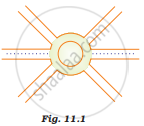
A boy is moving on a straight road against a frictional force of 5 N. After travelling a distance of 1.5 km he forgot the correct path at a roundabout (Fig. 11.1) of radius 100 m. However, he moves on the circular path for one and half-cycle and then he moves forward up to 2.0 km. Calculate the work done by him.
The energy conversion in a washing machine is from ______.
In an electric cell while in use, the change in energy is from ______.
