Advertisements
Advertisements
प्रश्न
The shadow of a tower standing on a level plane is found to be 50 m longer when Sun’s elevation is 30° than when it is 60°. Find the height of the tower.
Advertisements
उत्तर
Let SQ = h be the tower.
∠SPQ = 30° and ∠SRQ = 60°
According to the question,
The length of shadow is 50 m long the angle of elevation of the sun is 30° than when it was 60°.
So, PR = 50 m and RQ = x m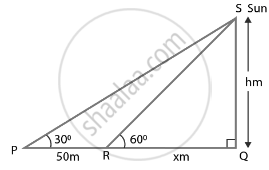
So in ∆SRQ, we have
tan 60° = `"h"/x` ...`[∵ tan θ = "perpendicular"/"base" ⇒ tan 60^circ = "SQ"/"RQ"]`
⇒ `sqrt(3) = "h"/x` ...`[∵ tan 60^circ = sqrt(3)]`
⇒ `x = "h"/sqrt(3)`
In ΔSPQ,
tan 30° = `"h"/(50 + x)` ...`[∵ tan 30^circ = "SQ"/"PQ" = "SQ"/("PR" + "PQ")]`
⇒ `1/sqrt(3) = "h"/(50 + x)` ...`[∵ tan 30^circ = 1/sqrt(3)]`
⇒ `50 + x = sqrt(3)"h"`
Substituting the value of x in the above equation, we get
⇒ `50 + "h"/sqrt(3) = sqrt(3)"h"`
⇒ `(50sqrt(3) + "h")/sqrt(3) = sqrt(3)"h"`
⇒ `50sqrt(3) + "h" = 3"h"`
⇒ `50sqrt(3) = 3"h" - "h"`
⇒ `3"h" - "h" = 50sqrt(3)`
⇒ 2h = `50sqrt(3)`
⇒ h = `(50sqrt(3))/2`
⇒ h = `25sqrt(3)`
Hence, the required height is `25sqrt(3) "m"`.
