Advertisements
Advertisements
प्रश्न
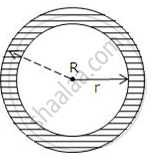
The shaded portion of the figure, given alongside, shows two concentric circles. If the circumference of the two circles is 396 cm and 374 cm, find the area of the shaded portion.
Advertisements
उत्तर
Let R and r be the radius of the big and small circles respectively.
Given that the circumference of the bigger circle is 396 cm
Thus, we have,
2πR = 396 cm
⇒ R = `[ 396 xx 7 ]/[ 2 xx 22 ]`
⇒ R = 63 cm
Thus, the area of the bigger circle = πR2
= `22/7 xx 63^2`
= 12474 cm2
Also, given that the circumference of the smaller circle is 374 cm
⇒ 2πr = 374
⇒ r = `[ 374 xx 7 ]/[ 2 xx 22 ]`
⇒ r = 59.5 cm
Thus, the area of the smaller circle = πr2
= `22/7` x 59.52
= 11126.5 cm2
Thus the area of the shaded portion = 12474 - 11126.5 = 1347.5 cm2
APPEARS IN
संबंधित प्रश्न
In the given figure, ∆ ABC is a right-angled triangle in which ∠ A is 90°. Semicircles are drawn on AB, AC and BC as diameters. Find the area of the shaded region

An arc of length 20𝜋 cm subtends an angle of 144° at centre of circle. Find the radius of the circle.
Below fig shows a sector of a circle, centre O. containing an angle 𝜃°. Prove that
Area of shaded region is`r^2/2(tantheta −(pitheta)/180)`
The areas of two circles are in the ratio 4: 9. What is the ratio between their circumferences?
The sum of the radii of two circles is 7 cm, and the difference of their circumferences is 8 cm. Find the circumference of the circles.
The area of the circle is given below; find the diameter.
176 sq cm
Find the area and perimeter of the following semi-circle :
Diameter= 5.6 cm
The diameter of a circular well is 4.2 m. What is its circumference?
In covering a distance s metres, a circular wheel of radius r metres makes `s/(2πr)` revolutions. Is this statement true? Why?
The moon is about 384000 km from earth and its path around the earth is nearly circular. Find the length of path described by moon in one complete revolution. (Take π = 3.14)
