Advertisements
Advertisements
प्रश्न
The scene of the beggar and the girl made Meena peep into her own life.
विकल्प
Right
Wrong
Advertisements
उत्तर
The scene of the beggar and the girl made Meena peep into her own life. - Right
APPEARS IN
संबंधित प्रश्न
Make small groups and share.
A piece of advice that stopped a bad habit in you.
Make small groups and share.
An experience that taught you a lifelong lesson.
Make small groups and share.
A story/news/episode/movie/play that has impressed and changed you.
Many slang expressions/terms are used for people having positive or negative traits.
Match the expressions in Column A with type of persons in Column B.
| A | B | |
| 1. | Couch Potato | (a) brilliant/genius |
| 2. | Worry Wart | (b) very energetic/active |
| 3. | Fuddy-duddy | (c) shameful person |
| 4. | Wet blanket | (d) lazy/good for nothing |
| 5. | Whiz | (e) spoils other peoples fun/mood |
| 6. | Black sheep | (f) always nervous/worried |
| 7. | Live wire | (g) old-fashioned/refuses change |
Discuss in your group and write the difference in reactions of an Optimist and Pessimist in the given situations.
| Optimist | Pessimist | |
| Failure in exams/tests | ||
| Lose a good amount of cash | ||
| Unexpected rainfall/bad weather | ||
| Illness | ||
| Extra classes in school |
Complete the following table.
| Utterance | Who said | To whom |
| “Shwetha is a very beautiful girl, isn’t she ?” | ||
| “When a pony is young, he looks handsome ?” | ||
| “It’s a beautiful day.” | ||
| “No, the sun is too hot.” | ||
| “I’m all excited, it’s nice to meet old friends.” | ||
| “Let’s chat.” | ||
| “We won’t get a taxi in this rain.” | ||
| “Then, what’s the secret of your energy?” | ||
| “A beggar changed my life.” |
The author and Meena were great enemies.
Meena was a very cheerful person initially.
Meena was the second child of her parents.
Meena stayed alone in an appartment in Delhi.
The author spotted Meena at Bombay’s Flora Fountain.
The beggar and the young girl were playing on the road because there was a lot of traffic.
The beggar became Meena’s role model
Meena was able to give Gurudakshina directly to her Guru, the beggar.
Meena, who is an LIC officer, is ____________.
The writer was standing near Akbarallys, a popular department store because - __________________
The only thought in the writer’s mind till they reached the Grand Hotel was __________________
Meena sponsored the granddaughter of the beggar because __________________
Write in your own words:
How did Meena show her gratitude to her guru?
Why would Meena be sad initially? Give reasons. Pick out sentences from the story which prove that Meena was a pessimist.
- She was forever unhappy.
- ________________________
- ________________________
- ________________________
- ________________________
- ________________________
Go through the points below showing Meena’s encounter with the beggar that transformed her completely. The sequence of events are jumbled up below. Arrange the events according to the occurence. Fill in the number as per sequence.
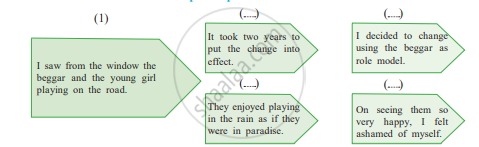
How did the beggar change Meena’s attitude towards life? Write it down in 5 to 6 lines. One is done for you.
- The incident made Meena to look at her own life
- ______________________________
- ______________________________
- ______________________________
- ______________________________
- _______________________________
Summarise the story with the help of the points given below.
- Meena’s initial attitude
- Meena’s meeting with Sudha Murthy in Mumbai
- Beggar’s incident
- Change in attitude
Summary Maker
| Dos | Don’ts |
| Use important/relevant points/ incidents/ events short forms of the text. | Select irrelevant/less important points/ incidents/events |
| Make a paragraph containing the message, theme etc | exceed the word limit |
| Use your own language taking help of the sentences in a topic and key words | reproduce/copy the text |
Read the following passage and do the activities.
B1. Answer the following in 1-2 words: [2]
- The person who changed the writer’s life –
- The age of beggar’s granddaughter –
- The writer’s role model –
- The things that the writer used to give to beggar every day –
|
‘Then what’s the secret of your energy?’ I asked like Tendulkar does in the advertisement. She smiled, ‘A beggar changed my life.’ I was absolutely dumbfounded and she could see it. |
B2. Describe how the beggar and his granddaughter enjoyed the rain. [2]
B3. Write antonyms of the following. [2]
- optimist × -____________
- unhappy × -___________
B4. Do as directed: [2]
- She could see it. (Use ‘able to’.)
- I used to give my leftovers to this beggar every day. (Use ‘would’.)
B5. Who is your role model? Why? [2]
Read the following passage and do the activities:
B1. Complete the following sentences: (2)
- Meena stayed alone as ______.
- Meena had the habit of ______.
- The narrator was caught in ______.
- Seeing Meena the narrator's first reaction was ______.
|
That was Meena. She stayed alone in an apartment as her parents lived in Delhi. She was an only child and had the habit of complaining about anything and everything. Naturally, she wasn't very pleasant company and nobody wanted to visit her. Then one day, Meena was transferred to Bombay and soon we all forgot about her. Many years later, I found myself caught in the rain at Bombay's Flora Fountain. It was pouring and I didn't have an umberella. I was standing near Akbarallys, a popular department store, waiting for the rain to subside. Suddenly, I spotted Meena. My first reaction was to run, even in that pouring rain. I was anxious to avoid being seen by her, having to listen to her never-ending complaints. However, I couldn't escape. She had already seen me and caught hold of my band warmly, What's more, she was very cheerful. |
B2. Describe Meena's character. (2)
B3. Find similar words: (2)
- pleasant
- Heavy rainfall
- well known
- noticed
B4. Do as Directed: (2)
(i) She wasn't a very pleasant company. (Choose the correct question tag)
- did she?
- can she?
- can't she?
- was she?
(ii) I spotted Meena. (Rewrite the sentence beginning with 'Meena....')
B5. Personal Response: (2)
In your opinion, how should a friend be?
Read the following passage and do the activities:
B1. Complete the following table: (2)
| Utterance | Who said | To whom | |
| i. | Meena, did you know Rakesh has come first in his school? | ||
| ii. | Naturally, his father is a school teacher. |
|
Meena is a good friend of mine. She is an LIC officer earning a good salary. But there was always something strange about her. She was forever unhappy. Whenever I met her, I would start to feel depressed. It was as though her gloom and cynicism had a way of spreading to others. She never had anything positive to say on any subject or about any person. For instance, I might say to her, ‘Meena, did you know Rakesh has come first in his school?’ Meena’s immediate response would be to belittle the achievement. ‘Naturally, his father is a school teacher’, she would say. If I said, ‘Meena, Shwetha is a very beautiful girl, isn’t she?’ Meena would be pessimistic. ‘When a pony is young, he looks handsome. It is age that matters. Wait for some time. Shwetha will be uglier than anyone you know.’ ‘Meena, it’s a beautiful day. Let’s go for a walk.’ ‘No, the sun is too hot and I get tired if I walk too much. Besides, who says walking is good for health? There’s no proof.’ That was Meena. She stayed alone in an apartment as her parents lived in Delhi. She was an only child and had the habit of complaining about anything and everything. |
B2. Describe Meena’s character. (2)
B3. Find from the passage the antonyms of: (2)
- bad × ______
- never × ______
- happy × ______
- optimistic × ______
B4. Do as Directed: (2)
- Shwetha is a very beautiful girl. (Make it exclamatory.)
- Meena is an LIC officer. (Frame a ‘Wh’ question to get the underlined part as an answer.)
B5. Personal Response: (2)
If you have a friend like Meena, what would be your attitude towards her?
