Advertisements
Advertisements
प्रश्न
The fourth vertex D of a parallelogram ABCD, whose three vertices are A(–2, 3), B(6, 7) and C(8, 3), is ______.
विकल्प
(0, 1)
(0, –1)
(–1, 0)
(1, 0)
Advertisements
उत्तर
The fourth vertex D of a parallelogram ABCD, whose three vertices are A(–2, 3), B(6, 7), and C(8, 3) is (0, –1).
Explanation:
Let the fourth vertex of the parallelogram, D ≡ (x4, y4) and L, M be the middle points of AC and BD, respectively,
Then, `L ≡ ((-2 + 8)/2, (3 + 3)/2) ≡ (3, 3)` and `M ≡ ((6 + x_4)/2, (7 + y_4)/2)` ...`["Since mid-point of a line segment having points" (x_1, y_1) "and" (x_2, y_2) = ((x_1 + x_2)/2, (y_1 + y_2)/2)]`
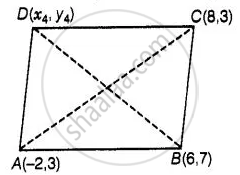
Since, ABCD is a parallelogram, therefore diagonals AC and BD will bisect each other.
Hence, L and M are the same points.
∴ 3 = `(6 + x_4)/2` and 3 = `(7 + y_4)/2`
⇒ 6 = 6 + x4 and 6 = 7 + y4
⇒ x4 = 0 and y4 = 6 – 7
∴ x4 = 0 and y4 = –1
Hence, the fourth vertex of the parallelogram is D = (x4, y4) = (0, –1).
