Advertisements
Advertisements
प्रश्न
The expression 4x3 – bx2 + x – c leaves remainders 0 and 30 when divided by x + 1 and 2x – 3 respectively. Calculate the values of b and c. Hence, factorise the expression completely.
Advertisements
उत्तर
given the cubic expression: f(x) = 4x3 − bx2 + x − c
Use the Remainder Theorem
Use f(−1) = 0
x + 1 = 0 ⇒ x = −1, we substitute into the expression:
f(−1) = 4(−1)3 −b(−1)2 + (−1) − c = 0
−4 − b − 1 − c = 0 ⇒ −b − c = 5 ⇒ b + c = −5
Use `f(3/2) = 30`
Because 2x − 3 = 0 ⇒ `x = 3/2`
`f(3/2) = 4(3/2)^3 - b(3/2)^2 + (3/2) - c = 30`
`(3/2)^3 = 27/8, "so" 4xx 27/8 = 108/8 = 13.5`
`(3/2)^2 = 9/4, bxx 9/4`
`13.5 - b xx 9/4 + 3/2 - c = 30`
`13.5 + 1.5 - c -(9b)/4 = 30 => 15-c-9b/4 = 30`
`-c-(9b)/4 = 15 => c + (9b)/4 (2) -15`
b + c = −5 ⇒ c = −5 − b
`(-5-b) + (9b)/4 = -15 => -5-b+ (9b)/4 = -15`
−20 − 4b + 9b = −60 ⇒ 5b = −40 ⇒ b = −8
b + c = −5 ⇒ −8 + c = −5 ⇒ c = 3
f(x) = 4x3 + 8x2 + x − 3
We use factor theorem and trial substitution to find a root.
f(1) = 4 + 8 + 1 − 3 = 10 ≠ 0
f(−1) = −4 + 8 − 1 − 3 = 0
Divide 4x3 + 8x2 + x − 3 by (x + 1)
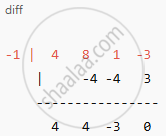
4x2 + 4x − 3
4x2 + 4x − 3 = (2x − 1) (2x + 3)
4x3 + 8x2 + x − 3 = (x + 1) (2x − 1) (2x + 3)
APPEARS IN
संबंधित प्रश्न
A two digit positive number is such that the product of its digits is 6. If 9 is added to the number, the digits interchange their places. Find the number.
Find the number that must be subtracted from the polynomial 3y3 + y2 – 22y + 15, so that the resulting polynomial is completely divisible by y + 3.
If (x + 1) and (x – 2) are factors of x3 + (a + 1)x2 – (b – 2)x – 6, find the values of a and b. And then, factorise the given expression completely.
Using the Reminder Theorem, factorise of the following completely.
2x3 + x2 – 13x + 6
Using the factor theorem, show that (x - 2) is a factor of `x^3 + x^2 -4x -4 .`
Hence factorise the polynomial completely.
If x – 2 is a factor of each of the following three polynomials. Find the value of ‘a’ in each case:
x3 + 2ax2 + ax - 1
Prove that (5x + 4) is a factor of 5x3 + 4x2 – 5x – 4. Hence factorize the given polynomial completely.
Factorize completely using factor theorem:
2x3 – x2 – 13x – 6
One factor of x3 – kx2 + 11x – 6 is x – 1. The value of k is ______.
For the polynomial x5 – x4 + x3 – 8x2 + 6x + 15, the maximum number of linear factors is ______.
