Advertisements
Advertisements
प्रश्न
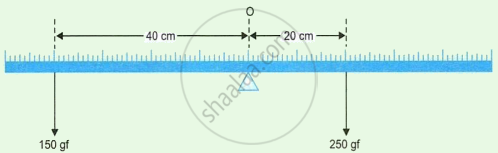
The diagram in Fig. shows a uniform metre rule weighing 100 gf, pivoted at its centre O. Two weights 150 gf and 250 gf hang from the point A and B respectively of the metre rule such that OA = 40 cm and OB = 20 cm. Calculate :
- the total anticlockwise moment about O,
- the total clockwise moment about O,
- the difference of anticlockwise and clockwise moments, and
- the distance from O where a 100 gf weight should be placed to balance the metre rule.

Figure shows a uniform metre rule weighing 100 gf, pivoted at its centre 'O'. Two weights of 150gf and 250 gf hang from the metre rule as shown. Calculate:
- Total C.W. moment about 'O',
- Total A.C.W. moment about 'O',
- Difference of C.W. and A.C.W. moments.
- The distance from 'O' where a 100 gf weight should be suspended to balance the metre scale.
Advertisements
उत्तर
i. Anticlockwise moments = 150 × 40 = 6000 gf
ii. Clockwise moments = 250 × 20 = 5000 gf
iii. Difference of anticlockwise moments and clockwise moments = 6000 − 5000 = 1000 gf
iv. 150 gf × 40 cm = 250 gf × 20 cm + 100 gf × d
6000 gf cm = 5000 gf cm + 100 gf × d
1000 = 100 × d
d = 10 cm on the right side of O
∴ 100 gf wt. should be placed 10 cm to right of O.
Distance from O = 60 − 50 = 10 cm right side of O.
संबंधित प्रश्न
Describe a simple experiment to verify the principle of moments, if you are supplied with a metre rule, a fulcrum and two springs with slotted weights.
A uniform metre rule is pivoted at its mid-point. A weight of 50 gf is suspended at one end of it. Where should a weight of 100 gf be suspended to keep the rule horizontal?
The diagram below shows a uniform bar supported at the middle point O. A weight of 40 gf is placed at a distance of 40 cm to the left of the point O. How can you balance the bar with a weight of 80 gf?

When a boy weighing 20 kgf sits at one end of a 4 m long see-saw, it gets depressed at this end. How can it be brought to the horizontal position by a man weighing 40 kgf.
A physical balance has its arms of length 60 cm and 40 cm. What weight kept on pan of the longer arm will balance an object of weight 100 gf kept on other pan?
A uniform metre rule of mass 100 g is balanced on the fulcrum at mark 40 cm by suspending an unknown mass m at the mark 20 cm.
- Find the value of m.
- To which side the rule will tilt if the mass m is moved to the mark 10 cm?
- What is the resultant moment now?
- How can it be balanced by another mass of 50 g?
A uniform metre rule of weight 10 gf is pivoted at its 0 mark.
- What moment of force depresses the rule?
- How can it be made horizontal by applying a least force?
A uniform half-metre rule can be balanced at the 29.0 cm mark when a mass of 20 g is hung from its one end.
- Draw a diagram of the arrangement.
- Find the mass of the half-metre rule.
- In which direction would the balancing point shift if 20 g mass is shifted inside from its one end?
A uniform metre rule of mass 100g is balanced on a fulcrum at mark 40cm by suspending an unknown mass m at the mark 20cm.
How can it be balanced by another mass 50 g ?
State the principle of moments.
