Advertisements
Advertisements
प्रश्न
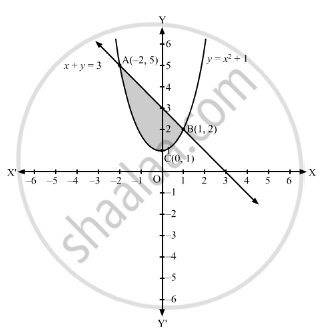
The area of the region bounded by the parabola y = x2 + 1 and the straight line x + y = 3 is given by
विकल्प
\[\frac{45}{7}\]
\[\frac{25}{4}\]
\[\frac{\pi}{18}\]
\[\frac{9}{2}\]
Advertisements
उत्तर

To find the point of intersection of the parabola y = x2 + 1 and the line x + y = 3 substitute y = 3 − x in y = x2 + 1
\[3 - x = x^2 + 1\]
\[ \Rightarrow x^2 + x - 2 = 0\]
\[ \Rightarrow \left( x - 1 \right)\left( x + 2 \right) = 0\]
\[ \Rightarrow x = 1\text{ or }x = - 2\]
\[ \therefore y = 2\text{ or }y = 5\]
So, we get the points of intersection A(−2, 5) and C(1, 2).
Therefore, the required area ABC,
\[A = \int_{- 2}^1 \left( y_1 - y_2 \right) dx ............\left(\text{Where, }y_1 = 3 - x\text{ and }y_2 = x^2 + 1 \right)\]
\[ = \int_{- 2}^1 \left[ \left( 3 - x \right) - \left( x^2 + 1 \right) \right] d x\]
\[ = \int_{- 2}^1 \left( 3 - x - x^2 - 1 \right) d x\]
\[ = \int_{- 2}^1 \left( 2 - x - x^2 \right) d x\]
\[ = \left[ 2x - \frac{x^2}{2} - \frac{x^3}{3} \right]_{- 2}^1 \]
\[ = \left[ 2\left( 1 \right) - \frac{\left( 1 \right)^2}{2} - \frac{\left( 1 \right)^3}{3} \right] - \left[ 2\left( - 2 \right) - \frac{\left( - 2 \right)^2}{2} - \frac{\left( - 2 \right)^3}{3} \right]\]
\[ = \left[ 2 - \frac{1}{2} - \frac{1}{3} \right] - \left[ - 4 - 2 + \frac{8}{3} \right]\]
\[ = 2 - \frac{1}{2} - \frac{1}{3} + 4 + 2 - \frac{8}{3}\]
\[ = 8 - \frac{1}{2} - \frac{9}{3}\]
\[ = 5 - \frac{1}{2}\]
\[ = \frac{9}{2}\text{ square units }\]
APPEARS IN
संबंधित प्रश्न
Find the area of the region bounded by the parabola y2 = 16x and the line x = 3.
Area bounded by the curve y = x3, the x-axis and the ordinates x = –2 and x = 1 is ______.
Sketch the graph of y = |x + 4|. Using integration, find the area of the region bounded by the curve y = |x + 4| and x = –6 and x = 0.
Draw a rough sketch to indicate the region bounded between the curve y2 = 4x and the line x = 3. Also, find the area of this region.
Draw the rough sketch of y2 + 1 = x, x ≤ 2. Find the area enclosed by the curve and the line x = 2.
Find the area of the region bounded by the curve xy − 3x − 2y − 10 = 0, x-axis and the lines x = 3, x = 4.
Find the area bounded by the curve y = cos x, x-axis and the ordinates x = 0 and x = 2π.
Show that the areas under the curves y = sin x and y = sin 2x between x = 0 and x =\[\frac{\pi}{3}\] are in the ratio 2 : 3.
Find the area of the minor segment of the circle \[x^2 + y^2 = a^2\] cut off by the line \[x = \frac{a}{2}\]
Find the area of the region bounded by the curve \[x = a t^2 , y = 2\text{ at }\]between the ordinates corresponding t = 1 and t = 2.
Find the area of the region bounded by x2 = 16y, y = 1, y = 4 and the y-axis in the first quadrant.
Calculate the area of the region bounded by the parabolas y2 = x and x2 = y.
Using integration, find the area of the region bounded by the triangle ABC whose vertices A, B, C are (−1, 1), (0, 5) and (3, 2) respectively.
Draw a rough sketch of the region {(x, y) : y2 ≤ 3x, 3x2 + 3y2 ≤ 16} and find the area enclosed by the region using method of integration.
Draw a rough sketch of the region {(x, y) : y2 ≤ 5x, 5x2 + 5y2 ≤ 36} and find the area enclosed by the region using method of integration.
Find the area of the region bounded by \[y = \sqrt{x}\] and y = x.
Find the area of the region in the first quadrant enclosed by x-axis, the line y = \[\sqrt{3}x\] and the circle x2 + y2 = 16.
Using integration, find the area of the triangle ABC coordinates of whose vertices are A (4, 1), B (6, 6) and C (8, 4).
Find the area of the region bounded by y = | x − 1 | and y = 1.
Find the area of the region in the first quadrant enclosed by the x-axis, the line y = x and the circle x2 + y2= 32.
In what ratio does the x-axis divide the area of the region bounded by the parabolas y = 4x − x2 and y = x2− x?
Find the area bounded by the parabola y2 = 4x and the line y = 2x − 4 By using horizontal strips.
The area of the region bounded by the parabola (y − 2)2 = x − 1, the tangent to it at the point with the ordinate 3 and the x-axis is _________ .
The area bounded by the y-axis, y = cos x and y = sin x when 0 ≤ x ≤ \[\frac{\pi}{2}\] is _________ .
Find the coordinates of a point of the parabola y = x2 + 7x + 2 which is closest to the straight line y = 3x − 3.
The area enclosed by the circle x2 + y2 = 2 is equal to ______.
Find the area of the region included between y2 = 9x and y = x
Find the area of region bounded by the line x = 2 and the parabola y2 = 8x
Find the area bounded by the curve y = sinx between x = 0 and x = 2π.
Compute the area bounded by the lines x + 2y = 2, y – x = 1 and 2x + y = 7.
Using integration, find the area of the region `{(x, y): 0 ≤ y ≤ sqrt(3)x, x^2 + y^2 ≤ 4}`
Area of the region bounded by the curve y = |x + 1| + 1, x = –3, x = 3 and y = 0 is
What is the area of the region bounded by the curve `y^2 = 4x` and the line `x` = 3.
Make a rough sketch of the region {(x, y): 0 ≤ y ≤ x2, 0 ≤ y ≤ x, 0 ≤ x ≤ 2} and find the area of the region using integration.
Find the area of the region bounded by curve 4x2 = y and the line y = 8x + 12, using integration.
For real number a, b (a > b > 0),
let Area `{(x, y): x^2 + y^2 ≤ a^2 and x^2/a^2 + y^2/b^2 ≥ 1}` = 30π
Area `{(x, y): x^2 + y^2 ≥ b^2 and x^2/a^2 + y^2/b^2 ≤ 1}` = 18π.
Then the value of (a – b)2 is equal to ______.
Area of figure bounded by straight lines x = 0, x = 2 and the curves y = 2x, y = 2x – x2 is ______.
Let f(x) be a non-negative continuous function such that the area bounded by the curve y = f(x), x-axis and the ordinates x = `π/4` and x = `β > π/4` is `(βsinβ + π/4 cos β + sqrt(2)β)`. Then `f(π/2)` is ______.
Using integration, find the area of the region bounded by line y = `sqrt(3)x`, the curve y = `sqrt(4 - x^2)` and Y-axis in first quadrant.