हिंदी

The Area Bounded by Y = 2 − X2 and X + Y = 0 is (A) 7 2 Sq. Units (B) 9 2 Sq. Units (C) 9 Sq. Units (D) None of These - Mathematics

Advertisements
Advertisements

प्रश्न

The area bounded by y = 2 − x2 and x + y = 0 is _________ .

विकल्प

  • \[\frac{7}{2}\] sq. units

  • \[\frac{9}{2}\] sq. units

  • 9 sq. units

  • none of these

MCQ
Advertisements

उत्तर

\[\frac{9}{2}\text{ sq . units }\]
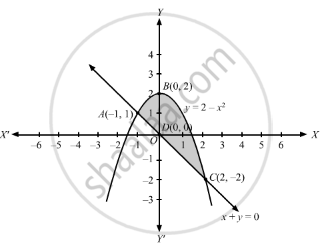


To find the points of intersection of x + y = 0 and y = 2 − x2.
We put x = − y in y = 2 − x2, we get \[y = 2 - y^2 \]
\[ \Rightarrow y^2 + y - 2 = 0\]
\[ \Rightarrow \left( y - 1 \right)\left( y + 2 \right) = 0\]
\[ \Rightarrow y = 1, - 2\]
\[\Rightarrow x = - 1, 2\]
Therefore, the points of intersection are A(−1, 1) and C(2, −2).
The area of the required region ABCD,
\[A = \int_{- 1}^2 \left( y_1 - y_2 \right) d x ...........\left(\text{Where, }y_1 = 2 - x^2\text{ and }y_2 = - x \right)\]
\[ = \int_{- 1}^2 \left( 2 - x^2 + x \right) d x\]
\[ = \left[ 2x - \frac{x^3}{3} + \frac{x^2}{2} \right]_{- 1}^2 \]
\[ = \left\{ 2\left( 2 \right) - \frac{\left( 2 \right)^3}{3} + \frac{\left( 2 \right)^2}{2} \right\} - \left\{ 2\left( - 1 \right) - \frac{\left( - 1 \right)^3}{3} + \frac{\left( - 1 \right)^2}{2} \right\}\]
\[ = \left( 4 - \frac{8}{3} + 2 \right) - \left( - 2 + \frac{1}{3} + \frac{1}{2} \right)\]
\[ = 6 - \frac{8}{3} + 2 - \frac{1}{3} - \frac{1}{2}\]
\[ = 8 - \frac{9}{3} - \frac{1}{2}\]
\[ = 5 - \frac{1}{2}\]
\[ = \frac{9}{2}\text{ square units }.\]
shaalaa.com
  क्या इस प्रश्न या उत्तर में कोई त्रुटि है?
अध्याय 21: Areas of Bounded Regions - MCQ [पृष्ठ ६२]

APPEARS IN

आरडी शर्मा Mathematics [English] Class 12
अध्याय 21 Areas of Bounded Regions
MCQ | Q 4 | पृष्ठ ६२

वीडियो ट्यूटोरियलVIEW ALL [1]

संबंधित प्रश्न

Using integration, find the area of the region bounded by the lines y = 2 + x, y = 2 – x and x = 2.


Find the equation of a curve passing through the point (0, 2), given that the sum of the coordinates of any point on the curve exceeds the slope of the tangent to the curve at that point by 5


Find the area of ellipse `x^2/1 + y^2/4 = 1`


Draw a rough sketch of the curve and find the area of the region bounded by curve y2 = 8x and the line x =2.


Find the area of the region bounded by the parabola y2 = 4ax and the line x = a. 


Draw a rough sketch to indicate the region bounded between the curve y2 = 4x and the line x = 3. Also, find the area of this region.


Draw a rough sketch of the graph of the function y = 2 \[\sqrt{1 - x^2}\] , x ∈ [0, 1] and evaluate the area enclosed between the curve and the x-axis.


Sketch the graph y = | x − 5 |. Evaluate \[\int\limits_0^1 \left| x - 5 \right| dx\]. What does this value of the integral represent on the graph.


Draw a rough sketch of the curve \[y = \frac{x}{\pi} + 2 \sin^2 x\] and find the area between the x-axis, the curve and the ordinates x = 0 and x = π.


Find the area of the region bounded by the curve \[x = a t^2 , y = 2\text{ at }\]between the ordinates corresponding t = 1 and t = 2.


Find the area bounded by the curve y = 4 − x2 and the lines y = 0, y = 3.


Using integration, find the area of the region bounded by the triangle whose vertices are (2, 1), (3, 4) and (5, 2).


Using integration, find the area of the triangular region, the equations of whose sides are y = 2x + 1, y = 3x+ 1 and x = 4.


Prove that the area in the first quadrant enclosed by the x-axis, the line x = \[\sqrt{3}y\] and the circle x2 + y2 = 4 is π/3.


Find the area of the region bounded by \[y = \sqrt{x}, x = 2y + 3\]  in the first quadrant and x-axis.


Using integration, find the area of the region bounded by the triangle whose vertices are (−1, 2), (1, 5) and (3, 4). 


Make a sketch of the region {(x, y) : 0 ≤ y ≤ x2 + 3; 0 ≤ y ≤ 2x + 3; 0 ≤ x ≤ 3} and find its area using integration.


Find the area enclosed by the curves 3x2 + 5y = 32 and y = | x − 2 |.


The area bounded by the curves y = sin x between the ordinates x = 0, x = π and the x-axis is _____________ .


The area bounded by the parabola y2 = 4ax and x2 = 4ay is ___________ .


The area bounded by the curve y = x4 − 2x3 + x2 + 3 with x-axis and ordinates corresponding to the minima of y is _________ .


Find the area of the region bound by the curves y = 6x – x2 and y = x2 – 2x 


Using integration, find the area of the region bounded by the parabola y= 4x and the circle 4x2 + 4y2 = 9.


Find the area of the region bounded by the curve ay2 = x3, the y-axis and the lines y = a and y = 2a.


Find the area of the region bounded by the parabola y2 = 2px, x2 = 2py


Find the area of the region bounded by the curve y2 = 4x, x2 = 4y.


Find the area of the region included between y2 = 9x and y = x


Find the area bounded by the curve y = sinx between x = 0 and x = 2π.


The area of the region bounded by the y-axis, y = cosx and y = sinx, 0 ≤ x ≤ `pi/2` is ______.


The area of the region bounded by the curve x2 = 4y and the straight line x = 4y – 2 is ______.


The area of the region bounded by the ellipse `x^2/25 + y^2/16` = 1 is ______.


Area lying in the first quadrant and bounded by the circle `x^2 + y^2 = 4` and the lines `x + 0` and `x = 2`.


What is the area of the region bounded by the curve `y^2 = 4x` and the line `x` = 3.


Using integration, find the area of the region bounded by the curves x2 + y2 = 4, x = `sqrt(3)`y and x-axis lying in the first quadrant.


The area (in sq.units) of the region A = {(x, y) ∈ R × R/0 ≤ x ≤ 3, 0 ≤ y ≤ 4, y ≤x2 + 3x} is ______.


Make a rough sketch of the region {(x, y) : 0 ≤ y ≤ x2 + 1, 0 ≤ y ≤ x + 1, 0 ≤ x ≤ 2} and find the area of the region, using the method of integration.


Using integration, find the area bounded by the curve y2 = 4ax and the line x = a.


Using integration, find the area of the region bounded by the curve y2 = 4x and x2 = 4y.


Share
Notifications

Englishहिंदीमराठी


      Forgot password?
Use app×