Advertisements
Advertisements
प्रश्न
The apparatus shown in the following diagram is Garreau’s potometer designed to demonstrate unequal transpiration from the two surfaces of a dorsiventral leaf. Before keeping the leaf in between the cups, anhydrous calcium chloride (CaCl2) contained in two small vials were weighed and placed in both the cups. The ends of the cups were closed with corks through which two mercury manometers were connected. After few hours, CaCl2 vials were taken out and weighed again.
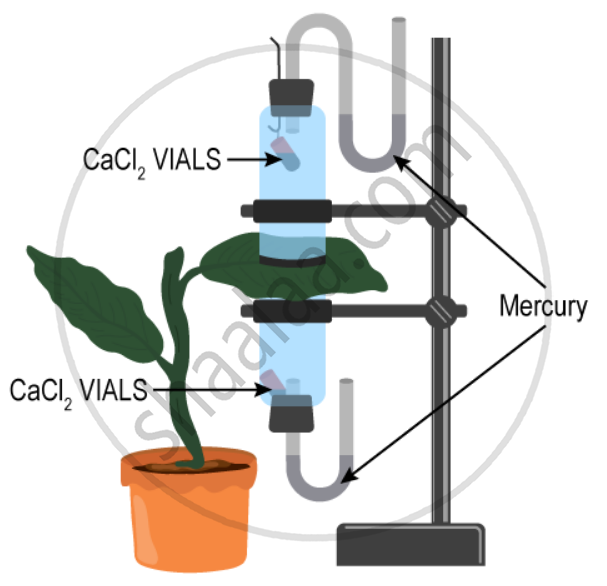
What is the purpose of using a manometer?
Advertisements
उत्तर
Manometer is used to measure the pressure. In order to measure the pressure exerted by the fluid, the fluid is allowed to exert pressure on one of the closed ends of the tube. Under the effect of the pressure, the liquid inside the manometer tube gets displaced and the amount of displaced liquid is measured.
संबंधित प्रश्न
Distinguish between the following:
Stomata and lenticels
Choose the correct answer:
Stomata open during day time because guard cells
Give Reasons for the following:
Guard cells are small in size and are kidney-shaped in outline.
Given below are the diagrams of a certain structure in plants in two conditions.

(i) Name the structure shown.
(ii) Name the parts numbered 1-5.
(iii) What is the most apparent difference between A and B in the structure shown?
(iv) Describe the mechanism which brings about the change in the structure depicted in A and B.
Draw a neat diagram of the stomatal apparatus found in the epidermis of leaves and label the Stoma, Guard cells, Chloroplast, Epidermal Cells, cell wall and Nucleus.
State the Location:
Stomata
How will you differentiate the different types of transpiration?
Write a short note on lenticular transpiration.
The upper layer of mesophyll in a leaf consists of elongated ground tissue called ______.
