Advertisements
Advertisements
प्रश्न
The angle of elevation of the top of a tower from certain point is 30°. If the observer moves 20 metres towards the tower, the angle of elevation of the top increases by 15°. Find the height of the tower.
Advertisements
उत्तर
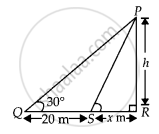
Let the height of the tower be h.
Also, SR = x m,
Given that, QS = 20 m
`sqrt("PQR")` = 30°
And `sqrt("PSR") = sqrt("PQR") + 15^circ`
= 30° + 15°
= 45°
Now, In ∆PSR,
tan 45° = `"PR"/"SR" = "h"/x`
⇒ `1 = "h"/x` ...[∵ tan 45° = 1]
⇒ x = h ...(i)
Now, In ∆PQR
tan 30° = `"PR"/"QR" = "PR"/("QS" + "SR")`
⇒ tan 30° = `"h"/(20 + x)`
⇒ 20 + x = `"h"/(tan 30^circ) = "h"/(1/sqrt(3))`
⇒ 20 + x = `"h"sqrt(3)`
⇒ 20 + h = `"h"sqrt(3)` ...[From (i)]
⇒ 20 = `"h"sqrt(3) - "h"`
⇒ `"h"(sqrt(3) - 1)` = 20
⇒ h = `20/(sqrt(3) - 1) * (sqrt(3) + 1)/(sqrt(3) + 1)` ...[By rationalisation]
⇒ h = `(20(sqrt(3) + 1))/(3 - 1) = (20(sqrt(3) + 1))/2`
⇒ h = `10(sqrt(3) + 1) "m"`
Hence, the required height of tower is `10(sqrt(3) + 1) "m"`.
