Advertisements
Advertisements
प्रश्न
State which of the following pertain to – chemical changes.
- Substance retains its identity.
- The change is permanent.
- No new substance is formed.
- Is easily reversible.
- Produces one or more new substances by a change in its composition.
- The change is temporary.
- The composition and properties of the original substance are not altered.
Advertisements
उत्तर
The following points pertain to chemical changes:
b. The change is permanent.
e. Produces one or more new substances by change in its composition.
The remaining points pertain to physical changes.
APPEARS IN
संबंधित प्रश्न
State three differences between evaporation and boiling
Write true or false
Burning of paper and formation of curd are reversible changes.
Solve this crossword by using the clues that follow-
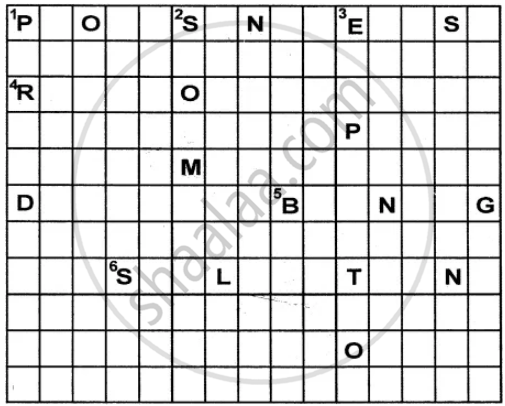
Across
1. Energy in the form of sunlight is absorbed by the green plants in this process.
4. The reddish-brown substance formed over iron in the presence of oxygen and moisture.
5. This change is permanent and irreversible.
6. The process in which a solid directly changes into gaseous state.
Down
1 . It is the change that takes place in case of swinging pendulum of a clock. –
2. Occurrence of this is a non-periodic change as well as a natural change.
3. It is a physical change.
Make a list of different types of changes with example.
Separate the following into physical and chemical changes :
Sublimation of a solid, Decomposition of water into hydrogen and oxygen by passing electric current, Formation of clouds, Making a fruit salad from raw fruits, Dissolving carbon dioxide in water
Fill in the blank with the appropriate word of the statement given below:
Germination of seeds is considered a __________ change.
State whether the following statement is true or false. If false write the correct statement.
Melting of butter and wax are examples of chemical changes.
State whether the following statement is true or false. If false write the correct statement.
Melting of ice is an exothermic, irreversible chemical change.
Name the following:
The term involved in the change of state from – ‘water to ice’ – which is a physical change.
Give two examples for the following case:
Physical changes which are not reversible
