Advertisements
Advertisements
प्रश्न
State whether the following statement is true or false. Give reasons for your answer :
X and Y are complementary goods. A fall in the price of Y will result in a rise in the price of X.
विकल्प
True
False
Advertisements
उत्तर
X and Y are complementary goods. A fall in the price of Y will result in a rise in the price of X.
False, if X and Y are complementary goods, then a fall in the price of good Y will lead to a rise in the demand of good X.
Explanation:
Graphically, the effect of this change can be seen as follows:
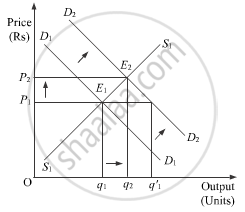
Here, Suppose D1D1 and S1S1 are the initial market demand curve and market supply curve, respectively. The initial equilibrium is established at point E1, where the market demand curve and the market supply curve intersect each other. Accordingly, the equilibrium price is OP1 and the equilibrium quantity demanded is Oq1.
Now, as the market demand of good X increases, this shifts the market demand curve parallely rightwards to D2D2 from D1D1, while the market supply curve remains unchanged at S1S1. This implies that at the initial price OP1, there exists excess demand equivalent to (Oq'1 – Oq1) units. This excess demand will increase competition among the buyers and they will now be ready to pay a higher price to acquire more units of good. This will further raise the market price. The rise in the price will continue till it the market price becomes OP2. The new equilibrium is established at point E2, where the new demand curve D2D2 intersects the supply curve S1S1. Observe that at the new equilibrium both market price and quantity demanded are more than the initial equilibrium. The new equilibrium quantity supplied Oq2 and the new equilibrium price is OP2. Hence, an increase in demand with supply remaining constant results in a rise in the equilibrium price as well as the equilibrium quantity.
