Advertisements
Advertisements
प्रश्न
State one major difference between covalent and ionic bonds and give one example each of covalent and ionic compounds.
Advertisements
उत्तर
Covalent compounds have usually low melting points and boiling points. But ionic compounds have high melting points and boiling points.
An example for a covalent compound is methane (CH4).
An example for an ionic compound is sodium chloride (NaCl).
APPEARS IN
संबंधित प्रश्न
Write the number of covalent bonds in the molecule of butane, C4H10.
Buckminsterfullerene is spherical molecule in which 60 carbon atoms are arranged in interlocking hexagonal and pentagonal rings of carbon atoms.
How many pentagons of carbon atoms are present in one molecule of buckminsterfullerene?
Which inert gas electron configuration do the Cl atoms in Cl2 molecule resemble? What is this electron configuration?
What type of chemical bonds are formed by carbon? Why?
Give the formula of the compound that would be formed by the combination of the following pair of elements:
Al and Cl2
Explain why, diamond has a high melting point.
Why are covalent compounds generally poor conductors of electricity?
You can buy solid air-freshners in shops. Do you think these substance are ionic or covalent? Why?
State the type of bonding in the following molecule.
Ammonium ion
Explain the following term with example.
Alkane
Acids dissolve in water to produce positively charged ions. Draw the structure of these positive ions.
What is the term defined below?
A bond formed by a shared pair of electrons, each bonding atom contributing one electron to the pair.
An element L consists of molecules.
What type of bonding is present in the particles that make up L?
An element L consists of molecules.
Why L is heated with iron metal, it forms a compound FeL. What chemical term would you use to describe the change undergone by L?
The following table shows the electronic configuration of the elements W, X, Y, Z:
|
Element |
W |
X |
Y |
Z |
|
Electronic |
2,8,1 |
2,8,7 |
2,5 |
1 |
Answer the following questions based on the table above:
What type of bond is formed between Y and Z.
Complete the following activity.
Write the names of the hydrocarbons for the following structural formula.
(isobutylene, cyclohexane, propene, cyclohexene, cyclopentane, benzene, propyne, isobutane, propane)
| \[\begin{array}{cc} \phantom{..}\ce{H}\phantom{...}\ce{H}\phantom{...}\ce{H}\\ \phantom{..}|\phantom{....}|\phantom{....}|\\ \ce{H - C - C- C- H}\\ \phantom{.}|\phantom{....}|\phantom{....}|\\ \ce{H - C - H}\\ |\\\ce{H}\end{array}\] |
Complete the following activity.
Write the names of the hydrocarbons for the following structural formula.
(isobutylene, cyclohexane, propene, cyclohexene, cyclopentane, benzene, propyne, isobutane, propane)
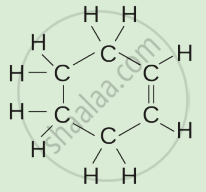 |
Which of the following statements are usually correct for carbon compounds? These
- are good conductors of electricity
- are poor conductors of electricity
- have strong forces of attraction between their molecules
- do not have strong forces of attraction between their molecules.
An element A is soft and can be cut with a knife. This is very reactive to air and cannot be kept open in air. It reacts vigorously with water. Identify the element from the following
State the reasons, why carbon cannot
- Lose four electrons to form C4+ cation and
- Gain four electrons to form C4- anion.
How does carbon overcome this problem to form compounds?
