Advertisements
Advertisements
प्रश्न
Solve the following LPP:
Maximize z = 4x + 2y subject to 3x + y ≤ 27, x + y ≤ 21, x ≥ 0, y ≥ 0.
Advertisements
उत्तर
First we draw the lines AB and CD whose equations are 3x + y = 27 and x + y = 21 respectively.
| Line | Equation | Points on the X-axis | Points on the Y-axis | Sign | Region |
| AB | 3x + y = 27 | A(9, 0) | B(0, 27) | ≤ | origin side of line AB |
| CD | x + y = 21 | C(21, 0) | O(0, 21) | ≤ | origin side of line CD |
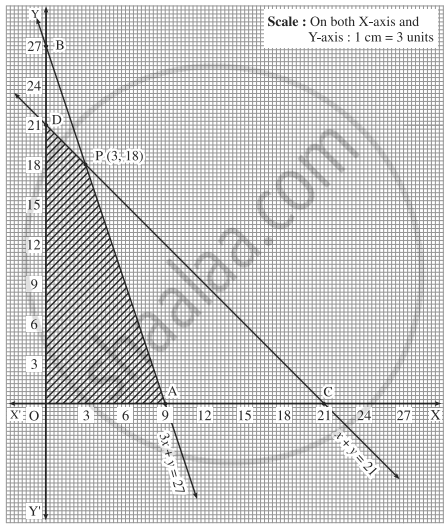
The feasible region is OAPDO which is shaded region in the graph. The vertices of the feasible region are O(0, 0), A (9, 0), P and D (0, 21). P is the point of intersection of lines
3x + y = 27 ....(1)
and x + y = 21 ....(2)
On substracting, we get 2x = 6
∴ x = 3
Substituting x = 3 in equation (1), we get
9 + y = 27
∴ y = 18
∴ P ≡ (3, 18)
The values of the objective function z = 4x + 2y at these vertices are
z(O) = 4(0) + 2(0) = 0 + 0 = 0
z(a) = 4(9) + 2(0) = 36 + 0 = 36
z(P) = 4(3) + 2(18) = 12 + 36 = 48
z(D) = 4(0) + 2(21) = 0 + 42 = 42
∴ 2 has minimum value 48 when x = 3, y = 18.
