Advertisements
Advertisements
प्रश्न
Solutions of two electrolytes ‘A’ and ‘B’ are diluted. The Λm of ‘B’ increases 1.5 times while that of A increases 25 times. Which of the two is a strong electrolyte? Justify your answer. Graphically show the behavior of ‘A’ and ‘B’.
Advertisements
उत्तर
B is a strong electrolyte. The molar conductivity increases slowly with dilution as there is no increase in number of ions on dilution as strong electrolytes are completely dissociated.
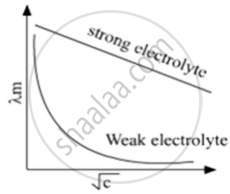
APPEARS IN
संबंधित प्रश्न
The conductivity of sodium chloride at 298 K has been determined at different concentrations and the results are given below:
| Concentration/M | 0.001 | 0.010 | 0.020 | 0.050 | 0.100 |
| 102 × κ/S m−1 | 1.237 | 11.85 | 23.15 | 55.53 | 106.74 |
Calculate ∧m for all concentrations and draw a plot between ∧m and c1/2. Find the value of `Lambda_m^0`.
Conductivity of 0.00241 M acetic acid is 7.896 × 10⁻⁵ S cm−1. Calculate its molar conductivity and if `Lambda_m^0` for acetic acid is 390.5 S cm2 mol−1, what is its dissociation constant?
10.0 grams of caustic soda when dissolved in 250 cm3 of water, the resultant gram molarity of solution is _______.
(A) 0.25 M
(B) 0.5 M
(C) 1.0 M
(D) 0.1 M
The conductivity of 0.02 M AgNO3 at 25°C is 2.428 × 10⁻³ Ω−1 cm−1. What is its molar conductivity?
Conductivity always decreases with decrease in concentration both, for weak and strong electrolytes because of the fact that ____________.
Write the cell reaction of a lead storage battery when it is discharged. How does the density of the electrolyte change when the battery is discharged?
Assertion (A) : Conductivity decreases with decrease in concentration of electrolyte.
Reason (R) : Number of ions per unit volume that carry the current in a solution decreases on dilution.
Assertion (A): Molar conductivity decreases with increase in concentration.
Reason (R): When concentration approaches zero, the molar conductivity is known as limiting molar conductivity.
Which of the following solutions will have the highest conductivity at 298 K?
Suggest a way to determine the \[\ce{\Lambda^{\circ}_m}\] value of water.
