Advertisements
Advertisements
प्रश्न
Simplify `("b"^2 + 3"b" - 28)/("b"^2 + 4"b" + 4) ÷ ("b"^2 - 49)/("b"^2 - 5"b" - 14)`
Advertisements
उत्तर
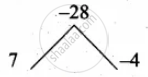
b2 + 3b – 28 = (b + 7) (b – 4)
b2 + 4b + 4 = (b + 2) (b + 2)
b2 – 49 = b2 – 72
= (b + 7) (b – 7)
b2 – 5b – 14 = (b – 7) (b + 2)


`("b"^2 + 3"b" - 28)/("b"^2 + 4"b" + 4) ÷ ("b"^2 - 49)/("b"^2 - 5"b" - 14)`
= `(("b" + 7)("b" - 4))/(("b" + 2)("b" + 2)) ÷ (("b" + 7)("b" - 7))/(("b" - 7)("b" + 2))`
= `(("b" + 7)("b" - 4))/(("b" + 2)("b" + 2)) xx (("b" + 2))/(("b" + 7))`
= `(("b" - 4))/(("b" + 2))`
APPEARS IN
संबंधित प्रश्न
Reduce the following rational expression to its lowest form
`("p"^2 - 3"p" - 40)/(2"p"^3 - 24"p"^2 + 64"p")`
Find the excluded values, of the following expression
`(x^2 + 6x + 8)/(x^2 + x - 2)`
Simplify `(x + 4)/(3x + 4y) xx (9x^2 - 16y^2)/(2x^2 + 3x - 20)`
Simplify `(x^3)/(x - y) + (y^3)/(y - x)`
Identify rational expression should be subtracted from `(x^2 + 6x + 8)/(x^3 + 8)` to get `3/(x^2 - 2x + 4)`
If A = `x/(x + 1)` B = `1/(x + 1)` prove that `(("A" + "B")^2 + ("A" - "B")^2)/("A" + "B") = (2(x^2 + 1))/(x(x + 1)^2`
One hundred and fifty students are admitted to a school. They are distributed over three sections A, B and C. If 6 students are shifted from section A to section C, the sections will have equal number of students. If 4 times of students of section C exceeds the number of students of section A by the number of students in section B, find the number of students in the three sections
Simplify `(1/("p") + 1/("q" + "r"))/(1/"p" - 1/("q" + "r")) xx [1 + ("q"^2 + "r"^2 - "p"^2)/(2"qr")]`
A boat takes 1.6 hours longer to go 36 kms up a river than down the river. If the speed of the water current is 4 km per hr, what is the speed of the boat in still water?
The number of seats in a row is equal to the total number of rows in a hall. The total number of seats in the hall will increase by 375 if the number of rows is doubled and the number of seats in each row is reduced by 5. Find the number of rows in the hall at the beginning.
