Advertisements
Advertisements
प्रश्न
Show the relationship between LAC and LMC.
विस्तार में उत्तर
Advertisements
उत्तर
The Long-Run Marginal Cost (LMC) is the additional cost of producing one more unit of output when a firm has time to adjust all its inputs (like labour, capital, plant size, etc.). Both the LMC and LAC curves are U-shaped, but the LMC curve is usually flatter than the short-run marginal cost curve. The relationship between LAC and LMC is very similar to how Average Cost (AC) and Marginal Cost (MC) behave in the short run.
- When LMC < LAC:
- The LAC curve is falling.
- This means that each extra unit costs less than the average, so the average goes down.
- When LMC = LAC:
- The LAC is at its minimum point.
- This is where the cost per unit is the lowest.
- The LMC curve cuts the LAC curve from below at this point.
- When LMC > LAC:
- The LAC curve is rising.
- This means each additional unit costs more than the average, so the average cost goes up.
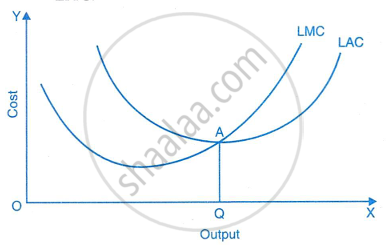
LMC curve starts below the LAC curve, then intersects it at the minimum point, and then lies above it as output increases.
shaalaa.com
क्या इस प्रश्न या उत्तर में कोई त्रुटि है?
