Advertisements
Advertisements
प्रश्न
Show that the semi-vertical angle of the cone of the maximum volume and of given slant height is `cos^(-1)(1/sqrt3)`
Advertisements
उत्तर
Let us consider the following variables:
h = height of the cone
l = slant height of the cone (given)
r = radius of the base of the cone
α = semi vertical angle of the cone
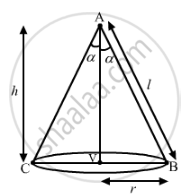
Let us assume that V' is the volume of the cone which has to be maximised.
We know that
`V' = 1/3πr^2h ...(1)`
From the figure, we have:
`l^2=r^2+h^2⇒l^2−h^2=r^2`
On substituting the value of r2 in equation (1), we get:
`V' = 1/3π(l^2−h^2)h=1/3π(l^2h−h^3) `
On differentiating with respect to h, we get:
`dV'/dh=1/3π(l^2−3h^2) ...(2)`
For maximum volume of V, let us put `(dV')/(dh)=0.`
So, from equation (2), we have:
`1/3π(l^2−3h^2)=0⇒h=l/sqrt3 (∵ h,l >0)`
Again, differentiating equation (2) with respect to h, we get:
`(d^2V'/dh^2)=1/3π(−6h)=−2πh`
`∴ ((d^2V')/(dh^2))_(h=l/sqrt3)=−2πl/sqrt3<0`
Thus, the volume of the cone is maximum at
`h=l/sqrt3`
From the figure, we have:
`cosα =h/l⇒cosα =l/lsqrt3=1/sqrt3`
`⇒α=cos^(−1)(1/sqrt3)`
∴ The semi-vertical angle is
`cos^(−1)(1/sqrt3). `
संबंधित प्रश्न
Differentiate the following functions from first principles \[e^\sqrt{2x}\].
Differentiate etan x ?
Differentiate \[e^{3 x} \cos 2x\] ?
Differentiate \[\log \left( \cos x^2 \right)\] ?
Differentiate \[\sin^{- 1} \left( \frac{1}{\sqrt{1 + x^2}} \right)\] with respect to x.
If \[y = \tan^{- 1} \left( \frac{2x}{1 - x^2} \right) + \sec^{- 1} \left( \frac{1 + x^2}{1 - x^2} \right), x > 0\] ,prove that \[\frac{dy}{dx} = \frac{4}{1 + x^2} \] ?
If \[y \sqrt{x^2 + 1} = \log \left( \sqrt{x^2 + 1} - x \right)\] ,Show that \[\left( x^2 + 1 \right) \frac{dy}{dx} + xy + 1 = 0\] ?
Find \[\frac{dy}{dx}\] \[y = x^{\sin x} + \left( \sin x \right)^x\] ?
Find \[\frac{dy}{dx}\] \[y = \left( \tan x \right)^{\cot x} + \left( \cot x \right)^{\tan x}\] ?
Find \[\frac{dy}{dx}\] \[y = x^{\log x }+ \left( \log x \right)^x\] ?
If \[x^y + y^x = \left( x + y \right)^{x + y} , \text{ find } \frac{dy}{dx}\] ?
If \[y = x \sin y\] , prove that \[\frac{dy}{dx} = \frac{y}{x \left( 1 - x \cos y \right)}\] ?
If \[x = a \left( \frac{1 + t^2}{1 - t^2} \right) \text { and y } = \frac{2t}{1 - t^2}, \text { find } \frac{dy}{dx}\] ?
Differentiate \[\sin^{- 1} \left( 2x \sqrt{1 - x^2} \right)\] with respect to \[\tan^{- 1} \left( \frac{x}{\sqrt{1 - x^2}} \right), \text { if }- \frac{1}{\sqrt{2}} < x < \frac{1}{\sqrt{2}}\] ?
Differentiate \[\tan^{- 1} \left( \frac{x - 1}{x + 1} \right)\] with respect to \[\sin^{- 1} \left( 3x - 4 x^3 \right), \text { if }- \frac{1}{2} < x < \frac{1}{2}\] ?
If \[f\left( 0 \right) = f\left( 1 \right) = 0, f'\left( 1 \right) = 2 \text { and y } = f \left( e^x \right) e^{f \left( x \right)}\] write the value of \[\frac{dy}{dx} \text{ at x } = 0\] ?
If \[y = \log_a x, \text{ find } \frac{dy}{dx} \] ?
If \[y = \sin^{- 1} \left( \frac{1 - x^2}{1 + x^2} \right) + \cos^{- 1} \left( \frac{1 - x^2}{1 + x^2} \right),\text{ find } \frac{dy}{dx}\] ?
If \[\sin y = x \cos \left( a + y \right), \text { then } \frac{dy}{dx}\] is equal to ______________ .
If \[y = \log \left( \frac{1 - x^2}{1 + x^2} \right), \text { then } \frac{dy}{dx} =\] __________ .
Find the second order derivatives of the following function ex sin 5x ?
If x = a (θ − sin θ), y = a (1 + cos θ) prove that, find \[\frac{d^2 y}{d x^2}\] ?
If `x = sin(1/2 log y)` show that (1 − x2)y2 − xy1 − a2y = 0.
\[\text { If x } = a\left( \cos t + t \sin t \right) \text { and y} = a\left( \sin t - t \cos t \right),\text { then find the value of } \frac{d^2 y}{d x^2} \text { at } t = \frac{\pi}{4} \] ?
\[\text { If x } = a \sin t - b \cos t, y = a \cos t + b \sin t, \text { prove that } \frac{d^2 y}{d x^2} = - \frac{x^2 + y^2}{y^3} \] ?
If x = 2 at, y = at2, where a is a constant, then \[\frac{d^2 y}{d x^2} \text { at x } = \frac{1}{2}\] is
If \[y^\frac{1}{n} + y^{- \frac{1}{n}} = 2x, \text { then find } \left( x^2 - 1 \right) y_2 + x y_1 =\] ?
If \[\frac{d}{dx}\left[ x^n - a_1 x^{n - 1} + a_2 x^{n - 2} + . . . + \left( - 1 \right)^n a_n \right] e^x = x^n e^x\] then the value of ar, 0 < r ≤ n, is equal to
