Advertisements
Advertisements
प्रश्न
Show that electric potential at a point P, at a distance 'r' from a fixed point charge Q, is given by:
`v=(1/(4pi∈_0))Q/r`.
Advertisements
उत्तर
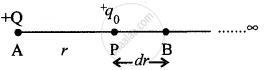
Let potential at point P is required due to a fixed point charge Q at A. Distance `bar(AP)`= r. Let us place a point test charge q0 at P. Let us consider a point B very near to P at a distance dr, such that \[ \overrightarrow{F_P} = \overrightarrow{F_B}\].
Force, \[\overrightarrow{F}\] between Q and q0 = `1/(4pi∈_0) -(Qxxq_0)/r^2`
where ∈0 = permittivity for free space
Now, work done in carrying the charge q0 from P to B is
`dW = -1/(4pi∈_0) (Qxxq_0)/r^2`.dr
The negative sign indicates negative work due to repulsion between Q and q0.
Similarly,
Work was done in carrying to infinity (∞),
W = `int dW=- int_r^∞ 1/(4pi∈_0). (Qxxq_0)/r^2`.dr
⇒ `W =-1/(4pi∈_0) .Qxxq_0` `" _r^∞r^-2`dr
⇒ `W = +1/(4pi∈_0) .Qxxq_0[1/r]_r^∞`
⇒ `W = +1/(4pi∈_0) .Qxxq_0[1/∞ ∼1/r]`
⇒ `W = -1/(4pi∈_0) .(Qxxq_0)/r`
When, the test charge, q0 is taken from ∞.
The work done is positive and magnitude remains the same.
∴ `W =1/(4pi∈_0) .(Qxxq_0)/r`
Since potential at P = `W/(q_0)`
∴ V. potential at P = `1/(4pi∈_0) .(Qxxq_0)/(r.q_0)`
`V = Q/(4pi∈_0.r) J C^-1 or V`
`V = (1/(4pi∈_0)).Q/r V`
