Advertisements
Advertisements
प्रश्न
Show how under perfect competition the price of a commodity is equal to its average and marginal costs of production in the long-run. Does the perfectly competitive firm always operate at the minimum point of the average cost curve?
“In a perfectly competitive equilibrium, the price of a commodity is equal to the marginal and average cost of production.” Explain.
स्पष्ट कीजिए
विस्तार में उत्तर
Advertisements
उत्तर
- In the long run, a firm under perfect competition earns only normal profit.
- Free entry and exit of firms ensure that abnormal profits or losses do not last.
- If firms earn supernormal profits, new firms enter the market.
- This increases industry supply, causing the market price to fall.
- As the price falls, supernormal profits reduce and become normal profits.
- If firms face losses, some firms exit the market.
- This decreases supply, raising the price until remaining firms earn normal profit.
- In the long run, firms earn just enough to cover all costs, i.e., normal profit.
- There is no incentive for new firms to enter or existing firms to exit.
- The firm is in equilibrium when LMC = MR and LMC cuts MR from below.
- Also, AR = LAC at equilibrium, ensuring normal profit.
- Since AR = MR in perfect competition, the equilibrium condition is:
LMC = MR = AR = LAC - This occurs at the minimum point of the LAC curve, where the firm produces optimum output.
- At this point, price = AR = MR = AC = MC, and the firm is fully efficient.
- Therefore, in the long run, the firm is in stable equilibrium with only normal profits.
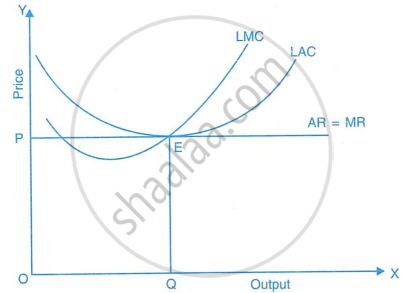
shaalaa.com
क्या इस प्रश्न या उत्तर में कोई त्रुटि है?
अध्याय 13: Price Output Under Perfect Competition - TEST QUESTIONS [पृष्ठ १३.१९]
